How to Choose a Creasing Die for Folding Carton Without Cracking
A carton can look perfect at the die-cutter delivery and still split along a fold at the folder gluer. By then, printing, coating, and converting costs are already committed. Selecting a creasing die for folding carton production therefore means more than matching a channel to nominal board thickness: the board, creasing rule, counter material, press settings, and folding conditions must work together.
For technical evaluators, the objective is not simply a deeper crease. It is a controlled hinge that folds consistently without breaking the visible surface or weakening the carton excessively. The most reliable selection process starts with the actual substrate, narrows the tooling options, and validates them under realistic production conditions.
Define the tooling you are actually selecting
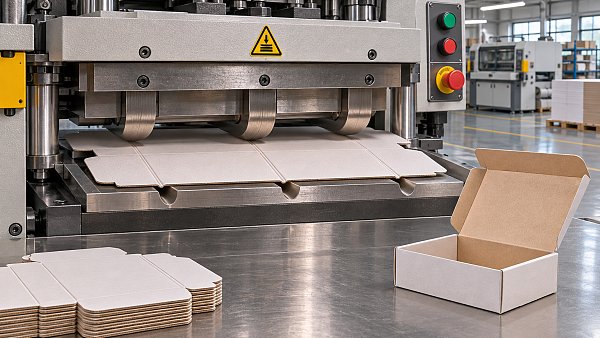
“Creasing die” can refer to the complete die assembly or, less precisely, to individual creasing components. Clarify the scope before comparing quotations. In conventional flatbed carton die-cutting, the system normally includes a male creasing rule in the dieboard and a female channel formed by creasing matrix or a machined counterplate.
The rule pushes the board into the channel, creating localized deformation and controlled internal separation within the board structure. This allows the fold to develop without forcing the outer surface to carry excessive tensile strain. A useful crease is therefore not merely a compressed line.
Evaluate the rule profile, rule height, channel width, channel depth, and supporting counter surface as a matched system. Changing one component while leaving the others unexamined can move the problem rather than solve it.
Start with a substrate specification, not a grammage
Two boards with the same grammage can need different crease settings. Their caliper, bulk, furnish, layer construction, and surface treatments may differ substantially. Before asking a supplier to recommend tooling, assemble the following information from production material rather than relying solely on a purchasing description.
Use finished, printed material for final trials. Unprinted stock is useful for isolating mechanical behavior, but it cannot prove that a heavy ink film, UV varnish, or decorative finish will survive folding.
Map grain direction across the carton layout
A carton blank often contains creases in both directions, so one successful fold does not qualify the whole design. Folds running parallel to the grain are generally easier to form cleanly than those running across it, but the actual response depends on board construction and finishing.
Flag cross-grain folds, short closure flaps, and folds through dark printed areas as separate inspection points. If the layout permits, changing blank orientation may improve performance. Balance that benefit against sheet utilization, carton stiffness, and other functional requirements rather than treating grain alignment as an isolated rule.
Choosing a creasing die for folding carton: match geometry to behavior
The supplier’s sizing chart is a sensible starting point, provided it applies to the board class and tooling system being used. It is not a substitute for testing. A channel that works on one folding boxboard may behave differently on another board of similar caliper.
Channel width controls how the hinge develops
A channel that is too narrow can pinch the board and concentrate stress, increasing surface damage or cutting-like marks. An excessively wide channel may produce a broad, poorly defined hinge, unstable fold position, or dimensional problems during gluing.
Some tooling systems use starting calculations based on rule thickness plus a multiple of board caliper. The multiplier and any allowances depend on the substrate, grain orientation, and counter system. Do not transfer a formula between suppliers without checking its definitions and application limits. Confirm that quoted dimensions refer to the same features.
Channel depth and rule height must work together
Channel depth provides space for board deformation; rule height affects how the board is driven into that space under the press’s working geometry. Neither dimension should be selected independently of the cutting-rule arrangement, counter thickness, and press setup.
A crease that looks shallow may result from inadequate effective penetration, but it may also reflect poor alignment, unsuitable channel geometry, or uneven pressure. Simply increasing impression can crush adjacent areas, overload the tooling, or damage printed surfaces before it creates a reliable fold.
Rule profile matters beyond nominal thickness
The rule’s working edge influences contact pressure and the shape of the deformation. Rounded profiles are commonly used for carton creasing, but the appropriate radius and thickness depend on the substrate and fold requirement. A worn, damaged, or inconsistent profile can defeat an otherwise suitable channel selection.
Ask suppliers to specify the complete rule profile rather than only its thickness. For difficult work, request a small set of compatible rule-and-channel combinations that can be tested without changing several uncontrolled variables.
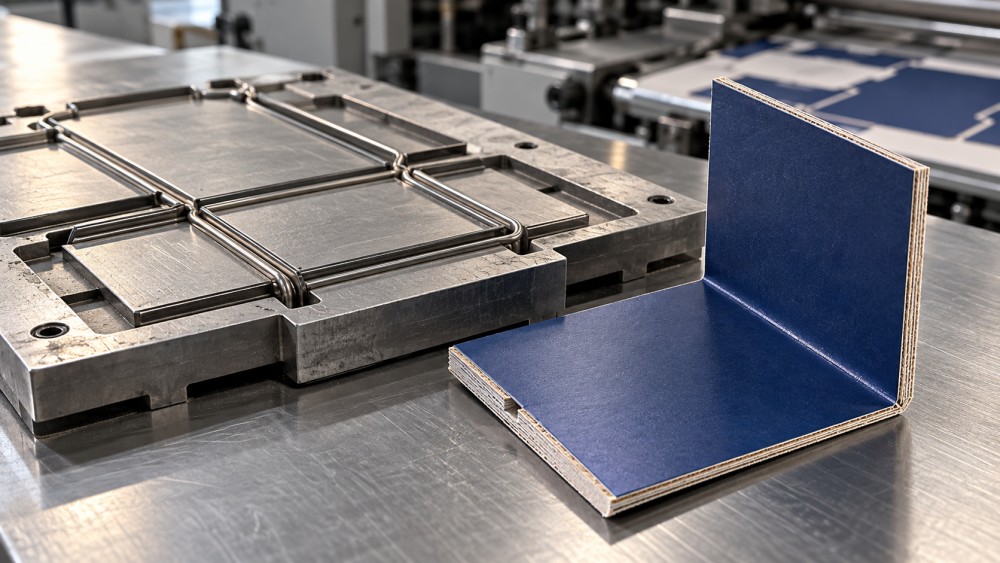
A cross-sectional comparison is particularly useful here: inspect whether the tooling forms a defined internal hinge while leaving the outside surface intact. Compare the unfolded crease and the folded specimen; either view alone can conceal a problem.
Matrix or machined counterplate: choose for the job mix
Adhesive-backed creasing matrix is practical for many carton applications, especially where job changes are frequent and replacement convenience matters. Its performance still depends on accurate positioning, secure adhesion, appropriate channel dimensions, and clean mounting surfaces.
A machined counterplate can offer repeatable channel geometry and integrated positioning for recurring work. Its value depends on manufacturing accuracy, registration, compatibility with the press, and the plant’s ability to manage revisions and storage. It is not automatically the better choice for every difficult board.
Compare the alternatives using the same finished substrate and acceptance criteria. Include makeready time, usable tooling life, replacement effort, and repeat-order consistency. A lower tooling price can disappear quickly if operators must repeatedly rebuild the setup or run below the required production speed.
Diagnose cracking before ordering replacement tooling
The location and timing of a defect often reveal more than its severity. Inspect samples immediately after die-cutting, after controlled hand folding, and after machine folding. This separates damage created at the press from damage introduced by the folding path.
Use magnification to distinguish a fractured surface film from exposed, broken fibers. Both can be unacceptable, but they may require different remedies. A brittle finish may need a coating-system adjustment; narrowing or deepening the crease indefinitely is unlikely to solve that material limitation.
Also inspect crease intersections, corners, and short segments separately. Local geometry can produce a failure that does not appear along a long, straight test crease.
Run a trial that supports a production decision
A successful hand-folded sample is a screening result, not production approval. The selected tooling must perform across normal substrate variation and through the intended folding process.
- Establish a baseline. Record material batch, measured caliper, grain direction, surface finish, rule specification, channel dimensions, press settings, and the observed defect.
- Check the mechanical setup. Verify rule condition, channel centering, mounting security, and pressure uniformity before comparing alternative geometries.
- Test controlled alternatives. Change one main variable at a time where practical. When comparing complete matched systems, record all differences so the result remains interpretable.
- Assess folds consistently. Use the same folding direction, angle, method, and inspection conditions. Check both visual appearance and hinge behavior.
- Validate at production conditions. Run through the intended folder-gluer setup, including relevant pre-breaking stages, and inspect at the required operating speed.
- Confirm repeatability. Sample across sheet positions and over a meaningful run. For repeat work, consider another representative board batch before standardizing the specification.
Agree acceptance criteria before the trial. Depending on the carton, these may include no visible cracking under defined viewing conditions, controlled fold position, acceptable opening force, reliable squareness, and no interference with gluing or packing.
There is no universal acceptable crack size or fold force for every package. A premium cosmetic carton and a secondary transport carton face different appearance expectations. Record the customer’s standard instead of leaving approval to an informal impression that the fold “looks better.”
What to request from the tooling supplier
A useful quotation should identify more than a matrix code. Ask for the recommended caliper range, intended substrate type, compatible rule profile and height, channel dimensions, mounting requirements, and any grain-direction limitations. Confirm the dimensional tolerances that matter to your application.
Provide samples of the actual finished board, the carton drawing, press details, and photographs of existing failures. For recurring cracking, include marked samples showing sheet position and folding direction. This gives the supplier a diagnostic problem to solve rather than an invitation to recommend a generic product.
For CPCS readers evaluating converting investments, the important commercial comparison is cost per acceptable carton, not tooling purchase price alone. Track setup waste, adjustment time, achievable speed, rejects after folding, and repeat-job stability. Those measures connect crease quality to real factory performance.
The best choice is a matched tooling system with a documented operating window: suitable for the board and finish, correctly installed on the press, and proven through downstream folding. When those conditions are established, selecting a creasing die becomes a repeatable engineering decision—not another round of trial-and-error adjustments after valuable printed sheets have already been lost.
Related News
 How to Choose a Sheet Feeder for Paperboard ProductionChoose the right sheet feeder for paperboard with practical tips on material handling, line speed, integration, and trials to improve production reliability.Post-Press Kinematics Expert
 How Do Creasing Dies Prevent Cracks in Folded Cartons?Creasing Dies help prevent carton fold cracks through controlled deformation. Discover key tooling factors and practical production tips for cleaner, more consistent folds.Post-Press Kinematics Expert
 How to Prevent Sheet Misfeeds in an Automatic Feeder SystemPrevent automatic feeder system misfeeds with practical checks for sheet alignment, suction, air separation, timing, and double-sheet detection.Post-Press Kinematics Expert
 How Do Non Stop Feeder Piles Reduce Die-Cutter Downtime?Discover how non stop feeder piles reduce die-cutter downtime, improve pile-change efficiency, and keep sheet feeding reliable on long production runs.Post-Press Kinematics Expert
 USITC Advances Trade Probe Into Corrugated Die-Cut BoxesCorrugated die-cut boxes face a USITC trade probe. Explore what the investigations could mean for packaging costs and sourcing.Post-Press Kinematics Expert
 What to Consider When Choosing Heavy Duty Pile TurnersChoosing heavy duty pile turners? Discover how to assess load capacity, substrate handling, safety and operating costs to find the right fit for your production line.Post-Press Kinematics Expert