How to Choose a Counterplate Manufacturer for Accurate Creasing
Choose a counterplate manufacturer by its ability to reproduce a crease geometry that works with your board, cutting die, and press—and to maintain that result on repeat orders. Price and delivery time matter, but they become useful comparisons only after suppliers have demonstrated acceptable folding performance under representative production conditions. A plate that requires repeated pressure adjustments or local patching can consume its purchase-price saving during make-ready.
For technical evaluators, the strongest evidence combines a clear design specification, measurable manufacturing controls, and a production trial that continues through folding and gluing. Dimensional accuracy alone does not establish suitability. A precisely machined channel can still be wrong for the board, while an acceptable first sample says little about repeatability unless the supplier can explain how it controls subsequent production.
Define the creasing application before comparing suppliers
A meaningful quotation starts with the job conditions. “Suitable for folding cartons” leaves too much room for interpretation. Give each supplier the same information about board grade, measured caliper, grain direction, surface treatment, creasing rules, press configuration, and expected folding behavior. Include the approved die drawing and its revision, together with any existing crease defects that the new counterplate must address.
Board caliper deserves particular care. A nominal purchasing specification may not describe the material reaching the die-cutter. Establish the thickness range of representative production stock, using a consistent measurement method, and identify whether the trial will include different material lots. Moisture condition, coatings, and laminated surfaces can also affect how the board responds to creasing and folding. These variables should be recorded so that a supplier is solving a defined problem.
Clarify what the supplier means by a counterplate. A machined plate with integrated channels and a system assembled from individual creasing matrix strips have different positioning, replacement, and handling requirements. Compare equivalent constructions, or evaluate the practical consequences of each construction explicitly. A change in tooling format may alter setup work even when the intended crease geometry is similar.
The application boundary matters as well. Folding carton board and corrugated board respond differently under compression. If the work includes microflute or other corrugated structures, require application-specific recommendations that consider flute structure, liner condition, and allowable crushing. A successful trial on solid board does not qualify the supplier for corrugated work.
Require a reasoned channel design
Ask the manufacturer to specify channel width and depth, relevant plate thicknesses, and the relationship between the channels and the creasing rules. These choices should be tied to the actual board and tooling. A supplier should explain its starting geometry and identify the conditions that would justify changing it.
Channel width affects how the board deforms around the rule. An unsuitable width can contribute to surface damage, an indistinct fold, or excessive folding resistance, depending on the rest of the setup. Depth and the surrounding support influence the deformation available during creasing. Neither dimension should be judged independently of rule thickness, rule height, board structure, and the press’s working arrangement.
Grain direction and carton geometry can justify different treatments within the same layout. Closely spaced creases, reverse folds, narrow panels, and crease intersections may need particular attention. Ask whether the supplier reviews these features or simply applies one channel specification to every line. Automated preparation is useful, but the resulting design still needs an accountable technical review.
Universal formulas are best treated as starting points. They cannot establish acceptable performance for every substrate and carton design. The supplier’s willingness to revise a recommendation after a controlled trial is more valuable than an unsupported claim that one geometry works across all board grades.
Look for manufacturing controls that protect the working geometry
Once the proposed geometry is credible, examine how the manufacturer produces it. Request tolerances for the features that affect your job: channel width and depth, channel position, plate thickness, flatness, and locating features. “High precision” offers little basis for comparison unless it identifies what is measured, where it is measured, and the acceptance limits.
Channel position must be assessed in relation to the die and the mounting reference. An accurately cut channel can still sit off-center beneath the rule if the locating system, drawing reference, or installation method introduces an error. Have the supplier explain the complete positioning chain, from approved artwork to the plate installed on the press.
Inspection should cover representative locations across the usable plate, including areas where machining access or layout complexity could affect the result. Ask what equipment and methods are used and whether job-specific inspection records are available. A general quality certificate does not demonstrate that a particular plate meets its drawing.
Material selection also needs an application-based explanation. Depending on the construction, wear, compression, edge damage, distortion, or attachment failure may affect service performance. Request the material specification and the supplier’s guidance on expected operating conditions, cleaning, storage, and reuse. Claims about durability should identify the conditions under which they apply.
Hardness alone is an incomplete selection criterion. The plate must retain the required geometry while remaining compatible with mounting, machining, handling, and the intended run. For repeat work, dimensional stability after removal and storage may matter as much as performance during the first installation. For short runs, setup simplicity and replacement economics may carry greater weight.
Inspect sample plates for channel-edge condition, machining debris, local damage, and the quality of mounting or locating features. Where adhesive attachment is used, include attachment thickness and uniformity in the assessment. A small inconsistency in the installed stack can complicate pressure setting even when the machined plate itself meets its specification.
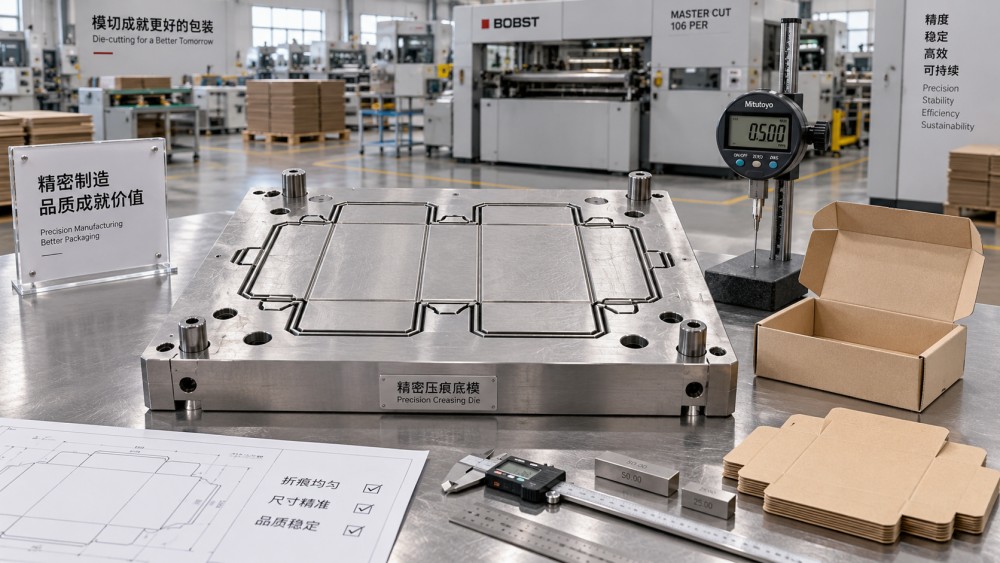
Drawing control is part of manufacturing capability. The supplier should connect the finished plate to the approved design revision, material specification, and production record. If an operator-approved channel adjustment is made during development, it must enter the controlled drawing. Otherwise, a repeat order may reproduce the original geometry and reintroduce the same problem.
Qualify samples through production and downstream folding
A hand-folded sample provides an early indication, but supplier qualification needs a trial on the intended production system. Use a job that represents the work you expect the manufacturer to support. If demanding folds drive your quality losses, include those features in the trial instead of choosing only a straightforward carton.
Agree on acceptance criteria before the plate arrives. They should describe observable results: acceptable crease location, absence of unacceptable cracking, consistent folding behavior, carton dimensions after forming, and reliable passage through the folder gluer. Define the inspection conditions, especially for cosmetic defects. Disagreements become difficult to resolve when one party checks a flat blank and the other judges a fully folded carton.
A useful trial sequence is:
- Verify the supplied plate. Check its identification, revision, agreed dimensions, condition, and locating features before installation.
- Establish a controlled press setup. Record board condition, die and rule details, mounting method, pressure settings, and any local make-ready work.
- Run at the intended operating conditions. Evaluate performance at the planned production speed and include representative stock variation where practical.
- Inspect across the layout and over the run. Look for differences between positions, progressive defects, and changes in fold behavior.
- Complete downstream evaluation. Fold and glue the blanks, then assess the finished carton against the agreed requirements.
Record how much intervention is necessary to reach acceptance. A sample that performs well only after extensive local patching may still be usable, but that work belongs in the supplier comparison. Separate the initial installation time from adjustment time so that a familiar operator’s skill does not conceal a difficult setup.
Do not attribute every cracked fold to the counterplate. Board condition, grain direction, rule selection, die condition, alignment, and pressure can produce similar symptoms. Diagnose defects by changing one relevant variable at a time where practical. Increasing pressure indiscriminately can introduce damage elsewhere and obscure the original cause.
The supplier’s response to a failed trial is revealing. A capable technical team should request the setup information, examine defect locations, and propose a specific adjustment with a reason. Repeated suggestions to increase pressure, without reviewing geometry or material conditions, provide weak evidence of application support.
Also evaluate the usable operating range. A setup that passes at one narrowly defined pressure setting may be difficult to maintain when board thickness varies. Establish whether acceptable results persist through the normal variation your plant expects. Avoid forcing a broad range simply for comparison; the relevant range is the one required by your production conditions.
For folding performance, appearance is only part of acceptance. Check whether panels follow the intended fold, whether springback disrupts handling, and whether finished cartons remain square within the job’s requirements. If folding force is measured, use a consistent method, sample conditioning, and timing. Results from different methods may not be directly comparable.
Make repeatability and replacement performance part of the purchase decision
A successful development sample qualifies a proposed design. It does not yet establish dependable supply. Before placing substantial repeat business, assess how the manufacturer reproduces the approved plate. A separately manufactured repeat order, checked against the same specification and production criteria, provides stronger evidence than several samples produced together during one setup.
Ask how the supplier controls material substitutions, machining-program revisions, inspection methods, and changes to mounting components. Any change capable of affecting the installed geometry or service performance should have an agreed notification and approval process. This is particularly relevant when plates are reordered after a long interval or supplied from more than one manufacturing location.
Reordering should identify an approved part and revision clearly. Define who owns the final drawing, how trial changes are recorded, and which records remain available for troubleshooting. A purchase order referencing only a carton name can leave uncertainty when artwork, board, or die specifications have changed.
Evaluate replacement support in operational terms. Distinguish the lead time for a new design from the lead time for reproducing an approved plate. Check what information the supplier needs to investigate damage or poor performance, and how it handles a remake while the cause is being established. Commercial terms should make responsibility clear without assuming every production defect originates in the plate.
Compare cost using the trial evidence. Relevant items include the plate price, installation and adjustment labor, make-ready waste, production rejects, replacement frequency, and any effect on achievable operating speed. For reusable tooling, include removal, storage, inspection, and reinstallation work. Do not credit a proposed longer life or faster setup until there is a credible basis for it.
The weighting will differ by plant. A producer with frequent short runs may favor dependable positioning and low adjustment time. A plant running repeat cartons may place more weight on retained geometry and reliable reorders. A difficult coated or laminated carton may justify closer technical support even if the plate costs more.
Select the counterplate manufacturer that can connect its design choices to your application, demonstrate acceptable performance on your equipment, and reproduce the approved result under controlled revisions. Place the first production order against that validated specification, with measurable acceptance criteria and an agreed route for resolving deviations. That gives both buyer and supplier a practical basis for deciding whether the plate—and the supply relationship—is performing as intended.
Related News
 How to Choose a Sheet Feeder for Paperboard ProductionChoose the right sheet feeder for paperboard with practical tips on material handling, line speed, integration, and trials to improve production reliability.Post-Press Kinematics Expert
 How Do Creasing Dies Prevent Cracks in Folded Cartons?Creasing Dies help prevent carton fold cracks through controlled deformation. Discover key tooling factors and practical production tips for cleaner, more consistent folds.Post-Press Kinematics Expert
 How to Prevent Sheet Misfeeds in an Automatic Feeder SystemPrevent automatic feeder system misfeeds with practical checks for sheet alignment, suction, air separation, timing, and double-sheet detection.Post-Press Kinematics Expert
 How Do Non Stop Feeder Piles Reduce Die-Cutter Downtime?Discover how non stop feeder piles reduce die-cutter downtime, improve pile-change efficiency, and keep sheet feeding reliable on long production runs.Post-Press Kinematics Expert
 USITC Advances Trade Probe Into Corrugated Die-Cut BoxesCorrugated die-cut boxes face a USITC trade probe. Explore what the investigations could mean for packaging costs and sourcing.Post-Press Kinematics Expert
 What to Consider When Choosing Heavy Duty Pile TurnersChoosing heavy duty pile turners? Discover how to assess load capacity, substrate handling, safety and operating costs to find the right fit for your production line.Post-Press Kinematics Expert