How to Choose Hardened Die Cutting Knives for Longer Production Runs
For procurement teams planning longer production runs, hardened die cutting knives are not a minor consumable decision. They influence cut quality, press uptime, make-ready frequency, waste levels, and the real cost of a carton or corrugated conversion job. A knife that appears economical on the purchase order can become expensive when it loses edge quality halfway through a demanding run, creates rough cut edges, or forces an unplanned die change.
The practical question is not simply whether a knife is “harder.” It is whether its material, edge condition, height consistency, bending quality, and supplier process are suitable for the board, press, tooling method, and run length involved. In packaging production, the best choice is usually the one that delivers stable performance through the planned order quantity without creating avoidable setup or quality risk.
Start with the production reality, not the knife catalogue
Buyers are often presented with several grades of cutting rule or die knife, each described through broad claims such as long life, superior hardness, or high wear resistance. Those descriptions are useful only when they are connected to the actual job. A long-run die-cutting application may involve repeated processing of coated folding boxboard, recycled corrugated board, laminated sheets, abrasive mineral-filled coatings, or material with adhesive residues. These substrates do not wear a cutting edge in the same way.
The die-cutting method matters just as much. A flatbed die-cutter places different stresses on the rule than a rotary system. Sheet flatness, press pressure distribution, counterplate condition, stripping configuration, and feeder stability can all affect how quickly an edge deteriorates. If a plant has frequent variation in board caliper or moisture, the knife may be exposed to inconsistent loading even when the nominal material specification remains unchanged.
Before requesting quotations, purchasing and production teams should define the job family: substrate type, thickness range, print or coating condition, expected run length, press type, required cut tolerance, stripping complexity, and whether the packaging contains fine internal cuts, narrow bridges, or small waste pieces. This information allows suppliers to recommend a suitable hardened die cutting knife rather than simply offering their highest-priced grade.
Hardness helps, but excessive hardness can create another problem
Hardening is intended to improve edge wear resistance. In a long production run, a durable edge can maintain cleaner cuts for longer and reduce the need for rule replacement or die refurbishment. That is particularly relevant in abrasive board grades, coated stocks, and repeat packaging work where the die is expected to return to press multiple times.
However, hardness should not be treated as a stand-alone buying criterion. A very hard rule may offer good wear resistance but can be less forgiving during bending, notching, or die assembly if the material and heat-treatment balance are not appropriate. In complex dies with tight radii, short cuts, or detailed internal geometry, poor bendability can increase toolmaking difficulty and create local weaknesses. A knife that survives a straight cutting application may not be the right choice for a complicated retail carton layout.
The useful balance is between edge retention, toughness, and workability. Procurement teams should ask the die maker or knife supplier how the recommended grade behaves in the intended forming process, not merely how it performs in a general wear test. If the dies are made in-house, involve the die-room supervisor early. They can identify whether a proposed knife grade will create problems at the bender, during manual finishing, or when setting nicks and bridges.
Match the edge profile to the board and the cut requirement
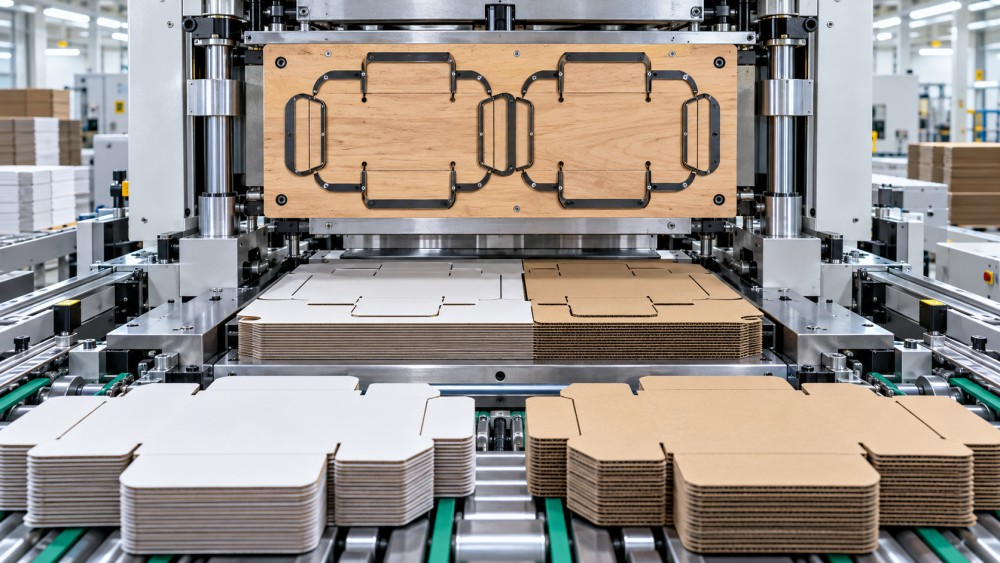
Knife performance is shaped by edge geometry as well as material hardness. A bevel profile influences penetration, cutting force, edge stability, and the way fibres separate at the cut line. For a simple shipping carton, the acceptable result may be very different from that required for a premium folding carton with visible edges, fine windows, and precise stripping.
A sharper edge can reduce initial cutting force, which may be useful for clean conversion of certain materials. But a finer edge can also be more vulnerable if the board is abrasive or if press conditions are poorly controlled. A more robust edge profile may last longer under heavy-duty conditions, though it can require careful setup to avoid crush, incomplete cutting, or excess pressure. There is no universal “best edge” for every converting plant.
Buyers should make the supplier explain the intended application of each offered edge profile. Ask whether it is designed primarily for corrugated board, solid board, coated cartonboard, laminated material, or mixed production. If the plant regularly runs both lightweight retail cartons and heavier corrugated formats, separate knife specifications may be more sensible than trying to standardize on one grade for all work.
Consistency in height and finish often matters more than a headline claim
For longer runs, inconsistency is often more damaging than average performance. Variation in knife height can lead to uneven cutting pressure across the die. The operator may compensate by increasing overall pressure, which can accelerate wear, mark the sheet, affect creasing performance, and place extra load on the machine. On a detailed die, a small inconsistency can show up as intermittent incomplete cuts or unstable stripping rather than an obvious failure.
Surface condition also deserves attention. Burrs, rough edges, poor polishing, or inconsistent coating can complicate die assembly and reduce reliability. In packaging operations where clean stripping is essential, especially for tightly nested blanks or small apertures, the quality of the rule surface and cutting edge can influence how waste behaves during the run.
This is where a sample evaluation is more useful than a brochure comparison. A trial should not stop after a few hundred impressions if the purchase decision concerns long-run durability. Whenever production planning allows, evaluate the knife over a meaningful portion of the intended run and monitor cut quality, pressure adjustments, stripping behavior, and operator intervention. The purpose is not to create a laboratory test; it is to see whether the knife remains predictable in the plant’s own operating conditions.
Calculate total conversion cost, not price per length
The quoted price of die-cutting rule is visible. The cost of a mid-run quality problem is often scattered across several departments: machine downtime, die-room labor, rejected sheets, reinspection, delayed gluing, and shipment pressure. For this reason, hardened die cutting knives should be assessed as part of the total converting cost rather than as an isolated material purchase.
A higher-grade knife may be justified when it reduces die maintenance, allows a die to remain in service for repeat orders, or prevents quality drift during a high-volume job. It may not be justified for short campaigns, simple low-abrasion board, or work that is unlikely to be repeated. The right commercial decision depends on the frequency of use and the operational consequences of failure.
A simple internal cost review can be enough. Compare the extra price of a hardened grade with the cost of one avoided die repair, one avoided press interruption, or a reduction in rejected sheets. The numbers will vary by plant, but the calculation forces a more useful discussion than “Which supplier is cheapest?”
Do not overlook the condition of the rest of the die-cutting system
A knife cannot correct an unstable process. If a die-cutter has uneven pressure, a worn cutting plate, poor sheet registration, inconsistent board moisture, or incorrect make-ready material, even a premium hardened rule may show disappointing life. In some plants, repeated knife replacement is actually a symptom of a press-side issue rather than a consumable-quality issue.
This is especially relevant in integrated corrugated and packaging operations. Board quality is influenced upstream by paper grade, adhesive control, moisture balance, scoring, and handling. A sheet that varies in flatness or caliper can create unpredictable die-cutting pressure. The most capable purchasing teams therefore gather input from the die room, press operators, quality personnel, and maintenance staff before changing knife specification.
CPCS coverage of converting equipment, board production, printing, inspection, and factory automation reflects this wider view. Die-cutting performance should be considered alongside feeder reliability, stripping design, inline inspection, material handling, and downstream folder-gluer requirements. A clean cut that does not fold consistently or pass inspection is not a successful converting result.
Questions worth putting to the supplier
A capable supplier should be able to discuss application fit in practical terms. Procurement should ask what substrates the proposed knife is commonly used for, whether the grade is intended for high-wear or repeat-use dies, and whether the supplier recommends different options for flatbed and rotary work. It is also reasonable to ask about available heights, thicknesses, bevel types, bending characteristics, packaging protection, batch identification, and lead-time consistency.
For recurring production, ask how the supplier manages consistency between deliveries. If a plant validates a knife grade through trials and then receives a materially different product later, the initial approval has limited value. Clear product identification and a stable specification are more valuable than vague assurances of “equivalent quality.”
When possible, include the die maker in the technical discussion. Purchasing may negotiate commercial terms, but the die maker understands practical issues such as rule cracking during bending, irregular ejection, difficult nicks, or where cutting performance fades first. Their feedback can prevent a cost-saving substitution that creates hidden labor in the tool room.
A sensible buying approach for repeat and high-volume work
For long production runs, avoid making a plant-wide decision based on a single simple job. Select representative work: a standard corrugated format, a demanding coated cartonboard job, and, if relevant, a design with intricate stripping. Track what operators actually observe: cutting pressure changes, edge condition, waste release, defects, die repairs, and run interruptions. Keep the evaluation notes attached to the die specification rather than relying on informal memory.
The final specification does not need to be complicated. It should state the knife grade, dimensions, edge profile, approved applications, and any limits identified during trials. This gives buyers a clear basis for reorder decisions while allowing technical teams to request a different rule where the board or job geometry genuinely requires it.
The strongest choice of hardened die cutting knives is usually not the hardest option, the lowest-cost option, or the most heavily marketed option. It is the grade that stays stable on the press, works reliably in the die room, and supports the required production length with the least disruption. That is the standard worth using when the cost of stopping a converting line is higher than the cost of choosing the right rule in the first place.
Related News
 How Platen Presses Support Precise Foil Stamping and Die CuttingPlaten Presses deliver precise foil stamping, clean die cutting, and reliable creasing for premium packaging. Discover setup practices that improve quality and reduce waste.Post-Press Kinematics Expert
 How Pre-Breaking Units Reduce Cracking in Die-Cut Carton FoldsPre-Breaking Units help reduce cracking in die-cut carton folds by easing bend stress, improving fold accuracy, and supporting high-speed carton production.Post-Press Kinematics Expert
 How a High Pile Feeder Reduces Downtime in Die-CuttingHigh pile feeder solutions reduce die-cutting downtime, improve sheet supply stability, and help packaging plants increase throughput with fewer interruptions.Post-Press Kinematics Expert
 Carton Die Cutting for Folding Cartons That Reduces Setup WasteCarton die cutting for folding cartons reduces setup waste with stable registration, reliable creasing, smarter tooling, and repeatable production control.Post-Press Kinematics Expert
 How to Choose Hardened Die Cutting Knives for Longer Production RunsHardened die cutting knives for longer runs: learn how to balance hardness, edge profile, consistency, and total conversion cost for reliable results.Post-Press Kinematics Expert
 How a High Speed Feeder System Improves Die-Cutting OutputDiscover how a high speed feeder system boosts die-cutting output through stable sheet feeding, precise registration, reduced waste, and reliable productivity.Post-Press Kinematics Expert