How to Choose Flatbed Die Cutting Presses for Accurate Short-Run Packaging
Short-run packaging exposes weaknesses that a long-run job can hide. A press that reaches an attractive top speed may still lose time through slow make-ready, unstable sheet control, repeated pressure adjustments, or difficult stripping. Selection should begin with the jobs that create the most disruption: the smallest repeat quantities, the most demanding printed cartons, the board grades that crack at the score, and the designs with tight internal cutouts or waste-prone stripping.
Set acceptance criteria around finished blanks rather than nominal machine output. The press should repeatedly place the cut, crease, perforation, and stripping features in the required relationship to printed artwork and sheet edges. It should also retain that result across the usable sheet pile, after a tool change, and when stock characteristics vary within an incoming batch. A machine that performs well on a clean sample sheet but needs frequent correction in a production run is poorly matched to short-run work.
Start with the job mix and tool format
The useful press format is determined by the largest and smallest sheets that must be processed, but format alone is not enough. Compare the actual printed sheet, gripper margin, color bar area, trim allowance, and layout direction against the usable chase and platen area. A nominal maximum sheet size can be misleading when the feeder requires a larger leading edge, when a delivery system limits the usable trailing edge, or when the die board needs a protected mounting margin.
Short-run folding carton work often includes many layouts on coated paperboard, solid bleached sulphate, recycled board, metallized sheets, laminated material, and digitally printed sheets. Each changes the cutting and creasing response. Corrugated material adds flute direction, sheet warp, crushed edges, and greater variation in caliper. A press intended for both cartonboard and light corrugated sheets needs a feed and pressure system that remains controlled across that range. It is better to define the real material envelope by grade, caliper, surface treatment, and flatness than to accept a broad statement about supported substrates.
Ask for the maximum and minimum sheet dimensions at the required production condition, including automatic feeding, stripping, and delivery. Very small blanks may be technically possible but difficult to separate, eject, or stack cleanly. Large sheets may fit the platen yet demand more consistent feeding and longer stabilization time. The right format leaves practical room for registration marks, trim, and safe tool mounting without forcing routine work into an awkward layout.

Accuracy is a system result, not a single specification
Cutting accuracy depends on the interaction of sheet registration, feeder timing, side lay behavior, gripper transport, platen parallelism, die condition, and the printed sheet itself. A stated positional tolerance has little value unless its measurement basis is clear. Confirm whether it refers to repeated die-cut position on one unprinted material, alignment to printed artwork, or variation over a full production stack. These are different tests.
Registration problems are often attributed to the press when the source is upstream. Sheet growth from ink coverage, uneven moisture, skew created during guillotine cutting, or curl from coating and lamination can shift artwork relative to the physical sheet. The press should have enough adjustment range and stable reference points to manage normal variation, but it cannot correct a sheet whose dimensions change unpredictably from one side to the other.
Request a trial that uses representative artwork and the intended material, rather than a simple rectangular die. Include narrow creases, close cut-to-crease relationships, windows, perforations, and any features near the gripper edge. Inspect the first sheets, middle of the pile, and final sheets. Compare registration in both feed and cross-sheet directions. A single sample pulled after extensive manual tuning does not reveal repeatability.
Pay close attention to platen pressure uniformity. Insufficient pressure leaves incomplete cuts; excessive pressure shortens the life of cutting rules, damages the cutting plate, and can emboss or mark sensitive printed surfaces. Uneven pressure creates a misleading pattern: some areas cut cleanly while distant areas require patching under the die. Frequent patching slows make-ready and makes results sensitive to die-board replacement. A rigid platen, accessible pressure adjustment, and clear pressure indication reduce that dependency.
Creasing quality deserves separate evaluation
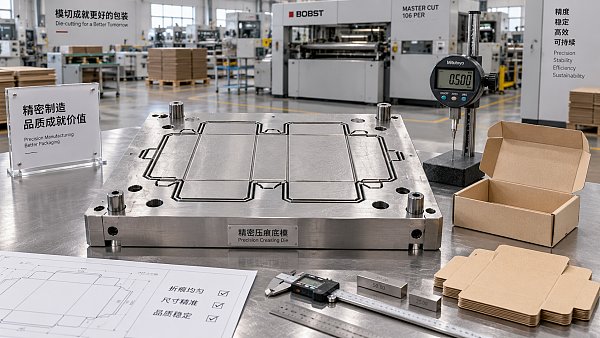
A cut edge can look acceptable while the crease is already causing a downstream failure. Creasing quality should be judged after folding, not only on the flat blank. Test folds in both directions where the carton design requires them. Look for cracked coating, exposed fibers, split liner, distorted panels, and inconsistent fold resistance. These faults can arise from an unsuitable channel width, incorrect crease rule, excess platen pressure, poor grain direction, or a board caliper outside the tool design assumptions.
The press must hold pressure consistently enough that crease depth does not drift through a run. This matters when blanks are later processed on a folder gluer, where variable creases cause poor panel alignment, spring-back, or unstable glue flap closure. Printed surfaces with dense ink coverage, UV varnish, film lamination, or metallic decoration need representative trials because their surface layers can fracture before an uncoated sample shows a problem.
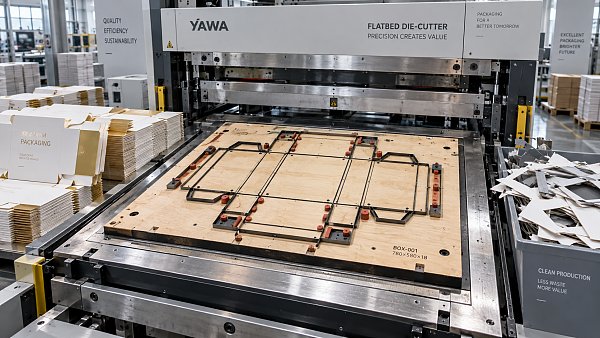
For short runs, tooling preparation is often the larger constraint. Confirm how quickly a chase can be removed, mounted, centered, and locked. Determine whether the press uses a common die-board standard already used in the plant. A press that requires a special tool format, unusual locking hardware, or extensive manual centering can create avoidable delay and complicate tool inventory. Compatibility with existing cutting, creasing, stripping, and blanking tools should be assessed before comparing automation features.
Measure changeover from the last good sheet to the next good sheet
Short-run productivity is governed by usable output per shift, not by the highest cycling rate. The relevant interval begins when the previous job stops and ends when the next job produces acceptable, fully stripped blanks at normal operating conditions. It includes removal of the prior die, chase cleaning, new-tool installation, feeder and delivery adjustment, side lay setting, pressure preparation, stripping setup, sample inspection, and correction of first-sheet defects.
Separate activities that must stop the press from activities that can occur in parallel. Preparing stripping pins, organizing ejection components, staging the next tool, and pre-setting job information can reduce idle time, but only when the workflow and machine access permit it. A heavily automated press may still have long changeovers if stripping frames require extensive manual build-up. Conversely, a simpler machine with quick-lock chases and predictable adjustments may be more suitable for a varied short-run schedule.
- Record the number of settings that must be changed for a typical carton job, including feeder height, suction, front and side lays, gripper setting, delivery guides, and stripping registration.
- Observe whether adjustment scales return reliably to a prior position or merely provide a rough reference.
- Assess job data storage only in relation to the settings it actually recalls; stored information does not eliminate material-specific tuning.
- Include cleaning time for adhesive, coating residue, dust, and small waste pieces, because these affect the readiness of the next order.
Automation should remove recurring sources of variation rather than add a fragile layer of complexity. Automatic feeder setting, motorized registration adjustment, preset delivery guides, and recipe recall are valuable when they are accessible and repeatable. Automatic stripping or blanking needs the same scrutiny. A sophisticated section that handles only a narrow family of layouts can become a bottleneck when the order mix changes.
Feeding and delivery determine whether accuracy survives the run
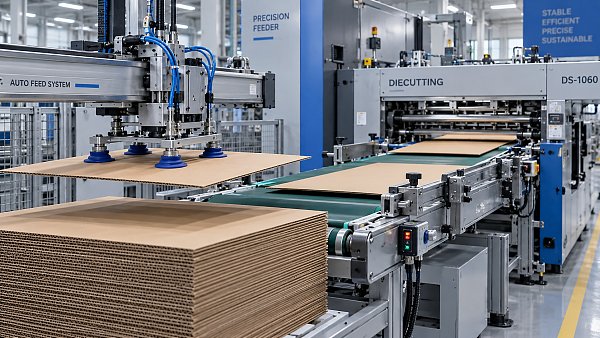
Flatbed die cutting presses apply force at the platen, but the process begins at the feeder. Examine how the machine separates sheets with static charge, curled edges, high ink coverage, or uneven surfaces. Vacuum separation, air blast, suction head adjustment, and pile lifting must be controllable without creating marks on the print. Double-sheet detection is especially important where material variation makes a misfeed expensive. Its sensitivity should be tested on the lowest and highest caliper stocks expected in routine work.
Side lay selection affects both registration and surface protection. Pull lays can mark delicate sheets if set aggressively, while push lays can be less forgiving of poor sheet squareness. Neither arrangement is universally superior; the relevant issue is whether the chosen configuration controls the actual material and print finish without excessive manual correction. For digitally printed sheets, verify whether toner, inkjet coating, or variable image areas alter friction or create marking risk at contact points.
At delivery, confirm that stripped blanks remain in their intended orientation and do not catch, fan, or scuff as the stack forms. Cartons with narrow bridges, loose internal pieces, or large waste windows require close observation. Waste that fails to clear may re-enter the delivery area and damage subsequent sheets. For jobs requiring bundling or transfer to a next process, the delivery stack must be stable enough to preserve count and orientation without extensive hand sorting.
Stripping capability should follow the actual design complexity
Stripping is where many short-run assumptions fail. A carton with a simple outer profile may run without difficulty, while one with small holes, hanging chads, narrow waste bridges, or multiple internal apertures needs carefully designed upper and lower stripping tools. The value of an integrated stripping section depends on whether it can be set up efficiently for those features and whether waste removal remains dependable as rule sharpness and board condition change.
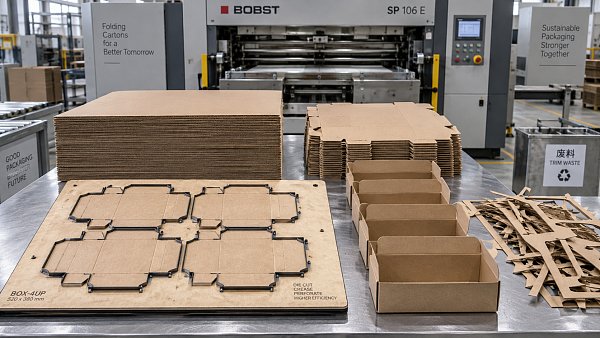
Evaluate three conditions: an unstripped blank, a normal stripped blank, and the most difficult recurring layout. Examine loose waste around small apertures, intact nicks where waste should stay connected, and damage to fine features. Blanking is useful when finished cartons need to leave in counted, separated piles, but it introduces another tool and setup stage. It should be chosen when downstream handling benefits justify that preparation, not simply because it is available.
Specify the press around maintainable accuracy
Maintenance assessment should focus on components that affect registration, pressure, feeding, and sheet transport. Review lubrication points, access to gripper bars, feeder wear parts, bearings, chains, drive components, suction elements, sensors, and safety interlocks. A compact layout is not automatically easier to maintain if routine inspection requires removal of guards or difficult access to adjustment points.
Ask how wear is detected before it becomes a quality fault. Clear service intervals are useful, but condition visibility is equally important. For example, accessible gripper inspection, pressure trend records, fault history, and sensor diagnostics allow an issue to be isolated before a job accumulates scrap. The availability of replacement parts matters most for parts that stop production, such as feeder components, gripper elements, electrical modules, and critical pneumatic items. Stocking strategy should match the machine's actual configuration rather than a generic parts list.
Installation conditions also affect long-term results. Floor loading, levelness, access for die changes, material staging space, compressed air quality, electrical capacity, dust extraction, and clearance for maintenance should be verified against the selected configuration. Insufficient space near the feeder or delivery encourages improvised handling that increases sheet damage and slows changeovers. The press should be placed so that tool movement, pallet access, and inspection of first-off sheets fit the intended work sequence.
Use a controlled acceptance trial
A meaningful acceptance trial uses documented job conditions and a defined inspection method. Prepare several representative sheets from each chosen material, including printed and finished surfaces where applicable. Define the target cut-to-print relationship, permitted crease appearance after folding, stripping condition, stack quality, and the observation points during the run. Record setup actions and any adjustment made after the first acceptable sheet.
Do not treat an impressive run on one simple carton as confirmation of general suitability. Compare performance across a straightforward repeat order, a design with demanding stripping, and a material that is sensitive to creasing. The objective is to expose where the press requires skill-intensive intervention and where it maintains control on its own. That distinction determines whether accurate short-run packaging remains predictable when job frequency rises.
Related News
 How to Calculate Short Run Die Cutting Costs Before Placing an OrderCalculate short run die cutting costs before you order. Learn how tooling, setup, material waste, and finishing affect your budget—and compare quotes to avoid hidden charges.Post-Press Kinematics Expert
 How a High Accuracy Sheet Feeder Reduces Misfeeds in Die CuttingDiscover how a high accuracy sheet feeder reduces die-cutting misfeeds, waste, and downtime. Learn how to choose the right system for more reliable production.Post-Press Kinematics Expert
 How to Choose a Platen Die Cutter Manufacturer for Reliable OutputChoose a platen die cutter manufacturer with proven output. Discover how material trials, service support, and clear acceptance criteria help reduce downtime and protect your investment.Post-Press Kinematics Expert
 How to Choose a Counterplate Manufacturer for Accurate CreasingChoose a counterplate manufacturer that delivers accurate creasing. Learn how to assess channel design, production trials, and repeatability to reduce setup waste and improve folding.Post-Press Kinematics Expert
 How Flatbed Steel Rule Dies Improve Cut Accuracy and Changeover SpeedFlatbed steel rule dies improve cut accuracy, crease quality, waste release, and changeover speed. Discover practical tooling tips for reliable, efficient converting.Post-Press Kinematics Expert
 How Platen Presses Support Precise Foil Stamping and Die CuttingPlaten Presses deliver precise foil stamping, clean die cutting, and reliable creasing for premium packaging. Discover setup practices that improve quality and reduce waste.Post-Press Kinematics Expert