How to Calculate Short Run Die Cutting Costs Before Placing an Order
A low unit price can hide an expensive short run die cutting order once tooling, setup, material waste, and finishing charges are added. For procurement teams buying cartons, corrugated packaging, or printed components, an accurate estimate starts with separating one-time costs from production costs—and dividing the total by the quantity of usable finished pieces.
The difficulty is that suppliers do not always quote the same scope. One may include a cutting die and stripping; another may quote only machine time. Before placing an order, you need to understand what happens between receiving the artwork and delivering packaging that is ready to use. That is where a realistic budget begins.
Start with the finished piece, not the machine rate
“Short run” has no universal quantity threshold. A batch that is small for an automated corrugated converting plant may be routine for a specialist sample-making business. From a costing perspective, the important characteristic is that tooling, preparation, and changeover account for a substantial share of the order value.
Define the purchasing unit before asking for prices. Is it a die-cut blank, a stripped and stacked carton blank, or a folded and glued carton? Does the quoted quantity mean sheets processed or acceptable pieces delivered?
For short run die cutting, a useful starting formula is:
Total order cost = tooling and engineering + setup + material + cutting/converting + finishing and inspection + packing and delivery + applicable additional charges.
Then calculate:
Effective cost per usable piece = total order cost ÷ accepted finished quantity.
Use the same tax treatment across quotations, particularly where taxes are recoverable. If buyers supply printed sheets, include their acquisition cost in the internal budget even when it does not appear on the converter’s invoice. Otherwise, a conversion-only quotation can look cheaper than an integrated supply offer without actually being cheaper.
Build the estimate around three cost groups
1. Costs triggered by the design
A conventional steel-rule die may require a dieboard, cutting and creasing rules, ejection rubber, and associated preparation. Depending on the process, stripping tools, blanking tools, counterplates, or creasing matrices may also be needed. “Tooling included” does not necessarily mean every tool required for the finished product is included.
Complexity matters. Tight internal cutouts, numerous small features, difficult waste removal, and demanding crease requirements can increase engineering and preparation work. A simple outline and a detailed retail carton should not be budgeted on perimeter length alone.
Ask whether structural design, dieline correction, and sample approval are separate charges. Also establish ownership, storage duration, maintenance responsibility, and reuse conditions. A die may be reusable, but a revised layout, different board caliper, or different machine format can require modification or replacement.
2. Costs triggered by each production run
Setup covers more than loading a tool. It can include feeder adjustment, cutting-pressure balancing, crease adjustment, register alignment, stripping setup, trial sheets, and quality approval. Short batches have fewer saleable pieces over which to spread these costs.
Repeat orders usually still require make-ready. The supplier may retrieve an existing die, but the machine must be prepared and the output checked again. Keep reusable tooling separate from recurring setup in your budget rather than classifying both as one-time expenses.
A minimum job charge can also apply. Ask whether it replaces the calculated machine charge or is added to other fees. Adding both without clarification can overstate the estimate; overlooking the minimum can understate it.
3. Costs that rise with production volume
Material, running time, consumables, manual handling, finishing, and packing generally increase with quantity. They may not increase proportionally: a larger order can use a different sheet layout, press, or finishing route.
For corrugated packaging, specify flute profile, board construction, dimensions, and relevant strength requirements. For folding cartons, specify board grade, caliper, grain direction where important, and coatings or laminations. These details influence cutting behavior, creasing quality, feeding stability, and yield—not just material price.
Calculate sheet demand before calculating material cost
The finished quantity alone does not tell you how much board to buy. You also need the number of pieces per sheet, expected production yield, and the sheets reserved for make-ready.
A practical planning calculation is:
Estimated input sheets = round up [required good pieces ÷ (pieces per sheet × production yield)] + make-ready sheets.
This formula assumes production yield excludes the separately counted make-ready allowance. If a supplier’s waste percentage already includes setup waste, do not add it again.
Consider a quantity-only example. Suppose you need 1,000 acceptable blanks, a layout produces four blanks per sheet, and the agreed planning yield is 95%. You would budget 264 production sheets after rounding up. If make-ready requires another 30 sheets, the total is 294 sheets. These are illustrative assumptions, not standard waste allowances.
At full theoretical yield, the same order needs only 250 sheets. That difference matters particularly when sheets have already been printed, laminated, or foil stamped. Losing one during die cutting means losing the value of all earlier processes as well as the substrate.
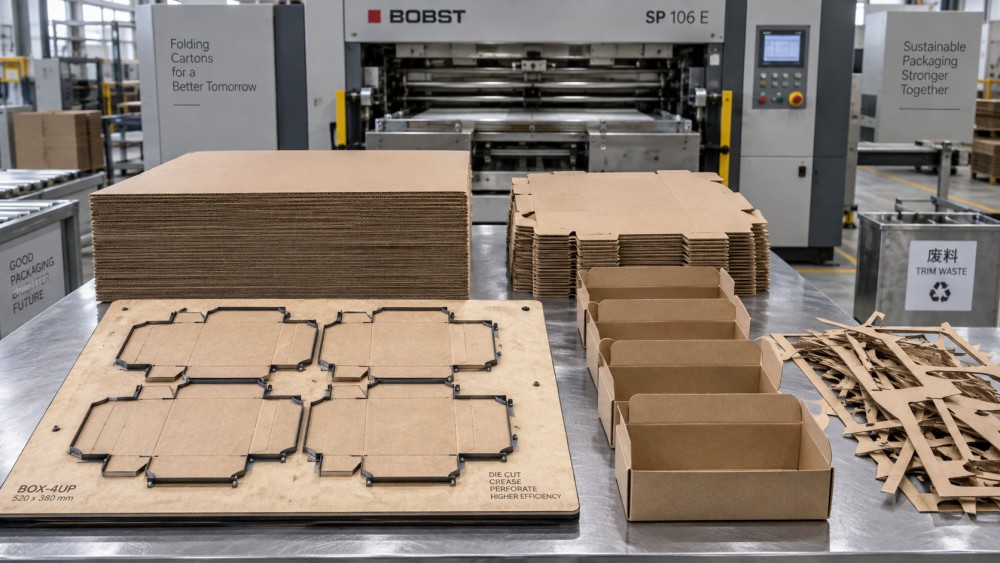
Ask the supplier to confirm the proposed layout and usable sheet area. Gripper margins, trim, flute or grain direction, and stripping constraints can limit nesting. A layout that looks efficient on screen may not run reliably on the intended equipment.
Also clarify material purchasing rules. A mill, merchant, or printer may impose a minimum purchase quantity. Establish whether unused sheets will be returned, stored for a repeat order, or charged as part of the job.
Choose the production route by total cost
The cheapest hourly rate is not automatically the cheapest route. Procurement should compare complete costs for producing the same acceptable output.
Digital cutting can be attractive for prototypes, changing designs, or small quantities, but it is not automatically cheaper. Long cutting paths and manual unloading can increase processing time. Conversely, conventional tooling may be justified when repeat orders are likely or the product needs a particular crease result.
If two routes produce equivalent acceptable output, their approximate break-even quantity is:
Break-even quantity = (fixed cost of Route A − fixed cost of Route B) ÷ (variable cost per piece of Route B − variable cost per piece of Route A).
This calculation is useful when Route A has higher fixed costs but lower variable costs. Treat it as a guide, not a quotation: minimum charges, changing layouts, material purchases, and capacity constraints can make actual pricing step-based rather than linear.
Do not let finishing disappear from the quotation
A die-cut sheet is not necessarily a usable packaging component. Waste may still need stripping, individual blanks may need separating, and cartons may require folding, gluing, inspection, and packing.
For short runs, manual work can be commercially sensible because automated finishing also needs setup. However, that labor should be visible. Ask whether the quotation includes internal waste removal, outer skeleton removal, blank separation, counting, bundling, and pallet preparation.
Quality requirements must be equally clear. Define critical dimensions, crease position, cut-to-print registration, and acceptable edge condition. Corrugated products may also need attention to flute crushing and folding performance. Printed cartons may require checks for cracking, scuffing, and readable codes.
A vague requirement such as “high quality” gives neither party a reliable costing basis. An approved sample and agreed acceptance criteria make it easier to distinguish normal variation from rejectable output.
Send an RFQ that suppliers can price consistently
A useful request for quotation should contain enough information to establish the production route without forcing suppliers to guess. Include:
- Quantity: required acceptable pieces, delivery splits, and permitted overrun or underrun.
- Files: a dimensioned dieline, artwork where relevant, and a clear revision reference.
- Material: board specification, supplied sheet dimensions, and whether sheets arrive printed or finished.
- Scope: cutting, creasing, stripping, blanking, folding, gluing, inspection, and packing requirements.
- Acceptance: critical tolerances, sample approval, and functional requirements.
- Commercial details: delivery location, required date, tooling ownership, quote validity, and repeat-order expectations.
Request separate prices for tooling, recurring setup, production, finishing, and delivery. Where suppliers use bundled pricing, ask them to state inclusions and exclusions explicitly.
For buyer-supplied sheets, agree who bears losses from defective incoming material, setup consumption, and conversion errors. Ask how shortages are handled. A replacement-printing delay can be more disruptive than the immediate cost of wasted sheets.
Compare offers on one worksheet
Normalize each quotation to the same specification, accepted quantity, delivery point, and finishing scope. Keep quoted charges separate from your internal estimates for missing items; otherwise, assumptions can start to look like supplier commitments.
Your comparison should show three results: first-order total, effective cost per accepted piece, and repeat-order total using reusable tooling where confirmed. For uncertain items, calculate a base case and a downside case rather than hiding them inside a generic contingency percentage.
Challenge unusually low offers with specific questions. Is material included? Is waste removal included? Does the price assume customer-owned tooling? Is the delivery quantity guaranteed or subject to an underrun allowance? These questions are more revealing than simply asking for a discount.
Quantity breaks also deserve restraint. Buying extra pieces may reduce the quoted unit price while increasing cash outlay, storage, and obsolescence risk. Order more only when the likely future use justifies the additional commitment.
Before approval, close the remaining cost gaps
For urgent short run die cutting orders, confirm that the quoted lead time includes file review, tooling manufacture, sample approval, production, and delivery. Ask what happens if approval changes the dieline and whether rush work or expedited freight is chargeable.
As CPCS emphasizes in packaging equipment evaluation, purchase price is only one part of the decision. For an individual converting order, the same principle applies: setup efficiency, material utilization, handling requirements, and finished-product yield determine what you actually pay.
Approve the order when the supplier has confirmed the scope, usable delivery quantity, waste basis, tooling terms, acceptance criteria, and additional-charge triggers. The goal is not merely to secure the lowest number on a quotation. It is to know what that number buys—and to receive packaging you can use without an unexpected second bill.
Related News
 How to Choose a Sheet Feeder for Paperboard ProductionChoose the right sheet feeder for paperboard with practical tips on material handling, line speed, integration, and trials to improve production reliability.Post-Press Kinematics Expert
 How Do Creasing Dies Prevent Cracks in Folded Cartons?Creasing Dies help prevent carton fold cracks through controlled deformation. Discover key tooling factors and practical production tips for cleaner, more consistent folds.Post-Press Kinematics Expert
 How to Prevent Sheet Misfeeds in an Automatic Feeder SystemPrevent automatic feeder system misfeeds with practical checks for sheet alignment, suction, air separation, timing, and double-sheet detection.Post-Press Kinematics Expert
 How Do Non Stop Feeder Piles Reduce Die-Cutter Downtime?Discover how non stop feeder piles reduce die-cutter downtime, improve pile-change efficiency, and keep sheet feeding reliable on long production runs.Post-Press Kinematics Expert
 USITC Advances Trade Probe Into Corrugated Die-Cut BoxesCorrugated die-cut boxes face a USITC trade probe. Explore what the investigations could mean for packaging costs and sourcing.Post-Press Kinematics Expert
 What to Consider When Choosing Heavy Duty Pile TurnersChoosing heavy duty pile turners? Discover how to assess load capacity, substrate handling, safety and operating costs to find the right fit for your production line.Post-Press Kinematics Expert