How a Counterplate Manufacturer Helps Prevent Cracking at Creases
A carton can meet dimensional tolerances and still fail when folded. Cracking at the crease means the board surface, coating, or printed layer has been strained beyond what it can tolerate. A counterplate manufacturer helps prevent this by matching the female creasing channel to the board, creasing rule, and press conditions—not simply by supplying a plate that matches the cutting-die drawing.
The practical objective is a controlled hinge: enough internal deformation to let the board fold without tearing the outer surface, but not so much compression that the crease becomes crushed or weak. Correct channel geometry is essential, yet it cannot compensate for excessively dry stock, brittle finishes, damaged rules, or unstable press settings. Prevention therefore depends on treating the counterplate as part of a complete creasing system.
Why an accurately positioned crease can still crack
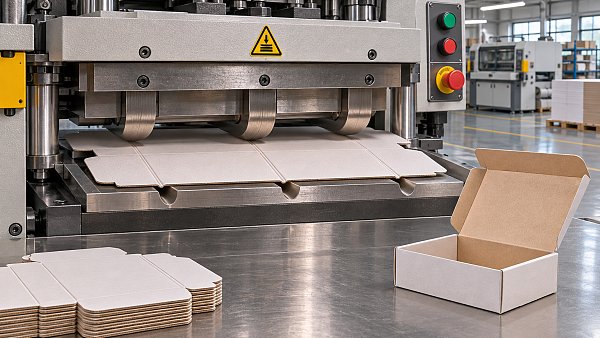
During creasing, the male rule pushes the board into the counterplate channel. In folding carton board, this action compresses and redistributes material and promotes controlled separation within its layered structure. That internal movement helps the board form a hinge rather than forcing the outer surface to accommodate all the stretching during folding.
If the channel provides insufficient space, the board can be pinched or excessively compressed. If it provides too little support, the resulting crease can be broad, poorly defined, or difficult to fold consistently. A crease that looks deep is not necessarily a good crease: appearance alone does not establish whether the internal structure has been prepared for folding.
Cracking also needs to be distinguished from other surface defects. A fractured varnish film, split coating, exposed paper fibers, and a print scuff may look similar at normal viewing distance, but they require different corrective actions. Magnified inspection of the unfolded surface and the folded crease helps establish which layer is failing.
Fold direction matters as well. Inspection must reproduce the intended carton fold, with the correct side placed in tension. Reverse-folding a sample can reveal useful information, but it is not a substitute for evaluating the actual folding sequence.
The specifications that determine whether the counterplate fits the job
A useful specification starts with the actual substrate, not just its commercial description. Two boards sold at the same grammage can differ in caliper, density, fiber composition, coating, and folding behavior. Even a previously successful board grade needs reassessment if its construction or finishing process changes.
The manufacturer should receive representative production stock, preferably including printed and finished sheets when those treatments cross the crease. The tooling information should identify creasing rule thickness, height, profile, layout, and relevant press and mounting details.
Channel-sizing formulas are useful starting points, but they are not universal acceptance criteria. A formula developed for one board family or tooling system may not transfer reliably to another. The manufacturer should explain the assumptions behind its recommendation and identify where production trials are needed.
Grain direction deserves explicit treatment in the drawing. Creases parallel and perpendicular to the grain do not necessarily respond to the same geometry. A single channel specification across the entire carton can therefore overlook meaningful differences, particularly where the design combines long panel folds, short flap folds, and intersecting creases.
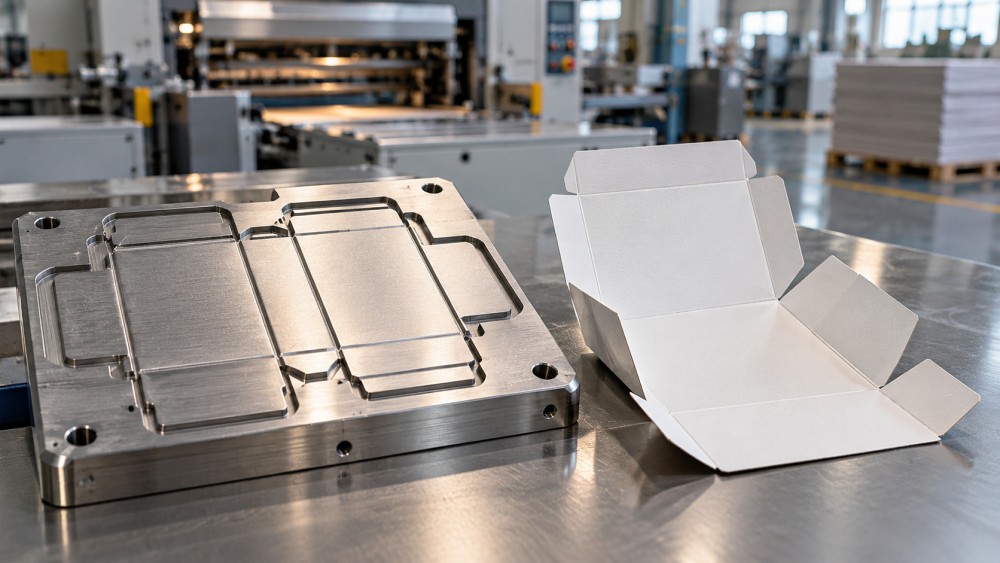
At intersections, closely spaced folds, and short crease segments, the surrounding board constrains material movement differently from an isolated straight crease. Local relief or revised geometry may help, but changes must preserve fold location, carton dimensions, and closure performance. This is where application support adds more value than simply reproducing a standard channel.
Separate tooling problems from material and finishing problems
A counterplate manufacturer can help narrow the cause of cracking only if the evidence includes where the defect occurs and under what conditions. “The board cracks” is less useful than a marked sheet showing affected creases, grain direction, printed areas, and positions on the press.
If cracking follows one grain orientation across multiple positions, board behavior and channel selection deserve attention. If it is confined to one side of the sheet or one cavity, local pressure, alignment, rule condition, or plate seating becomes a stronger line of investigation. These patterns are diagnostic clues, not proof; more than one variable can be involved.
Moisture is another important boundary condition. Board that loses moisture during storage or processing can become less tolerant of deformation. Stock temperature, ambient conditions, storage duration, and exposure after printing can all influence the condition presented to the die-cutter. Conditioning should follow the board supplier’s guidance rather than an improvised moisture target.
Ink, varnish, foil, and lamination can change the result even when the underlying board folds acceptably. A coating-only fracture points toward a different failure mechanism from a split extending into the fibrous substrate. Comparing unprinted board, printed sheets, and fully finished sheets can help isolate that contribution, provided the samples are otherwise comparable.
Folding carton board and corrugated board also require different assumptions. Corrugated structures introduce flute direction, liner properties, and local flute crushing. A channel recommendation validated for solid paperboard should not be transferred directly to corrugated stock merely because the measured overall thickness is similar.
Run trials that reveal a usable process window
A successful hand-folded sample is necessary evidence, but it is not sufficient for production approval. The crease must work under the intended folding angle, folding speed, and downstream handling conditions. A sample that survives slow manual folding can still split during rapid prefolding or carton erection.
Before comparing counterplate options, establish a documented baseline: board identity and lot, measured caliper, grain direction, finish, rule details, plate revision, press settings, and conditioning history. Keep the material batch and other controllable conditions consistent while changing the variable being investigated.
Pressure adjustments should be deliberate and bounded by the equipment and tooling suppliers’ instructions. Increasing impression until a crease appears stronger can damage the surface, crush the board, or conceal an alignment problem. Cutting and creasing performance should be assessed together so that a correction to one does not create a defect in the other.
Trial evaluation should include:
- The intended fold: fold to the specified angle and inspect the outer surface under agreed viewing conditions.
- Defect location and depth: distinguish a finish fracture from exposed fibers or a deeper structural split.
- Fold behavior: assess folding resistance, springback, and whether the fold follows the intended line.
- Sheet-position consistency: compare cavities and positions rather than accepting a single good sample.
- Downstream performance: check prefolding, gluing, erection, and any relevant finished-pack handling.
Where fold resistance is measured, the fixture, folding angle, direction, and test procedure need to remain consistent. Results from different methods should not be treated as interchangeable. A low folding force is not automatically desirable if it comes from an excessively weakened hinge.
The strongest trial result is not one perfect sample at one exact press setting. It is acceptable performance across a practical operating window, including the normal variation expected in the approved material. A setup that fails after a minor adjustment offers little production security.
Turn an approved crease into a repeatable quality requirement
“No cracking” is too ambiguous unless the inspection conditions are defined. Acceptance should state the folding angle, viewing method, lighting, permitted surface appearance, and whether exposed fibers or structural splitting are prohibited. Customer-approved reference samples can make borderline decisions more consistent, especially on heavily printed or coated cartons.
Sampling should cover startup, stable production, and events that can change the process: a new board pallet or lot, a tooling adjustment, a stoppage, or a change in press conditions. Sampling frequency should reflect job risk and the site’s quality plan rather than an arbitrary universal interval.
Retained samples are most useful when linked to production records. A defective carton without its material lot, cavity position, counterplate revision, and relevant settings provides limited evidence. Traceability allows the factory and tooling supplier to distinguish recurring geometry problems from isolated material or setup changes.
Cosmetic failure and functional failure should also be assessed separately. Visible whitening may violate an appearance requirement without establishing a loss of package strength. Conversely, an inconspicuous split can matter if it compromises repeated opening, closure integrity, or protective performance. Where those functions are important, crease inspection needs to be supported by appropriate finished-package testing.
What effective manufacturer support should deliver
A capable counterplate manufacturer should provide more than a replacement plate. Useful support includes a reasoned geometry recommendation, clearly identified tooling revisions, installation guidance, and a defined response when trials fail. Manufacturing tolerances and inspection records should address the dimensions that affect performance, rather than relying on a general quality claim.
When cracking recurs, the response should connect the defect pattern to a testable explanation. For example, suspected off-center loading calls for alignment verification; suspected material brittleness calls for comparable substrate checks. Changing channel width, pressure, and board condition simultaneously may produce an acceptable carton, but it leaves the cause unresolved and makes future repeatability harder.
Any corrective work on mounted tooling must follow the machine’s isolation and safe-access procedures. Alignment checks, cleaning, and plate replacement should never depend on reaching into an active press. Unapproved grinding or reshaping can also introduce burrs and uncontrolled dimensional changes, replacing a documented specification with an uncertain one.
The appropriate release point is a documented combination of substrate, finish, tooling, and operating conditions that produces an acceptable fold and survives the relevant downstream process. The manufacturer’s contribution is to make that combination technically sound and reproducible—not to promise that channel geometry alone can eliminate every source of crease cracking.
Related News
 How to Choose a Sheet Feeder for Paperboard ProductionChoose the right sheet feeder for paperboard with practical tips on material handling, line speed, integration, and trials to improve production reliability.Post-Press Kinematics Expert
 How Do Creasing Dies Prevent Cracks in Folded Cartons?Creasing Dies help prevent carton fold cracks through controlled deformation. Discover key tooling factors and practical production tips for cleaner, more consistent folds.Post-Press Kinematics Expert
 How to Prevent Sheet Misfeeds in an Automatic Feeder SystemPrevent automatic feeder system misfeeds with practical checks for sheet alignment, suction, air separation, timing, and double-sheet detection.Post-Press Kinematics Expert
 How Do Non Stop Feeder Piles Reduce Die-Cutter Downtime?Discover how non stop feeder piles reduce die-cutter downtime, improve pile-change efficiency, and keep sheet feeding reliable on long production runs.Post-Press Kinematics Expert
 USITC Advances Trade Probe Into Corrugated Die-Cut BoxesCorrugated die-cut boxes face a USITC trade probe. Explore what the investigations could mean for packaging costs and sourcing.Post-Press Kinematics Expert
 What to Consider When Choosing Heavy Duty Pile TurnersChoosing heavy duty pile turners? Discover how to assess load capacity, substrate handling, safety and operating costs to find the right fit for your production line.Post-Press Kinematics Expert