How Flatbed Steel Rule Dies Improve Cut Accuracy and Changeover Speed
Flatbed steel rule dies improve die-cutting performance when they are treated as a matched production tool rather than a simple consumable. A well-designed die can produce cleaner cut edges, more repeatable crease lines, and less stripping trouble. It can also reduce the time spent correcting registration, packing the die, adjusting pressure, and restarting a job after changeover.
The result does not come from the steel rule alone. Cut accuracy depends on the relationship between the die board, cutting rules, creasing rules, rubber ejectors, counterplate or make-ready system, sheet condition, and the flatbed die-cutter itself. Changeover speed depends just as much on die standardization, mounting method, job documentation, and the condition of every reusable component.
For carton, folding box, label, and corrugated converting operations, the most useful question is not whether a die is “high quality” in general. It is whether its construction matches the material, artwork geometry, machine format, production volume, and required repeatability of the job.
Why cutting accuracy starts with die geometry
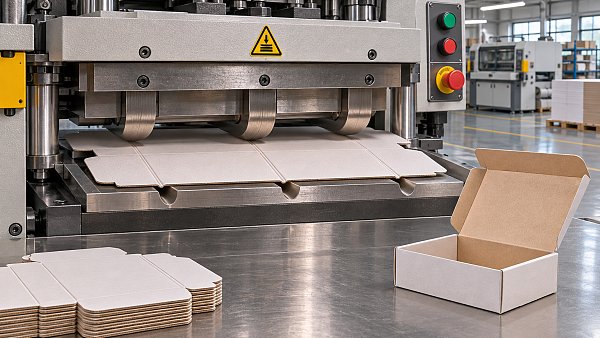
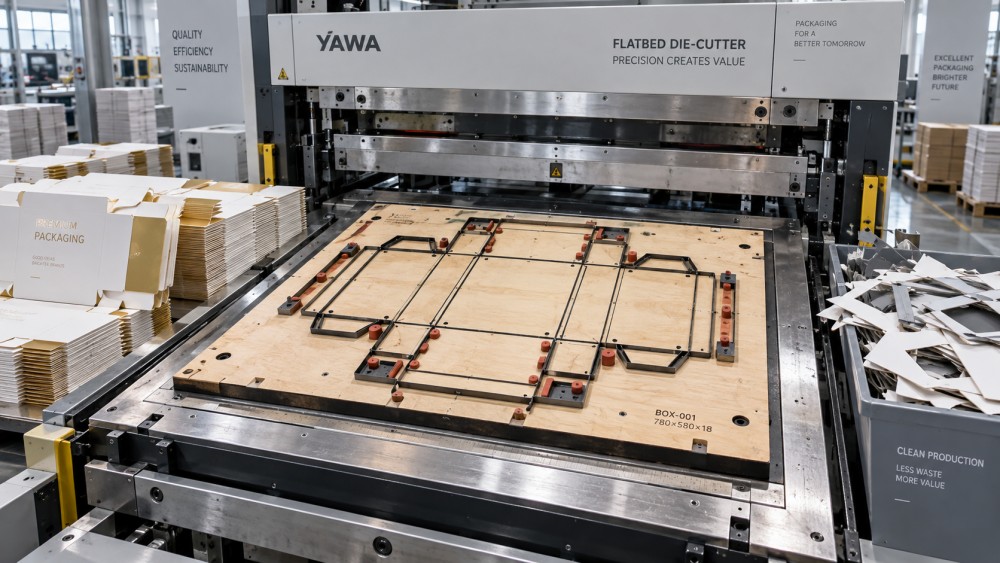
A flatbed steel rule die converts a two-dimensional layout into a physical cutting and creasing tool. The die board holds shaped steel rules in precise positions. Cutting rules create the outside profile, windows, slots, and internal cuts. Creasing rules compress the board or paper structure along controlled lines so the blank can fold without cracking or drifting.
Accuracy is often discussed as if it were only a question of how closely the die matches the drawing. In production, accuracy has several layers:
- Dimensional accuracy: the cut blank matches the intended outline and critical distances.
- Registration consistency: the cut and crease relationship remains aligned with printed graphics, varnish areas, codes, and windows.
- Functional accuracy: folds occur where intended, panels remain square, and locking features engage reliably.
- Repeatability: the first acceptable sheet and later sheets perform the same way through the run.
A die can look correct during initial inspection yet still create functional problems if rule height, rule placement, crease channel selection, or ejection behavior is inconsistent. For example, a narrow locking tab may be cut cleanly but fail later on the folder gluer because the crease is too deep, too shallow, or positioned slightly off relative to the panel edge.
Rule selection affects more than the cut line
Steel rule choices should reflect the substrate and the detail level of the design. Cutting rule thickness, bevel configuration, hardness, and edge profile influence penetration and edge quality. Creasing rule width and profile influence how material is compressed and displaced. These choices are particularly important when jobs include short folds, tight radii, perforations, narrow waste bridges, or mixed material structures.
A rule profile that performs well on a light folding carton may not give the same result on heavier paperboard or corrugated sheet. Corrugated material adds variables such as flute profile, liner properties, board warp, moisture variation, and crush sensitivity. In that setting, a technically correct outline can still produce poor blanks if the die creates excessive compression or if creasing does not accommodate the board thickness.
Fine detail is another area where an unsuitable specification creates avoidable risk. Small internal cuts and closely spaced rules need adequate support from the die board and sufficient ejection control. Treating every detailed design as a “precision die” without considering material behavior can lead to broken bridges, hanging waste, or premature rule damage.
Creasing is usually the hidden cause of converting defects
Cut quality is visible immediately. Crease quality may only become obvious when blanks move downstream. A poor crease can cause cracking on printed surfaces, inaccurate folding, uneven carton panels, weak glue seams, or unstable erection. This is why the die should be evaluated with the next process in mind, not only at the delivery pile of the die-cutter.
The crease rule and the corresponding channel or counterplate must work as a system. If the channel is too narrow, the board can be pinched and damaged. If it is too wide, the crease may lack definition and folding control. A mismatch can also force operators to compensate with machine pressure. That may temporarily improve one crease while increasing cutting stress, material marking, or wear elsewhere on the die.
Printed and coated sheets require additional care. Heavy ink coverage, coatings, lamination, metallized surfaces, and specialty papers can crack or whiten along a crease even when the die-cut shape is acceptable. The right response is not automatically more pressure. The evaluation should consider grain direction, score configuration, material stiffness, coating behavior, and the intended folding direction.
For corrugated blanks, crease quality should be judged by the finished box rather than the visible score alone. A score that appears strong on a flat sheet may crush the flute structure enough to reduce stacking performance or create a distorted fold. Conversely, a score that appears light may be sufficient when the board construction and folding equipment support it. Finished-box trials are more informative than relying only on the appearance of the die-cut blank.
Die-board stability protects registration
The die board is not passive backing material. Its flatness, thickness consistency, machining quality, and ability to retain rules affect how accurately the die performs under repeated impact. Poorly retained rules can shift, loosen, or develop uneven height. A board that distorts under operating conditions can contribute to registration movement and uneven cutting pressure across the sheet.
Die-board construction matters more as the job becomes larger, more detailed, or more demanding. Large carton layouts place greater importance on stable mounting and consistent support over the whole die area. Designs with many internal cuts place more stress on bridges and rule retention. High-repeat work increases the value of durable construction because minor movement that is tolerable in a short run can become a major source of waste in a longer production schedule.
Mounting precision is equally important. A highly accurate die cannot compensate for poor positioning in the chase, inconsistent lockup, worn locating features, or a setup method that depends on repeated manual adjustment. When registration problems appear, teams sometimes change the artwork position or blame feeder accuracy first. Those factors should be checked, but die mounting and tool condition need the same level of scrutiny.
How a better die shortens changeover time
Faster changeovers are not achieved simply by making dies lighter or reducing the number of setup steps on paper. The practical goal is to eliminate adjustments that must be rediscovered each time a job returns. A die system supports faster changeover when the tool arrives clearly identified, dimensionally stable, complete with the needed accessories, and compatible with a repeatable mounting procedure.
Several features have a direct effect on setup time:
A common mistake is to measure changeover only from removal of the previous die to the first sheet entering the machine. A more useful measure extends to the first stable, acceptable production output. A short mechanical installation is of limited value if operators then spend substantial time correcting cuts, clearing waste, adjusting creases, or recovering print-to-cut registration.
Repeat jobs benefit especially from controlled die documentation. The job record should connect the die revision to the material grade, sheet orientation, relevant machine settings, counterplate arrangement, stripping configuration, and known quality limits. This does not require turning a die shop into a complex data project. It requires preserving the information that avoids rediscovering the same setup decisions on the next order.
Rubber ejectors and stripping design determine whether the die runs cleanly
After the cutting rule penetrates the material, the sheet must release from the rule and waste must separate predictably. Rubber ejectors perform a major role in this process. Their location, height, density, and resilience affect sheet release, waste removal, and sheet flatness at delivery.
Too little ejection support can cause sheets to cling to the die, leading to jams, pulled fibers, incomplete stripping, or irregular delivery. Too much or poorly placed rubber can distort thin stock, interfere with small details, or alter local pressure conditions. The correct layout depends on the material, shape complexity, machine speed, and whether the job uses stripping stations.
Waste removal needs the same attention. Small holes, narrow skeletons, internal windows, and tight waste bridges can behave unpredictably if the stripping layout is treated as an afterthought. A die that cuts accurately but fails to release waste is not production-ready. For complex work, it is useful to review the complete waste path: where the waste separates, what supports it, how it exits, and whether a partially detached piece can travel into the delivery section.
Evaluate the die with the material and machine, not in isolation
Flatbed steel rule dies are often sourced separately from the die-cutter, paperboard, printing process, and downstream equipment. That separation can create an unrealistic expectation that the die supplier alone controls the final result. In practice, performance is a system outcome.
Material condition has a strong influence on cutting and creasing behavior. Changes in caliper, moisture, grain direction, coating, flute structure, or surface treatment can alter the amount of pressure needed and the way the blank folds. A die specification should therefore identify the intended substrate clearly. Using one die across materially different stocks may be practical for some tolerant designs, but it should not be assumed for cartons with tight functional requirements.
Machine condition also matters. Platen parallelism, pressure uniformity, feeder stability, gripper condition, and registration control all influence the result. Persistent variation across the sheet may indicate a press setup or mechanical condition issue rather than a die design defect. Conversely, repeated faults at the same local feature may point to a rule, rubber, bridge, or counterplate problem.
A practical acceptance approach before full production
Initial approval should test the output in the form it will be used, not only as a sample blank. The following sequence helps separate design, tooling, and process issues before a long run begins:
- Confirm that the die revision matches the approved structural artwork and print layout.
- Run representative production material, including the intended grain direction and surface treatment.
- Check critical cut dimensions, printed-feature clearance, windows, slots, and locking elements.
- Inspect crease lines for cracking, surface disruption, excessive crush, and fold-position consistency.
- Run blanks through folding, gluing, erection, or packing where those downstream processes are relevant.
- Observe waste stripping and delivery over enough sheets to reveal release or accumulation problems.
- Record approved make-ready details so the next setup begins from a known condition.
This approach is more useful than accepting a die because the first few sheets look clean. A blank can meet visible dimensional expectations while still causing a downstream bottleneck or inconsistent finished-carton performance.
Where cost-focused buying creates false savings
Initial die price is easy to compare; lost time is harder to see because it can be distributed across setup, waste, operator intervention, slower running, rework, and downstream disruption. The lowest-priced tool may be suitable for a simple, low-volume job with wide tolerances. It becomes less attractive when the work includes repeat orders, complex stripping, demanding graphics registration, tight folding geometry, or costly material.
The opposite mistake is to specify an unnecessarily elaborate die for every job. High-detail construction, extensive ejection treatment, and highly controlled tooling processes add value only when the design and production conditions require them. Simple carton shapes on stable stock may not need the same tooling approach as premium folding cartons, dense multi-out designs, or corrugated displays with critical folds and internal features.
A sound comparison asks where the die will influence the total conversion process: setup duration, acceptable running speed, material loss, intervention frequency, blank quality, and downstream reliability. This is the same system-based view used when assessing flatbed die-cutters, stripping equipment, folder gluers, and inspection systems. CPCS covers these connected converting stages because tooling decisions cannot be fully evaluated from a purchase-price comparison alone.
What to confirm before releasing a die order
Before release, align the structural drawing, printed registration points, substrate specification, grain direction, machine format, stripping requirements, and downstream folding needs. Identify the features that cannot drift: barcode zones, windows, lock tabs, glue flaps, narrow panels, embossed areas, or customer-facing graphics. These are the areas where die construction and setup tolerances deserve the closest attention.
Also define whether the job is a short-run, a repeat program, or a frequently changing product family. A single-use die may justify a different cost and documentation level than a recurring carton design. When the die is expected to return regularly, stable mounting references, revision control, storage protection, and recorded make-ready information become part of its performance specification.
Cut accuracy and changeover speed improve together when the die enters the machine as a controlled production tool: correctly specified for the material, built for the geometry, mounted repeatably, and supported by a usable setup record. That is the point at which flatbed die-cutting becomes more predictable, with less waste and fewer adjustments between jobs.
Related News
 How to Choose a Sheet Feeder for Paperboard ProductionChoose the right sheet feeder for paperboard with practical tips on material handling, line speed, integration, and trials to improve production reliability.Post-Press Kinematics Expert
 How Do Creasing Dies Prevent Cracks in Folded Cartons?Creasing Dies help prevent carton fold cracks through controlled deformation. Discover key tooling factors and practical production tips for cleaner, more consistent folds.Post-Press Kinematics Expert
 How to Prevent Sheet Misfeeds in an Automatic Feeder SystemPrevent automatic feeder system misfeeds with practical checks for sheet alignment, suction, air separation, timing, and double-sheet detection.Post-Press Kinematics Expert
 How Do Non Stop Feeder Piles Reduce Die-Cutter Downtime?Discover how non stop feeder piles reduce die-cutter downtime, improve pile-change efficiency, and keep sheet feeding reliable on long production runs.Post-Press Kinematics Expert
 USITC Advances Trade Probe Into Corrugated Die-Cut BoxesCorrugated die-cut boxes face a USITC trade probe. Explore what the investigations could mean for packaging costs and sourcing.Post-Press Kinematics Expert
 What to Consider When Choosing Heavy Duty Pile TurnersChoosing heavy duty pile turners? Discover how to assess load capacity, substrate handling, safety and operating costs to find the right fit for your production line.Post-Press Kinematics Expert