How Do You Choose a Delivery System Manufacturer for Die-Cutting Lines?
Choose a delivery system manufacturer by its ability to sustain acceptable output on your actual jobs, connect reliably with the die-cutter, and support the installation over its working life. Rated speed and purchase price help screen suppliers, but neither establishes whether sheets will arrive in stable stacks without damage, repeated stops, or excessive operator intervention.
The strongest candidate can demonstrate performance across your material range, explain the limits of its equipment, and accept clear responsibility for integration and acceptance testing. For business evaluators, the decision rests on four connected questions: does the system suit the production mix, can the manufacturer prove usable performance, who owns the interfaces, and what will reliable operation cost?
Define the delivery task before comparing manufacturers
“Delivery system” can describe different equipment boundaries. One quotation may cover sheet reception, jogging, and pile formation at the die-cutter exit. Another may include batch counting, pile changes, conveyors, pallet handling, or connections to downstream automation. Unless these boundaries match, a price comparison can reward the supplier that has left more work outside its scope.
Start by describing what enters the system and what must leave it. A flatbed die-cutter delivering stripped sheets presents a different handling task from a line producing separated blanks. Rotary die-cut corrugated sheets may require a different collection and stacking arrangement again. Ask each manufacturer to identify exactly which product conditions its proposed configuration can handle.
A useful application brief should include:
- Material range: board grades, thickness or caliper, flute profiles where relevant, coatings, and material conditions that affect handling.
- Product geometry: minimum and maximum sheet sizes, die-cut layouts, weak areas, windows, and any remaining waste or connecting points.
- Production pattern: typical runs, frequent jobs, difficult jobs, changeover frequency, and planned production speeds.
- Required output: stack or batch dimensions, count accuracy, alignment tolerance, pallet arrangement, and the needs of the next process.
- Operating conditions: available space, staffing, utilities, access routes, and existing machine interfaces.
These details determine which handling features deserve attention. Large sheets with limited stiffness may need more support during transfer. Coated or printed surfaces may require controlled contact to avoid marking. Intricate blanks can catch or shift during collection. A supplier should connect its equipment choices to these specific risks and explain any restrictions.
Also establish what happens when the receiving position is full. If the die-cutter must stop for every pile removal, that interruption belongs in the capacity calculation. Where continuous delivery is proposed, ask how temporary support, pile exchange, and transfer operate under load, and what operator actions remain necessary.
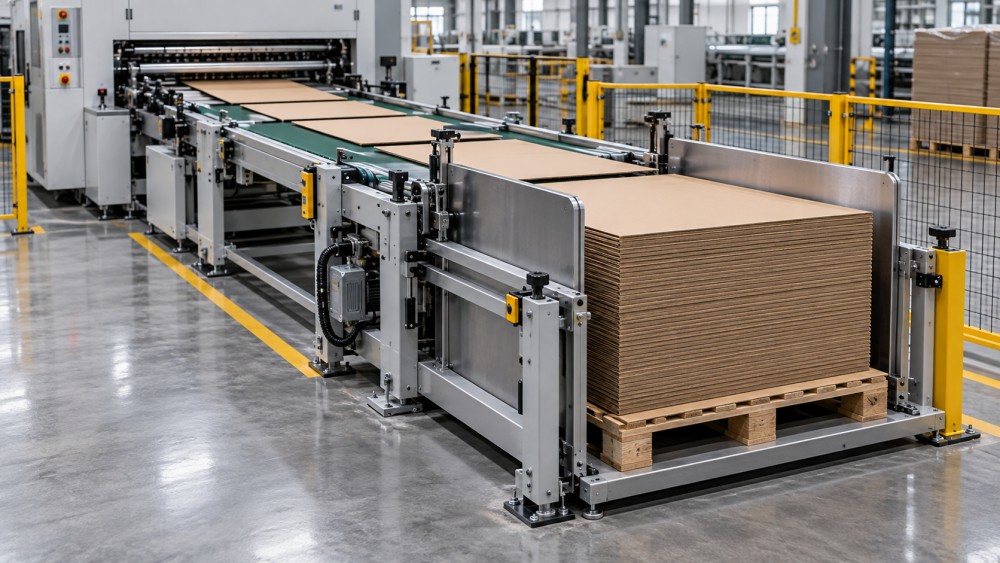
The physical layout deserves an early review. Space for a conveyor is only part of the requirement; the installation also needs room for pile removal, jam clearance, maintenance, and safe personnel access. A compact proposal can lose its commercial advantage if normal operation blocks a forklift route or makes routine service difficult.
Ask for evidence of sustained, usable performance
A maximum speed figure has limited value without its operating conditions. Sheet dimensions, material stiffness, cut pattern, stack height, and pile-change method can all affect delivery performance. Ask the manufacturer to state the conditions behind its quoted capacity and distinguish mechanical capability from sustained production output.
The practical measure is acceptable output over a defined period. A system that briefly reaches the required speed but frequently needs sheet repositioning may deliver less useful production than one operating steadily at a lower speed. The trial should therefore record interruptions, damaged output, and operator intervention alongside running speed.
Build the trial around jobs that expose handling limits
Use representative production materials wherever possible. Include a normal high-volume job, a demanding format or material, and a job that tests changeover. If the factory processes both solid board and corrugated products, do not assume that a successful demonstration on one proves suitability for the other.
Agree the test conditions before placing the order. Relevant acceptance measures can include:
- Good output: acceptable sheets or blanks produced during an agreed run, including routine pile changes.
- Product condition: limits for marking, bent corners, damaged creases, crushed flutes, or other defects relevant to the product.
- Stack quality: alignment, stability, count accuracy, and suitability for transport or the next process.
- Operating effort: staffing, manual adjustments, jam clearing, and assistance required during normal operation.
- Changeover: the work and elapsed time needed to move between agreed jobs, including adjustment and restart.
Each measure needs a definition that both parties can inspect. “Neat stacks” is too subjective for a contract. Identify which edges must align, how alignment will be checked, and what downstream operation must accept the stack. Likewise, specify whether a changeover ends at the first delivered sheet or when acceptable production is stable.
Separate existing material defects from damage introduced by handling. Trial stock may arrive curled, warped, or inconsistently cut. Record its condition before the test so that neither party attributes every problem to the wrong source. The manufacturer should also explain the incoming-material limits within which it commits to performance.
Evaluate the manufacturer's reasoning, not just the demonstration
A useful supplier explains why a proposed arrangement suits the application, where performance may fall, and which adjustments an operator will need. A polished demonstration on easy stock provides less decision value than a documented trial that reveals how the system handles your difficult work.
Comparable references can strengthen that evidence. Ask about installations with similar materials, die-cutter configurations, and delivery requirements. Where a reference visit or conversation is available, focus on routine operation: recurring stops, adjustment effort, access for maintenance, and service response. A broad installed base does not by itself prove suitability for a particular application.
Make integration responsibility explicit
A capable standalone delivery unit can still produce a disappointing line if transfers and controls are poorly coordinated. Before selecting a delivery system manufacturer, establish who is responsible for the complete connection from the die-cutter exit to the agreed delivery endpoint.
Mechanical compatibility includes transfer height, sheet support, available space, foundations, and access. Control compatibility includes speed coordination, ready signals, controlled stops, fault communication, and restart behavior. These interfaces should appear in an agreed technical scope, with responsibilities assigned to the delivery supplier, die-cutter supplier, plant team, and any external integrator.
Ask suppliers to walk through specific operating events. What happens when the delivery section fills, a sheet jams, a pallet is absent, or the downstream conveyor stops? How does the die-cutter respond? Which conditions require an operator reset, and how is an unexpected restart prevented? Such questions reveal whether the proposal addresses a working production line.
For a retrofit, involve the existing machine manufacturer or a competent integration specialist early. Confirm access to the necessary interfaces and documentation before relying on promised synchronization. Changes to an established line may affect support arrangements and require a fresh assessment of the combined machine’s safety functions.
Safety requirements should reflect the installation location and the complete equipment arrangement. Request documentation covering the applicable requirements, guarding, access controls, emergency stops, isolation, and safe recovery from faults. A component certificate alone does not establish that the integrated line is safe.
The supply agreement should also distinguish factory testing from site acceptance. Factory testing can establish equipment capability under controlled conditions. Site acceptance must address the installed interfaces, plant materials, utilities, operators, and output handling. Define who corrects each category of failure, who pays for repeat testing, and what evidence closes an outstanding issue.
This matters especially when several suppliers participate. Without a named party responsible for coordination, a transfer fault can become a prolonged dispute about whether the cause lies in the die-cutter, delivery equipment, controls, or incoming sheets.
Compare the cost of dependable operation
Normalize the quotations before judging value. Check whether each offer includes controls, guarding, installation, commissioning, training, documentation, initial spares, and site acceptance support. Identify any plant work separately, including electrical supply, compressed air, floor preparation, network connections, and alterations to existing equipment.
Then compare operating costs against the same production assumptions. Relevant items include labor, maintenance, wear parts, energy, damaged material, changeover losses, and production interruptions. Avoid assigning savings to every proposed feature automatically. Automatic pile handling, for example, creates value only if it removes a meaningful constraint in the intended operation.
Capacity benefits also need a commercial test. Additional delivery capability produces limited value when the die-cutter, staffing pattern, order book, or next process prevents the plant from using it. Conversely, a modest reduction in delivery-related stops may matter considerably where the die-cutter already constrains profitable output.
Ask finance and production teams to examine more than one operating case. A base case can reflect the expected job mix; a more demanding case can include shorter runs, difficult materials, and higher maintenance requirements. The purpose is to see whether the investment remains acceptable when performance is less favorable than the sales proposal assumes.
Check whether support can restore production
“After-sales support available” is too vague to price into an investment decision. Establish who provides service, where technicians are located, which hours are covered, and how escalation works. Distinguish an acknowledgment of a fault from remote diagnosis and from an on-site response commitment.
Request a recommended spare-parts list with prices, lead times, and the consequences of failure. Pay particular attention to proprietary components and assemblies that cannot be sourced locally. For controls and software, clarify backup access, license terms, remote-support arrangements, and the procedure for recovering from a controller failure.
Maintenance access deserves a practical inspection. Ask the supplier to demonstrate routine cleaning, inspection, adjustment, and replacement tasks. Training should cover fault diagnosis and safe recovery as well as normal operation. A system that depends on specialist intervention for frequent minor issues can undermine the staffing assumptions used to justify it.
For the final shortlist, place each proposal beside the same application brief, trial results, integration scope, and cost assumptions. Resolve mandatory failures before using a weighted commercial score: an attractive price should not compensate for unacceptable product damage, an unresolved safety issue, or an interface the supplier cannot support.
The purchase decision becomes defensible when the selected manufacturer’s commitments are specific enough to test and enforce. Before signing, the buyer should be able to trace each important production requirement to a demonstrated capability, a defined acceptance condition, and a party responsible for delivery. Any gap left between those three becomes a risk the plant will carry after installation.
Related News
 How to Choose a Sheet Feeder for Paperboard ProductionChoose the right sheet feeder for paperboard with practical tips on material handling, line speed, integration, and trials to improve production reliability.Post-Press Kinematics Expert
 How Do Creasing Dies Prevent Cracks in Folded Cartons?Creasing Dies help prevent carton fold cracks through controlled deformation. Discover key tooling factors and practical production tips for cleaner, more consistent folds.Post-Press Kinematics Expert
 How to Prevent Sheet Misfeeds in an Automatic Feeder SystemPrevent automatic feeder system misfeeds with practical checks for sheet alignment, suction, air separation, timing, and double-sheet detection.Post-Press Kinematics Expert
 How Do Non Stop Feeder Piles Reduce Die-Cutter Downtime?Discover how non stop feeder piles reduce die-cutter downtime, improve pile-change efficiency, and keep sheet feeding reliable on long production runs.Post-Press Kinematics Expert
 USITC Advances Trade Probe Into Corrugated Die-Cut BoxesCorrugated die-cut boxes face a USITC trade probe. Explore what the investigations could mean for packaging costs and sourcing.Post-Press Kinematics Expert
 What to Consider When Choosing Heavy Duty Pile TurnersChoosing heavy duty pile turners? Discover how to assess load capacity, substrate handling, safety and operating costs to find the right fit for your production line.Post-Press Kinematics Expert