How Can You Prevent Jams and Damage in a High Speed Carton Ejector?
How Can You Prevent Jams and Damage in a High Speed Carton Ejector?
A single misaligned carton can turn a high speed carton ejector into a source of crushed packaging, repeated stoppages, and costly waste. Prevention starts with consistent feeding, correctly adjusted guides, clean sensors, and ejection timing matched to actual line speed. But when a jam keeps returning, adjusting the ejector alone may not solve it. The fault can begin upstream with uneven spacing or end downstream with a blocked discharge.
The practical approach is to follow the carton through the transfer, identify where control is lost, and change one setting at a time. Safe jam clearing and routine maintenance are part of that process—not separate tasks to address after production becomes unreliable.
Find where the carton first loses control
“Carton ejector” can describe different mechanisms: a pneumatic reject device after inspection, a servo-driven diverter, or an outfeed mechanism transferring cartons from a converting machine. Their adjustments differ. Confirm the mechanism and its approved operating range before changing pressure, stroke, timing, or guide positions.
Observe the process through guarded viewing points or approved camera footage. Does the carton arrive skewed? Does it hit a guide before the ejector moves? Does it leave cleanly, then rebound from the collection area? The final pileup is often downstream of the original fault.
Damage patterns offer useful clues, although they are not proof by themselves:
- A crushed leading corner suggests contact with a guide, transfer edge, or preceding carton.
- A localized side dent may indicate excessive contact force, poor contact position, or inadequate support.
- Repeated scuffing along one edge points toward sustained rubbing or a damaged guide surface.
- Two cartons entering together suggests a feeding or spacing problem rather than simply insufficient ejector force.
Record whether the problem appears after changeover, during acceleration, on a particular board grade, or only after extended running. These details narrow the investigation much faster than describing every stop as an “ejector jam.”
Stabilize feeding before adjusting the discharge
An ejector needs a predictable arrival position and enough separation to complete its action without contacting the next carton. Irregular gaps can make correct timing appear inconsistent. Check the feeder, upstream belts, transfer rollers, and any acceleration section responsible for establishing carton pitch.
Pay attention to the material as well. Warped blanks, protruding flaps, incompletely formed folds, glue contamination, and variation in folded thickness can change how a carton tracks. A recipe that worked on a previous order may not suit a similar-looking carton made from a different board construction.
If only one batch causes trouble, compare its dimensions, flatness, fold condition, and surface characteristics with an accepted sample. Do not compensate for an out-of-specification carton by progressively tightening guides or increasing impact force. That can hide the original defect while introducing new damage.
For an inspection-triggered reject system, confirm that the machine can handle the expected rejection pattern. Rejecting one isolated carton is different from rejecting consecutive cartons. Actuator recovery, carton spacing, and reject-lane capacity all need to support the application within the manufacturer's limits.
Set guides for control, not compression
Guides should keep the carton on its intended path without continuously squeezing it. Excessively tight settings create drag, distort panels, and make small dimensional variations more disruptive. Excessive clearance allows rotation before the carton reaches the ejection point.
Use the manufacturer's setup method and clearance requirements for the carton format. Check the full path, not just the entrance. A guide can appear correct at the infeed while converging farther downstream. Inspect mounting brackets, joints, worn surfaces, and exposed edges that could catch a flap.
At the transfer itself, look for unsupported gaps and height differences. A leading edge can dip into a gap or strike a raised receiving surface. Where belts provide support, their condition and alignment matter as much as the side guides.
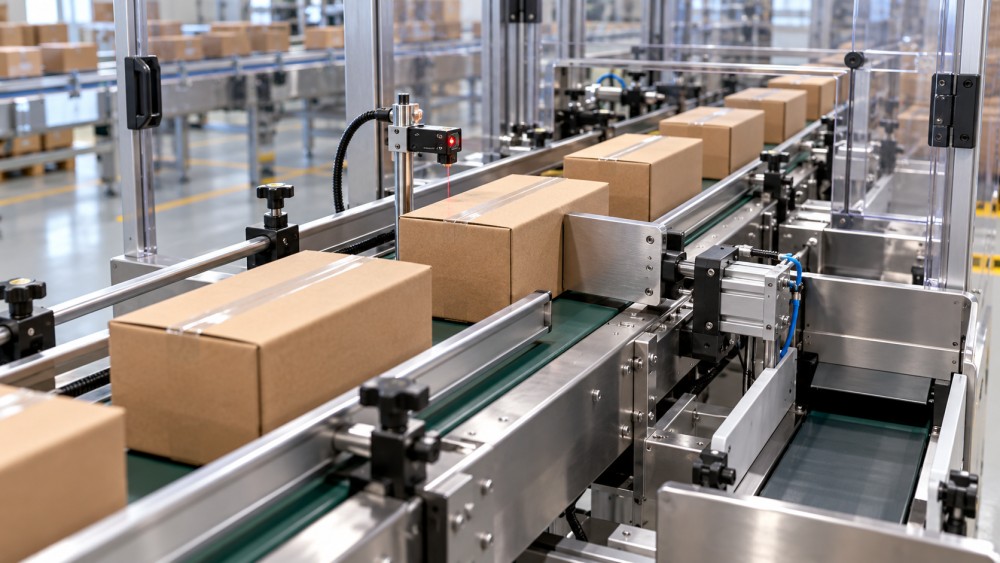
Contact position also matters. A pusher acting on an unsupported flap or weak panel can crease the carton even when its force is otherwise appropriate. Changes to pusher geometry, contact pads, or support arrangements should be reviewed with qualified maintenance personnel or the equipment supplier.
Match sensing and ejection timing to actual movement
A carton can be detected correctly and still be ejected incorrectly. The controller must associate the detection event with the carton’s arrival at the discharge point, while accounting for actuator response. Belt slip, unstable spacing, or an incorrect format recipe can disturb that relationship.
Start with basic sensor checks: clean optical surfaces using the approved method, confirm secure mounting, inspect reflectors where fitted, and verify reliable detection across the actual carton surfaces. Glossy coatings, dark print, cutouts, or changing flap positions can affect some sensing arrangements. Do not assume a flashing indicator proves reliable detection at production speed.
Fixed time-delay systems need particular attention when speed changes. Encoder-based tracking can account for conveyor movement, but it still depends on correct configuration and a valid relationship between measured travel and carton travel. Operators should not alter encoder scaling or control logic to compensate for a mechanical problem.
Test adjustments using the approved commissioning or setup procedure, with guards and safety functions active. Check performance at permitted lower speeds, then increase speed in controlled stages. Include acceleration and deceleration where the machine is designed to eject during those conditions.
For pneumatic systems, maintenance should assess air supply stability during repeated cycles, not just the pressure shown while idle. Restricted flow, leaks, valve problems, or slow return motion may cause intermittent failures. Increasing pressure is not a substitute for diagnosis and can increase carton damage.
Keep the receiving area from becoming the next obstruction
A correctly ejected carton still needs somewhere to go. A full reject bin, a poorly positioned chute, or a slow receiving conveyor can cause cartons to rebound into the product stream. Check discharge clearance under realistic operating conditions, including consecutive rejects and the largest approved format.
Where fitted, verify bin-full detection, reject confirmation, and downstream availability signals using the manufacturer's test procedure. An ejection command alone does not establish that the intended carton actually left the line. This distinction matters when rejecting cartons for unreadable codes, printing defects, or other quality failures.
Do not redirect rejects back into production without the required quality checks. If carton identity becomes uncertain after a jam or failed rejection, contain the affected output according to the plant's traceability procedure.
Clear jams safely—and preserve the evidence
Never reach into a moving ejector or bypass an interlock to pull out a trapped carton. An emergency stop is not energy isolation. Before accessing hazardous areas, follow the machine-specific procedure and the site's lockout/tagout requirements, including isolation of electrical and pneumatic energy, control of stored energy, and verification of the safe state. Authorized personnel should perform this work.
Before removal, document the jam position from a safe location if practical. Retain a damaged sample and note the active recipe, operating speed, fault message, and recent changes. Once the cartons have been pulled apart, the original contact sequence can be difficult to reconstruct.
After clearing, inspect for torn board, adhesive deposits, displaced guides, and damaged components. Restore guards and complete the prescribed restart checks. Repeatedly restarting into the same fault is not troubleshooting; it adds waste and may worsen mechanical damage.
Make the next shift less dependent on trial and error
Useful preventive maintenance focuses on the components that determine carton position and actuator response. Follow the manufacturer's intervals for belts, rollers, bearings, fasteners, pneumatic components, and lubrication. Keep dust and glue away from sensors and contact surfaces using approved cleaning methods; avoid spreading debris into mechanisms.
Save validated format settings with enough detail to reproduce them: carton orientation, guide references, approved speed range, timing recipe, and relevant material characteristics. Record changes rather than overwriting a working setup without explanation.
A short stoppage log should distinguish feed faults, mistimed ejections, discharge blockages, and carton damage. Track saleable output alongside operating speed. A high speed carton ejector running slightly slower but consistently may support better shift output than one repeatedly stopping at its nominal maximum.
Global Commercial Print & Corrugated Packaging Intelligence (CPCS) covers converting equipment, inspection, and factory automation as connected production systems. That perspective is useful here: an ejector should be evaluated with its feeder, inspection trigger, receiving conveyor, and maintenance requirements—not as an isolated mechanism.
If faults remain after basic checks, give maintenance or the supplier a specific problem statement: the affected format, material, speed, failure frequency, alarm history, and safely captured evidence. Ask them to confirm the approved operating envelope and tracking configuration. That gives the investigation a sounder starting point than another increase in pressure or another unrecorded timing adjustment.
Related News
 How to Choose a Sheet Feeder for Paperboard ProductionChoose the right sheet feeder for paperboard with practical tips on material handling, line speed, integration, and trials to improve production reliability.Post-Press Kinematics Expert
 How Do Creasing Dies Prevent Cracks in Folded Cartons?Creasing Dies help prevent carton fold cracks through controlled deformation. Discover key tooling factors and practical production tips for cleaner, more consistent folds.Post-Press Kinematics Expert
 How to Prevent Sheet Misfeeds in an Automatic Feeder SystemPrevent automatic feeder system misfeeds with practical checks for sheet alignment, suction, air separation, timing, and double-sheet detection.Post-Press Kinematics Expert
 How Do Non Stop Feeder Piles Reduce Die-Cutter Downtime?Discover how non stop feeder piles reduce die-cutter downtime, improve pile-change efficiency, and keep sheet feeding reliable on long production runs.Post-Press Kinematics Expert
 USITC Advances Trade Probe Into Corrugated Die-Cut BoxesCorrugated die-cut boxes face a USITC trade probe. Explore what the investigations could mean for packaging costs and sourcing.Post-Press Kinematics Expert
 What to Consider When Choosing Heavy Duty Pile TurnersChoosing heavy duty pile turners? Discover how to assess load capacity, substrate handling, safety and operating costs to find the right fit for your production line.Post-Press Kinematics Expert