When Wear Resistant Glue Rollers Deliver a Lower Total Cost
A premium roller earns its place when wear at the glue interface is creating costs that extend beyond the part itself. The relevant comparison is the cost of maintaining a stable adhesive film over the roller's useful life, not the invoice price of a replacement roller. Wear resistant glue rollers tend to produce a lower total cost where abrasive adhesive solids, extended running hours, frequent washdowns, or sensitive bond-quality requirements make surface deterioration a recurring production problem.
That conclusion is conditional. A durable coating or harder surface will not correct poor adhesive preparation, incorrect nip loading, damaged bearings, shaft misalignment, or a cleaning method that attacks the roller surface. It delivers economic value when wear is genuinely the limiting mechanism and the selected construction matches the adhesive, temperature, line speed, and contact arrangement.
Start with the cost created by surface change
A glue roller gradually changes its working behavior before it fails visibly. Surface roughness can become uneven, a coating can lose thickness at high-contact zones, and deposits can accumulate in worn areas. The result is often an inconsistent adhesive film rather than an immediate stoppage. On a corrugator, this may appear as variable bonding across the sheet, edge lift, delamination after converting, or a need to compensate by applying more starch adhesive. On folder-gluing equipment, the symptom may be irregular bead transfer, stringing, skips, or glue spread beyond the intended flap.
These symptoms are easily misread. A weak bond can originate from moisture imbalance, insufficient heat transfer, adhesive viscosity, paper absorbency, flute formation, machine speed, or compression settings. Yet a roller that no longer meters evenly can amplify each of those variables. Extra adhesive is then used as a practical response to instability, even though it may introduce warp, longer drying demand, contamination, or a higher cleanup burden.
The cost model should therefore include four linked effects:
- Material loss: excess adhesive applied to maintain a margin against missed coverage, plus board or cartons rejected when the bond remains unreliable.
- Interrupted production: cleaning, adjustment, roller replacement, restart work, and the production capacity lost while the line returns to stable output.
- Quality containment: additional inspection, sorting, rework, or downstream disruption when poor adhesion is found after printing, die-cutting, folding, or shipment preparation.
- Component-cycle cost: the roller, coating renewal where applicable, freight, spare holding, installation labor, and the practical life obtained between interventions.
A less expensive roller can remain the rational choice when it runs lightly, contacts a clean low-abrasion adhesive, and is exchanged during planned service without affecting throughput. The higher-specification option becomes financially stronger when each replacement creates a meaningful production interruption or when gradual wear forces continuous process compensation.
Where the case is strongest
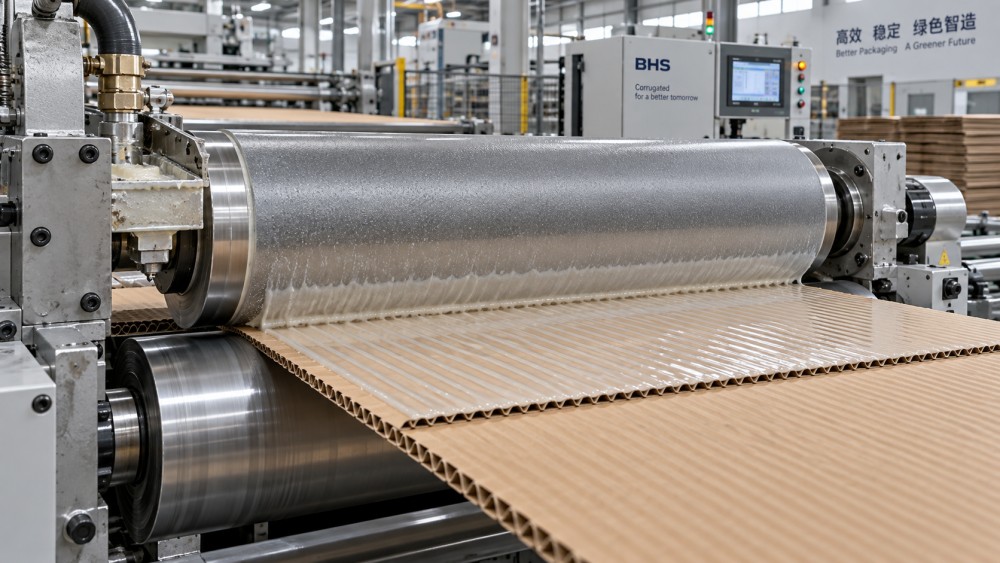
Corrugated board production commonly presents a demanding environment because starch systems contain solids and the adhesive film must remain controlled through long operating periods. A metering or applicator surface that wears unevenly can alter pickup and transfer across the machine width. The problem may be most apparent at the edges, in recurring order widths, or where local loading is greater. A broad average check can miss those zones, so width-wise evidence matters more than a single visual assessment.
High output also changes the economics. A roller changed on a low-utilization line during a scheduled pause has a different cost from one whose condition causes a disruption during a committed production window. The premium for wear resistance is easier to justify when loss of stable running includes paper consumption, adhesive correction, setup time, and delayed downstream converting rather than only maintenance labor.
Short production runs can also favor longer-lasting surfaces, although for a different reason. Frequent order changes increase washdown exposure and create more opportunities for operators to remove dried adhesive mechanically. If the selected surface tolerates the approved cleaning method and retains a consistent finish, it reduces the chance that routine cleaning becomes the dominant source of roller damage. That advantage disappears if abrasive tools or unsuitable chemicals are still used.
For folding-carton and specialty gluing processes, the decision often turns on transfer precision rather than sheer volume. A worn roller may create a narrow defect that does not stop the machine but weakens certain flap areas or contaminates visible carton surfaces. Where glue placement is close to a score, window, printed area, or food-contact barrier structure, a small transfer variation can become a high-cost quality issue. The appropriate surface must still suit the adhesive system; hardness alone does not establish compatibility with hot melt, cold glue, starch, or water-based formulations.
Do not compare hardness alone
Wear resistance is a system property. A hard surface may resist abrasion while being poorly suited to impact, thermal cycling, corrosion, or the required adhesive release behavior. Conversely, a compliant covering can provide useful transfer characteristics in an application that would suffer from an excessively hard, low-compliance surface. The specification needs to define what is wearing, how it wears, and what performance must remain unchanged.
Surface roughness figures also need context. A value that appears precise does not prove that a surface will meter a particular adhesive correctly. Adhesive solids, temperature, viscosity control, roller speed ratio, doctoring arrangement, and the mating roller all influence transfer. The useful question is whether the finish remains within a known functional range after real cleaning and running conditions, not whether the initial surface has an impressive specification.
Separate roller wear from upstream process drift
A sound approval review should avoid charging every bonding defect to the roller. Begin with the time pattern. Defects that develop gradually over many shifts, worsen at commonly used web widths, and improve after roller replacement support a wear-related explanation. Defects that appear immediately after an adhesive batch change, steam adjustment, paper-grade change, or speed increase point first to process conditions.
Width pattern is equally informative. A consistent center-to-edge difference can indicate cross-machine adhesive distribution, roller deflection, incorrect nip setting, or a profile issue. Random skips may be associated with contamination, dried adhesive, air entrainment, or a damaged local surface. A repeating mark at the roller circumference suggests eccentricity, localized damage, or buildup that returns with each rotation. These are distinct failure modes and should not be addressed with a generic “more durable” specification.
Inspection should combine the removed roller with its operating record. Photographing the surface after controlled cleaning, mapping worn areas across the face, noting deposits, and checking runout can establish whether the failure is abrasion, corrosion, mechanical scoring, coating separation, or distortion. Record adhesive type, solids condition, temperature range, cleaning chemistry, speed range, and operating hours since installation. Without that context, a replacement decision can simply repeat the prior mismatch.
Translate service life into an investment comparison
The calculation does not require invented precision. It needs consistent boundaries. Set the comparison period to a useful operating horizon, then include the expected number of roller interventions under each option. For each intervention, assign the full internal cost of planned or unplanned downtime, labor, cleanup, disposal or repair, inspection, and restart scrap. Add the recurring cost linked to unstable application, such as adhesive overuse or downgraded output, only where production records support it.
A practical expression is:
Total relevant cost = acquisition and freight + installation and commissioning + intervention cost across the period + documented process loss + residual repair or disposal cost.
The equation is simple; the assumptions determine its credibility. Installation cost should include the time required to restore alignment and settings, rather than only the physical exchange. Process loss should reflect the material and time used before normal bonding is confirmed. If a roller is re-coated, compare the total turnaround and restored geometry with a new roller, not merely the re-coating invoice.
A useful sensitivity test asks what must occur for the premium to pay back. For example, the durable option may be justified if it eliminates one unplanned exchange within the comparison period, reduces a persistent adhesive allowance, or avoids a quality hold at a costly stage of production. If the result only works under an optimistic lifespan assumption, the proposal should state that clearly and retain a lower-cost alternative for low-duty positions.
Installation can protect or erase the expected benefit
Rollers are often damaged indirectly. A new wear-resistant surface fitted to worn bearings, misaligned housings, or incorrect journal supports can experience edge loading and localized scoring from its first production run. Excessive contact pressure intended to solve poor adhesive transfer can accelerate wear and distort the very metering behavior the roller was meant to stabilize.
Before release to production, confirm journal condition, bearing fit, axial location, parallelism with the mating element, rotation direction where surface design is directional, and clearance or nip settings. Use clean handling practices: a hard coating still suffers when it is struck, dragged across a contaminated bench, or stored without face protection. Incoming inspection should verify dimensions and surface condition before the roller enters the machine, because transport damage discovered after installation creates avoidable diagnostic work.
Cleaning deserves its own operating standard. Dried starch adhesive or cold glue should be removed using methods compatible with the roller material and coating. Metal scrapers, uncontrolled abrasive pads, and prolonged chemical exposure can damage a surface that was selected specifically for longer wear life. A documented cleaning interval, approved tools, and a short post-cleaning visual inspection preserve the value of the component more reliably than a vague instruction to keep it clean.
Use a qualified trial rather than a price-only substitution
When operating conditions are uncertain, a controlled production trial provides stronger evidence than comparing catalogue claims. The trial roller should be installed with verified alignment and used on representative grades, adhesive conditions, speeds, and order patterns. Baseline records should cover adhesive consumption, bond-related rejects, cleaning frequency, downtime events, and observations of surface condition. The comparison must use the same measurement method before and after installation; otherwise an apparent improvement may only reflect a changed reporting practice.
Acceptance should focus on functional stability over time. Initial bond quality alone is insufficient because almost any new roller can appear satisfactory during the first run. The more revealing question is whether the adhesive application remains stable after the cleaning cycles and operating exposure that previously produced drift.
A durable glue roller lowers total cost when it reduces a verified source of variation and keeps that improvement in service long enough to outweigh its additional acquisition cost. Where the real constraint lies in adhesive preparation, machine geometry, or cleaning discipline, those conditions need correction first. The strongest investment case is built from the specific failure mechanism, the cost of each disruption, and evidence that the proposed surface will remain suitable for the actual production environment.
Related News
 How Steam Joints for Corrugator Rolls Prevent Heat LossSteam joints for corrugator rolls prevent heat loss, stabilize roll temperatures, improve condensate drainage, and support consistent board quality. Learn key maintenance practices.Corrugated Thermodynamics Architect
 When to Replace Single Facer Rolls to Prevent Corrugator DowntimeReplacement single facer rolls: learn the warning signs, inspection steps, and planning strategies that prevent corrugator downtime and protect board quality.Corrugated Thermodynamics Architect
 When Replacement Single Facer Rolls Can Restore Board QualityReplacement single facer rolls can restore flute definition, bonding consistency, and board quality. Learn when replacement helps reduce waste, stabilize production, and protect uptime.Corrugated Thermodynamics Architect
 When Wear Resistant Glue Rollers Deliver a Lower Total CostWear resistant glue rollers can reduce total cost by improving adhesive film stability, minimizing downtime, waste, and bond-quality risks.Corrugated Thermodynamics Architect
 When Should You Replace Industrial Single Facer Rolls?Industrial single facer rolls: discover the warning signs that demand replacement, from profile wear and runout to heat loss, quality defects, waste, and costly downtime.Corrugated Thermodynamics Architect
 When Should Corrugating Rolls Be Replaced?When should corrugating rolls be replaced? Discover key wear signs, inspection methods, and cost-saving steps to protect board quality, bonding, and uptime.Corrugated Thermodynamics Architect