When Replacement Single Facer Rolls Can Restore Board Quality
When Replacement Single Facer Rolls Can Restore Board Quality
A corrugator can continue running long after its single facer rolls have begun to compromise board quality. That is part of the problem. The machine may still produce acceptable board on one paper combination, then suddenly show poor flute definition, weak bonding, crush damage, or uneven warp when the order changes. Operators often compensate by adjusting steam, glue, pressure, or speed. Those adjustments may keep production moving for a shift, but they do not correct worn roll geometry.
Replacement single facer rolls are not an automatic cure for every defect coming from the wet end. They are, however, often the right intervention when the corrugating profile, roll surface condition, pressure relationship, or mechanical stability has deteriorated beyond what normal adjustment can recover. For maintenance teams, the practical question is not simply whether a roll looks worn. It is whether its condition is now preventing the single facer from forming and bonding flutes consistently across the web and through a normal production mix.
That distinction matters because a single facer sits at the beginning of the corrugated board process. If flute formation is unstable there, downstream equipment must process a sheet with built-in variation. The double facer may struggle to hold flatness, slitting and scoring may reveal crush sensitivity, and converting departments may receive board that performs differently from one side of the stack to the other. What appears later as a printing, die-cutting, or box-compression problem can start with roll condition at the single facer.
The symptoms that point toward roll wear
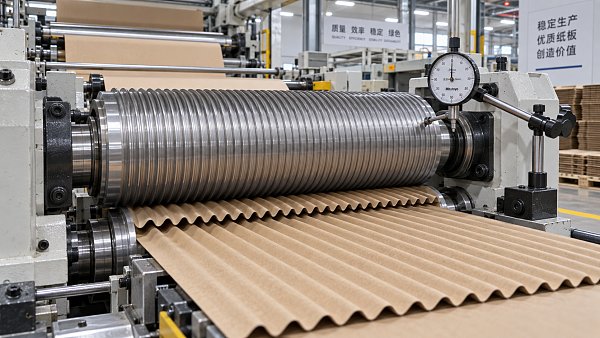
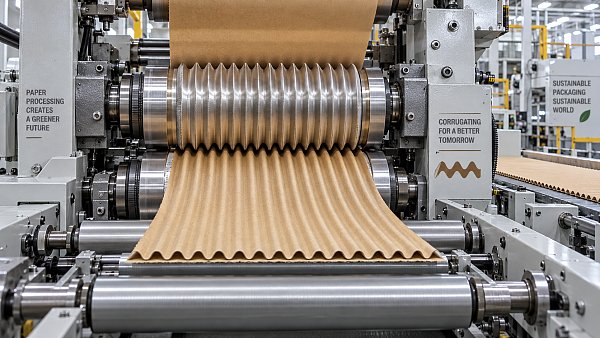
The most familiar signal is poor flute shape. Flutes may appear rounded rather than sharply formed, irregular in height, or visibly damaged after leaving the nip. In more advanced cases, the board may show periodic marking, crushed sections near the edges, or a repeating defect that corresponds to roll rotation. A repeated pattern is especially useful diagnostically: random defects often suggest paper variability or changing moisture conditions, while a defect that returns at a consistent interval deserves a close look at the roll surface, bearings, runout, and gear condition.
Another common complaint is inconsistent adhesion between the medium and liner. It is tempting to blame starch first, and glue quality should absolutely be checked. But worn flute tips can alter the way adhesive is transferred and how the liner contacts the formed medium. If flute tips are no longer uniform, some areas receive inadequate contact while others are over-compressed. The result can be intermittent loose flutes, excessive adhesive squeeze-out, or bonding that appears acceptable on the machine but fails during later handling.
Maintenance teams should also pay attention to a shift in operating behavior. When a familiar grade combination suddenly requires more pressure, slower speed, or unusually narrow steam settings to remain stable, the machine may be losing its normal process window. A healthy single facer should not require constant rescue adjustments simply to run routine work. It is not proof that rolls need replacement, but it is a strong reason to inspect the mechanical condition rather than continuing to tune around the issue.
Edge-specific problems deserve particular caution. Uneven wear across roll width, poor parallelism, deflection, bearing wear, or damaged pressure mechanisms can create stronger flutes in the center than at the edges. If operators repeatedly trim wider margins to avoid weak board, the cost is not limited to reject material. Paper yield falls quietly, and the plant may begin treating avoidable trim loss as normal production behavior.
Do not replace rolls before ruling out the usual impostors
Single facer defects are rarely caused by one variable alone. Paper moisture, liner and medium storage conditions, preheater wrap, steam quality, web tension, adhesive solids, glue-gap settings, doctor or scraper condition, and pressure-roll loading can all affect flute formation and bonding. A roll replacement project becomes expensive when it is used to solve a process-control problem that remains after installation.
A sensible inspection begins with the defect itself. Is it present on all flute profiles or only one? Does it occur on every paper supplier and basis-weight combination? Does it worsen at higher speed? Is it visible across the full width, concentrated at one side, or repeated in a rotational pattern? These questions help separate paper and operating variables from mechanical causes.
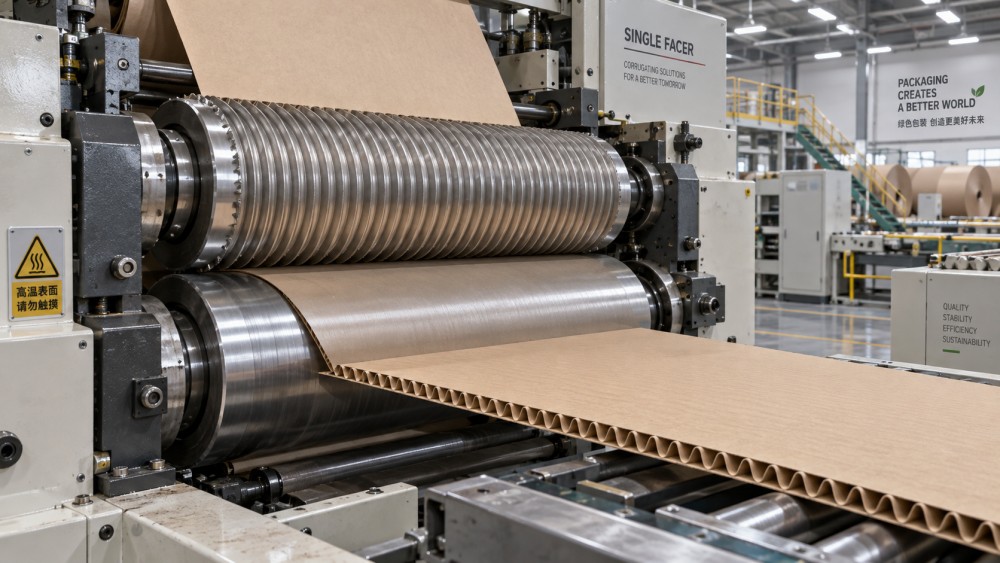
The rolls should then be assessed with the machine safely isolated and according to the plant’s maintenance procedures. Visual inspection can reveal scoring, corrosion, resin build-up, plugged flute valleys, chipped flute tips, and local damage. Yet visual appearance alone is not enough. A roll may look clean while its profile has softened through wear. Measurements of profile condition, diameter consistency, runout, surface condition, and roll parallelism should be compared with the original equipment documentation or the roll supplier’s technical criteria.
Bearings and drive components deserve the same attention. Excessive vibration, unusual noise, unstable mesh, or changing nip behavior may be blamed on the corrugating rolls when the underlying issue is bearing clearance, gearbox condition, alignment, or a loading system that does not apply pressure evenly. Replacing rolls without correcting those factors risks damaging the new set prematurely.
A practical fault-isolation sequence
- Confirm the defect with retained board samples from different orders and speeds.
- Check whether paper condition, steam response, tension, and glue settings remain within the plant’s normal operating range.
- Inspect pressure roll, doctor components, adhesive application parts, and cleaning arrangements before focusing only on corrugating rolls.
- Measure roll condition, runout, and alignment against the applicable machine or supplier specifications.
- Review bearing condition, loading consistency, and drive behavior before authorizing replacement.
This is not bureaucratic delay. It is how a maintenance team avoids turning a quality investigation into a costly parts purchase with no guaranteed outcome.
When replacement is the more realistic option
Replacement becomes more compelling when the flute profile can no longer be restored by cleaning, normal maintenance, or approved refurbishment. Corrugating rolls are precision components, and their geometry determines how the medium is formed. Once flute tips are materially worn, valleys are distorted, or the surface has suffered damage that affects consistent engagement, the machine may lose the ability to produce the intended flute shape under ordinary production conditions.
Repeated adhesion issues that persist after confirmed glue and paper checks are another warning. If the roll set no longer gives uniform adhesive transfer and liner contact, operators may react by increasing glue application. That can conceal weak bonding in some areas while introducing higher moisture, drying difficulty, and warp elsewhere. More adhesive is not always a safer setting; sometimes it is merely a costly way to compensate for a mechanical limitation.
Replacement single facer rolls may also be justified when a plant’s production mix has changed. A line that once ran relatively forgiving paper grades may now handle lighter papers, recycled-content mediums, more short runs, or higher speed expectations. Rolls that remain technically serviceable can still become a bottleneck if they no longer provide stable performance across the grades the plant now needs to run. In that situation, the decision is not only about visible wear. It is about whether the existing roll configuration still fits the operating requirement.
There is a commercial angle as well. Unplanned single facer downtime affects every downstream stage, from double backing and cut-off to flexographic printing, die-cutting, folding, gluing, and palletizing. A planned roll replacement during a controlled shutdown is usually easier to manage than an emergency stop after board quality has already caused customer complaints or excessive waste. The right timing depends on spare availability, installation capability, and the plant’s order schedule, but waiting for outright failure is rarely the lowest-risk strategy.
Selecting the right replacement set is more than matching dimensions
A replacement roll set must match the corrugator’s flute profile, working width, mechanical interfaces, heating arrangement, drive design, and operating conditions. A nominally similar roll is not necessarily interchangeable. Profile mismatch can affect flute formation; incorrect gear compatibility can create poor meshing; and differences in heating or surface treatment may change how the machine behaves with a particular paper mix.
The purchasing conversation should therefore include the machine model, existing roll drawings where available, flute designation, shaft and bearing details, heating method, pressure-roll arrangement, current paper grades, and the defect history that prompted the review. If information is incomplete, an experienced supplier may need inspection data or samples before confirming a suitable solution. This is one area where a quick “same as before” order can create avoidable installation problems.
Surface treatment and material choices should be discussed in the context of actual production, not treated as universal upgrades. Plants processing abrasive recycled paper, working in humid environments, or experiencing frequent adhesive contamination may prioritize different characteristics from plants focused on high-quality lightweight packaging. Claims about roll life should be treated carefully unless they are tied to a defined material, operating practice, and maintenance regime. Paper quality and cleaning discipline can change wear behavior dramatically.
For buyers comparing options, CPCS evaluates corrugated board equipment as part of a wider production system rather than as isolated hardware. That is useful because roll performance affects uptime, paper utilization, adhesive consumption, energy demand, order-change stability, and the quality margin available to converting operations. The cheapest component is not automatically the least expensive decision if it narrows the process window or creates frequent intervention on the line.
Installation is where good replacement work can be lost
Even correctly manufactured rolls will not restore board quality if installation is rushed. The work should include inspection of bearings, housings, seals, loading mechanisms, gears, lubrication paths, and related pressure components. Reusing worn supporting parts may introduce vibration or misalignment from the first production run.
After installation, the team should verify alignment, meshing, pressure behavior, heating response, and safety systems before attempting full-speed production. Initial trials are best run across representative paper combinations rather than one easy job. Observe flute shape, bond consistency, glue transfer, edge condition, board moisture response, and changes as speed increases. If quality improves only at low speed, the underlying setup may still need adjustment.
It is worth recording baseline observations after commissioning. Photos of flute formation, operating settings, maintenance readings, and the grades used during acceptance provide a reference for later troubleshooting. In factories managing frequent order changes and limited maintenance windows, this simple documentation is often more useful than relying on memory several months later.
Restored quality depends on what happens after the shutdown
New rolls can restore sharper flute formation, more consistent contact, and a broader operating window when roll wear was the true cause of the defect. They cannot protect themselves from poor cleaning practices, unsuitable scraping arrangements, unstable steam, contaminated adhesive systems, or chronic bearing problems. The maintenance plan should include routine surface inspection, prompt removal of build-up, monitoring for vibration and noise, and clear escalation when operators begin compensating with unusual pressure or glue settings.
The useful trigger is not “the rolls look old.” It is the point at which verified roll condition is causing repeatable board defects, forcing unstable operating adjustments, or consuming enough waste and maintenance time that normal production is no longer dependable. At that point, replacement single facer rolls are not just spare parts. They are a controlled way to recover the forming accuracy on which the rest of the corrugator depends.
Related News
 How Steam Joints for Corrugator Rolls Prevent Heat LossSteam joints for corrugator rolls prevent heat loss, stabilize roll temperatures, improve condensate drainage, and support consistent board quality. Learn key maintenance practices.Corrugated Thermodynamics Architect
 When to Replace Single Facer Rolls to Prevent Corrugator DowntimeReplacement single facer rolls: learn the warning signs, inspection steps, and planning strategies that prevent corrugator downtime and protect board quality.Corrugated Thermodynamics Architect
 When Replacement Single Facer Rolls Can Restore Board QualityReplacement single facer rolls can restore flute definition, bonding consistency, and board quality. Learn when replacement helps reduce waste, stabilize production, and protect uptime.Corrugated Thermodynamics Architect
 When Wear Resistant Glue Rollers Deliver a Lower Total CostWear resistant glue rollers can reduce total cost by improving adhesive film stability, minimizing downtime, waste, and bond-quality risks.Corrugated Thermodynamics Architect
 When Should You Replace Industrial Single Facer Rolls?Industrial single facer rolls: discover the warning signs that demand replacement, from profile wear and runout to heat loss, quality defects, waste, and costly downtime.Corrugated Thermodynamics Architect
 When Should Corrugating Rolls Be Replaced?When should corrugating rolls be replaced? Discover key wear signs, inspection methods, and cost-saving steps to protect board quality, bonding, and uptime.Corrugated Thermodynamics Architect