How to Select High Temperature Steam Joints for Reliable Heat Transfer
A steam joint should be selected as part of the complete heat-transfer system, not as a simple pipe connection. On corrugated board lines, preheaters, single facers, double facers, and other heated rolls depend on a stable supply of steam and effective condensate removal. A joint that matches the nominal pipe size but is poorly suited to rotation speed, condensate load, pressure variation, or roll condition can create leaks, uneven heating, premature seal wear, and avoidable downtime.
The most reliable selection starts with the actual operating envelope: steam pressure and temperature, roll speed, shaft dimensions, connection layout, condensate discharge method, media cleanliness, and expected duty cycle. High temperature steam joints must perform across that full range, including startup, grade changes, short stoppages, and higher-speed production, rather than only under steady design conditions.
Start with the heat-transfer duty, not the joint catalog
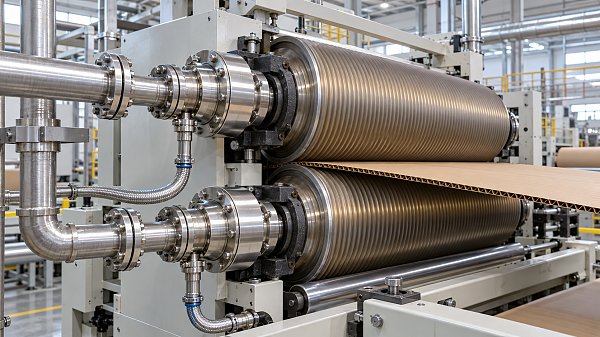
Steam joints are commonly installed on rotating cylinders or rolls where stationary steam piping must connect to moving equipment. Their purpose is not only to admit steam. In many applications, the joint must also support controlled condensate discharge. That return path has a direct effect on heat transfer because condensate remaining inside a roll forms a barrier between the steam and the shell.
For a corrugator, this means a steam joint decision should begin with the heating requirement of each roll position. A preheater may have different speed changes and condensate behavior from a pressure roll or a double facer hot plate system. A joint that works acceptably on one position may be unsuitable for another, even when the process uses the same steam source.
Ask the equipment team for operating, not just nameplate, information:
- Normal and maximum steam pressure at the joint inlet.
- Expected steam temperature, including upset conditions.
- Roll diameter, shaft size, rotational speed, and direction of rotation.
- Whether the joint needs one passage or separate inlet and condensate passages.
- The condensate-removal arrangement inside the roll, such as a siphon system.
- Frequency of acceleration, deceleration, idling, and product changeover.
- Available space for piping, support brackets, maintenance access, and joint replacement.
Without this information, suppliers may quote a joint that is physically compatible but not thermally or mechanically appropriate.
Pressure and temperature ratings must be assessed together
A frequent purchasing error is to compare only the maximum pressure printed in a catalog. Pressure capability matters, but it does not stand alone. Materials, seal geometry, lubricant behavior, and allowable loads can change as temperature rises. A joint should be evaluated against the combined pressure-temperature condition, with room for real operating variation.
Steam systems do not always remain at one stable setpoint. Pressure can change during startup, during production transitions, or when several sections demand heat at the same time. Thermal expansion also changes the alignment of piping and rolls. A joint that is selected too close to its practical limit may appear satisfactory during a short trial but lose sealing stability after repeated thermal cycles.
It is also important to separate process pressure from pressure loss through the complete circuit. A restrictive flow path, undersized supply pipe, unsuitable internal passages, or poor condensate return can reduce the steam available at the roll. The result may be a higher boiler setting without a corresponding improvement in roll temperature. The joint should have sufficient flow capacity for the required heat load while maintaining effective condensate handling.
Choose the flow arrangement around the condensate strategy
Reliable roll heating requires both steam admission and condensate removal. The correct steam-joint configuration depends heavily on how condensate leaves the rotating roll.
A single-flow arrangement may be suitable where steam and condensate share a passage and operating conditions are comparatively simple. It can reduce connection complexity, but its performance depends on the internal roll design and the ability of condensate to leave without obstructing incoming steam. It is less forgiving where line speed changes frequently or where heat demand is high.
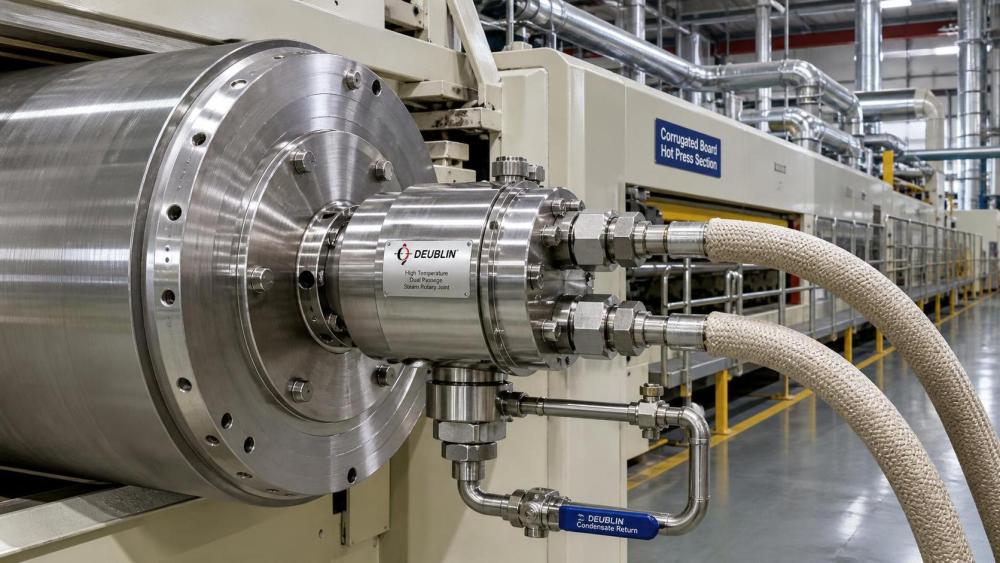
A dual-flow joint provides separate paths for incoming steam and returning condensate. This arrangement is often better suited to controlled roll heating, particularly when an internal stationary or rotating siphon is used. Separating the flows can help maintain steam delivery while moving condensate out of the roll, but it requires correct pairing with the internal piping, rotary union design, and return system.
Do not treat the steam joint and siphon as unrelated purchases. Their compatibility determines whether condensate is removed consistently, especially when production speed, paper grade, or steam demand changes.
Material selection is about corrosion, wear, and thermal movement
The body material of a high temperature steam joint must tolerate heat, pressure, and the surrounding plant environment. However, durability is not determined by body material alone. The rotating components, springs, bearings, seal faces, and elastomeric or graphite-based sealing elements all need to withstand the actual service conditions.
Steam quality has a strong influence on service life. Clean, dry steam reduces the risk of erosion and contamination at sealing surfaces. Wet steam, scale, corrosion products, oil carryover, or particles from poorly maintained piping can damage precision surfaces and accelerate leakage. A durable joint cannot compensate indefinitely for contaminated steam or inadequate filtration and drainage upstream.
Material compatibility should also include the condensate side. Condensate may carry dissolved gases and system contaminants that promote corrosion. Where the plant uses water treatment chemicals or has known water-quality issues, the joint supplier should receive that information along with the temperature and pressure data.
Thermal expansion deserves equal attention. Rigid piping connected directly to a rotating joint can transmit side load as the system heats and cools. A joint may then fail from misalignment or bearing stress rather than from its pressure rating. Proper hose selection, pipe support, expansion allowance, and alignment are part of the steam-joint specification.
Sealing design determines how predictable maintenance will be
Leakage is rarely caused by one factor alone. Seal wear can result from high temperature, dry running, contaminated media, shaft runout, excessive vibration, incorrect installation torque, or external piping loads. The best sealing arrangement is therefore the one that suits the plant's operating behavior and maintenance capability.
Mechanical seals with engineered sealing faces are commonly used where stable performance and low leakage are required. Their value depends on correct alignment and clean operating conditions. Other seal constructions may be appropriate for less demanding service or specific equipment designs, but they should not be judged only by initial purchase price. A lower-cost joint that needs frequent intervention can impose larger costs through lost heat stability, material waste, and unplanned line stops.
When comparing options, request a clear explanation of the wear components and replacement process. The useful questions are practical:
- Can seals and bearings be serviced without removing adjacent piping?
- Are replacement parts identifiable and available through the expected life of the line?
- Does the design allow early detection of leakage before it reaches the machine frame or product path?
- What installation conditions void the expected seal performance?
- Does the joint require a specific mounting orientation or support arrangement?
A repairable design is not automatically the best choice. For critical, continuously operated positions, a more robust cartridge-style or preassembled solution may reduce maintenance variability. For lower-duty locations, straightforward serviceability and spare-part standardization may be more valuable.
Match the joint to mechanical reality at the roll
Steam joints are exposed to more than heat. Rotation, vibration, shaft movement, and pipe weight all affect their life. Before selecting a model, inspect the roll journal, connection face, and surrounding structure. Shaft runout, worn threads, damaged mounting surfaces, or inadequate support can undermine a correctly rated joint.
Connection type must suit the equipment. Threaded, flanged, and proprietary mounting arrangements have different assembly requirements and different tolerance for repeated removal. Do not modify a connection simply to fit an available joint unless the mechanical and thermal consequences have been assessed. Adapters can introduce extra joints, dead zones, flow restrictions, and unsupported mass.
The routing of flexible hoses also matters. Hoses should accommodate thermal movement without pulling laterally on the joint. Their bend radius, length, pressure rating, and connection orientation should be reviewed as an assembly. A steam joint mounted on a perfectly aligned roll can still suffer premature wear when the hose acts as a lever during operation.
Evaluate a proposed joint against production conditions
Selection becomes more reliable when the supplier is asked to respond to the actual application rather than a brief request for a “high-temperature model.” Provide a simple operating sheet for each roll group and ask for confirmation of the proposed configuration, including the steam inlet, condensate outlet, seals, mounting, and internal siphon interface.
For high-speed corrugated board lines, assess the proposal against board-quality risks. Uneven roll temperature can affect paper conditioning, adhesive performance, warp control, and moisture balance. The issue may not appear as an obvious steam-joint failure. It can present as unstable board behavior, inconsistent bonding, extra waste during grade changes, or a need for operators to compensate with unrelated process settings.
This system view is central to the equipment analysis covered by Global Commercial Print & Corrugated Packaging Intelligence (CPCS): steam control, roll heating, material behavior, and uptime should be reviewed as connected production factors. A joint is a relatively small component, but it operates at a point where thermal performance and mechanical reliability meet.
Common selection mistakes that create avoidable failures
Choosing by connection size alone. Port size does not prove adequate flow capacity, correct condensate handling, or acceptable mechanical load.
Using maximum ratings as normal operating targets. Continuous operation close to the edge of a joint's temperature-pressure capability leaves little tolerance for transients, wear, and system variation.
Ignoring the condensate return. A steam supply can be correctly sized while poor return conditions leave condensate in the roll and reduce heating performance.
Replacing the joint without addressing alignment or hose loading. When the root cause is external load or shaft condition, the replacement part is likely to repeat the same failure pattern.
Specifying seals without considering steam quality. Contamination and wet steam can shorten seal life regardless of the nominal material specification.
Buying a nonstandard configuration without a spare-parts plan. A specialized joint can be justified, but its service parts, installation method, and lead-time exposure should be understood before it becomes a single-point production risk.
A practical approval sequence
- Document each roll position and its actual operating conditions, including transient conditions.
- Confirm the required steam and condensate flow arrangement with the roll and siphon design.
- Review the combined pressure-temperature condition, not separate maximum values.
- Check materials and sealing components against steam quality, condensate conditions, and plant environment.
- Inspect alignment, shaft condition, piping support, hose routing, and available maintenance space.
- Compare proposed joints by total operating fit: heat stability, leakage risk, service procedure, spare parts, and likely downtime consequences.
- Install with documented alignment and piping-support requirements, then monitor early operation for leaks, abnormal temperature variation, and return-system behavior.
The final decision should be supported by an application-specific configuration, not a generic claim that a joint is suitable for steam. When steam admission, condensate removal, sealing, roll mechanics, and maintenance access are considered together, the selected joint is far more likely to maintain reliable heat transfer throughout normal production changes and long-term operation.
Related News
 How Steam Joints for Corrugator Rolls Prevent Heat LossSteam joints for corrugator rolls prevent heat loss, stabilize roll temperatures, improve condensate drainage, and support consistent board quality. Learn key maintenance practices.Corrugated Thermodynamics Architect
 When to Replace Single Facer Rolls to Prevent Corrugator DowntimeReplacement single facer rolls: learn the warning signs, inspection steps, and planning strategies that prevent corrugator downtime and protect board quality.Corrugated Thermodynamics Architect
 When Replacement Single Facer Rolls Can Restore Board QualityReplacement single facer rolls can restore flute definition, bonding consistency, and board quality. Learn when replacement helps reduce waste, stabilize production, and protect uptime.Corrugated Thermodynamics Architect
 When Wear Resistant Glue Rollers Deliver a Lower Total CostWear resistant glue rollers can reduce total cost by improving adhesive film stability, minimizing downtime, waste, and bond-quality risks.Corrugated Thermodynamics Architect
 When Should You Replace Industrial Single Facer Rolls?Industrial single facer rolls: discover the warning signs that demand replacement, from profile wear and runout to heat loss, quality defects, waste, and costly downtime.Corrugated Thermodynamics Architect
 When Should Corrugating Rolls Be Replaced?When should corrugating rolls be replaced? Discover key wear signs, inspection methods, and cost-saving steps to protect board quality, bonding, and uptime.Corrugated Thermodynamics Architect