How Steam Joints for Corrugator Rolls Prevent Heat Loss
How Steam Joints for Corrugator Rolls Prevent Heat Loss
For a corrugator, heat is not simply a utility cost. It is part of the process control system. The preheater, single facer, double facer, hot plates, and corrugator rolls all depend on stable thermal conditions to prepare paper, activate starch adhesive, and remove moisture at a controlled rate. When heat transfer becomes unstable, operators may see warping, weak bonding, excess moisture, poor flute formation, or a line that needs to run slower than planned.
Steam joints for corrugator rolls sit at a small but sensitive point in that system. They connect stationary steam piping to rotating rolls, allowing steam to enter the roll and condensate to leave without creating a continuous leak path. A worn joint can waste steam visibly, but the more expensive problem is often less obvious: uneven roll temperature, poor condensate removal, and a gradual loss of process stability that gets blamed on paper, glue, or operator settings.
For maintenance teams, the practical question is not merely whether a steam joint is leaking. It is whether the joint, seal arrangement, piping condition, and condensate return system are still allowing the roll to operate as a controlled heat-transfer surface. That distinction matters during troubleshooting, especially on high-speed corrugated board lines where a modest thermal inconsistency can become a quality issue across an entire order.
The real job of a steam joint on a corrugator roll
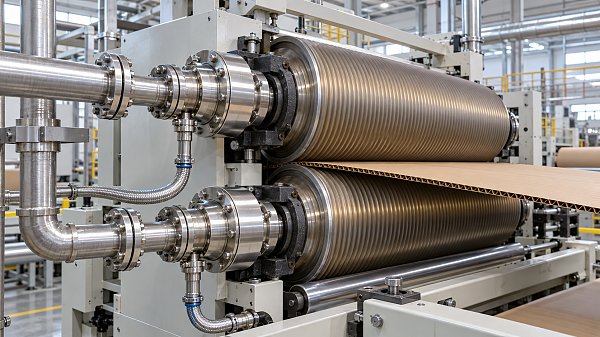
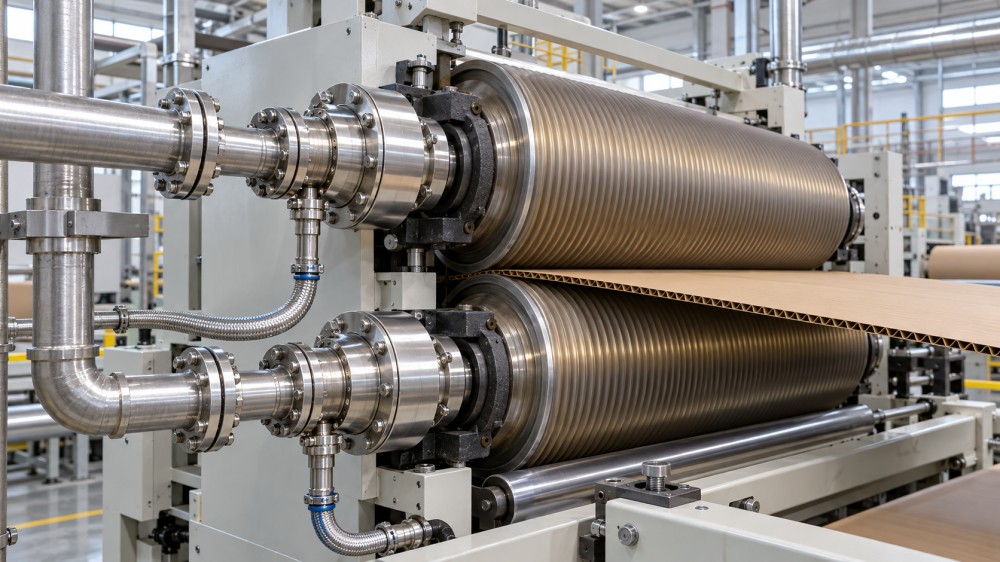
A corrugator roll rotates continuously while the steam supply and condensate return pipes remain stationary. The steam joint, also called a rotary steam joint or rotary union in some equipment documentation, provides the mechanical interface between those two conditions. Depending on the roll design, the assembly may manage a steam inlet only, or separate steam supply and condensate return passages.
Steam enters the hollow roll, releases latent heat as it condenses on the internal surface, and transfers that heat through the roll shell to the paper web. The condensate then needs a reliable route out of the roll. If condensate remains inside, it forms an insulating layer between incoming steam and the roll shell. In other words, the plant may still be consuming steam while receiving less useful heat at the paper-contact surface.
This is why steam joints for corrugator rolls cannot be judged by external appearance alone. A joint may look dry but still contribute to poor drainage if its internal passage, siphon connection, flexible hose arrangement, or associated return line has become restricted. Conversely, a small visible plume may indicate a seal issue, but maintenance should also determine whether the leak is caused by pressure imbalance, shaft misalignment, vibration, damaged sealing faces, or contaminated condensate.
Where heat loss actually occurs
When people discuss heat loss around corrugator steam systems, they often focus only on steam escaping from the joint. That is the most visible loss, but it is not the whole picture. Heat can be lost through poor condensate evacuation, leaking flange connections, uninsulated pipework, failed traps, excessive pressure reduction, or control valves that do not respond properly under changing production conditions.
At the rotary joint itself, leakage means that high-energy steam is leaving the intended closed path before it has transferred useful heat to the roll. The escaping steam may condense around the machine frame, hoses, bearings, or operator access areas. Besides energy loss, this can create corrosion, wet floors, reduced visibility, and burn hazards. A leak that appears minor during a slow run may become more pronounced when the line accelerates or when roll pressure changes during grade transitions.
The less visible loss is thermal inefficiency inside the roll. Condensate should be removed continuously enough to keep the internal heat-transfer area available. If a siphon tube is damaged, incorrectly positioned, or unsuitable for the roll’s operating arrangement, condensate may pool. The roll temperature can then become less uniform around its circumference or across its working width. Operators may compensate by increasing steam pressure, but that is usually a costly response to a mechanical or drainage problem rather than a true process requirement.
A useful troubleshooting distinction
A steam leak is not automatically a steam-joint failure, and a steam-joint failure is not always obvious as a leak. Maintenance work is more effective when the team separates sealing problems from condensate-management problems.
Why seal condition affects board quality, not just utility consumption
Corrugated board production is sensitive to the balance between paper moisture, heat, pressure, and adhesive behavior. A roll that runs cooler than expected may not precondition the liner or medium consistently. A roll with uneven temperature can create local differences in paper response that become harder to correct later in the process.
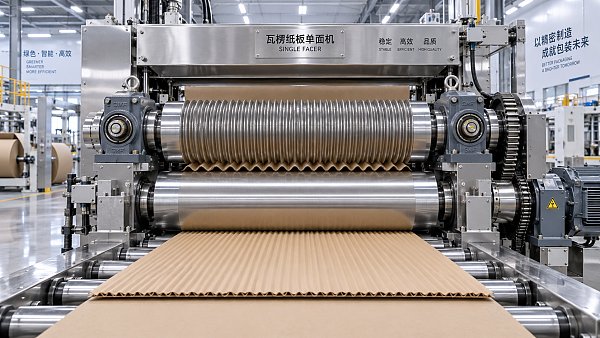
The symptoms are rarely as neat as “joint failure equals one defect.” On the single facer, maintenance teams may hear complaints about inconsistent flute shape, uneven bonding, or sensitivity to paper changes. At the double backer, the issue may appear as moisture variation, warp, or a need for excessive heat settings. The steam joint may not be the only cause, but it belongs in the diagnostic path whenever thermal symptoms accompany steam leakage, unstable condensate return, or recurring pressure adjustments.
This is particularly relevant when running lighter papers, recycled-content grades, or frequent short-run orders. These jobs can leave less operating margin for unstable heating conditions. A plant may get acceptable board from a heavy, forgiving grade while a marginal steam joint becomes obvious only after a change to a more moisture-sensitive combination.
Installation details that decide service life
Many premature rotary-joint failures begin at installation rather than during normal operation. Steam joints are designed to tolerate rotation and thermal cycling, but they are not intended to carry the weight of rigid pipework or absorb uncontrolled hose movement. Unsupported hoses can pull the joint off-axis. Rigid connections can transmit thermal expansion forces. Both conditions can accelerate wear on sealing faces and bearings inside the assembly.
Before replacing a failed unit, technicians should inspect the mounting face, roll journal condition, concentricity, connection threads or flanges, and the condition of the flexible connections. If the old joint shows uneven wear, scoring, or repeated leakage at the same location, simply fitting a new unit may only restart the same failure cycle.
Pressure conditions also deserve attention. A joint selected for one steam pressure range, rotational speed, and condensate-return configuration may not behave well after a line upgrade or process change. Changes to steam supply pressure, control-valve strategy, trap selection, or return backpressure can alter the environment around the joint. The correct replacement should therefore be verified against the corrugator manufacturer’s documentation and the actual operating configuration, not selected only by external dimensions.
Do not overlook the condensate side
A maintenance team may replace seals because of visible leakage, then find that heat performance still does not recover. In that situation, the condensate circuit deserves a closer look. The return line may have restrictions, the trap may be unsuitable for the load, a strainer may be fouled, or differential pressure may be insufficient for reliable drainage. These are system questions, not just component questions.
The internal siphon arrangement also matters. Corrugator rolls may use stationary or rotating siphon concepts depending on machine design. Each arrangement has its own clearance, support, and wear considerations. A bent or loose siphon can affect drainage and may also contact internal surfaces. Maintenance personnel should follow the original equipment guidance for positioning and inspection rather than applying a generic setting from another roll or machine line.
A practical inspection routine for steam joints
Inspection is most useful when it combines operator observations with maintenance checks. Operators often notice a change in noise, steam plume behavior, roll warm-up response, or board consistency before a component reaches obvious failure. Those observations should be recorded with the relevant order, grade, line speed, and steam conditions where possible. A brief log is more useful than relying on memory after several shift changes.
During planned maintenance, inspect for leakage at the joint body and connections, unusual movement of flexible hoses, discoloration from heat exposure, corrosion around fittings, and evidence that condensate has been escaping where it should not. Check that pipe supports allow thermal movement without loading the joint. If safe procedures and site instrumentation permit, compare process behavior between similar rolls rather than judging one temperature reading in isolation.
Any work on a steam system requires proper isolation, depressurization, cooling time, and site lockout procedures. Steam and trapped condensate can release unexpectedly, particularly around valves, joints, and low points in pipework. A joint that looks inactive may still contain pressure or high-temperature condensate. This is not a job for a quick adjustment while the system remains live.
Choosing replacement steam joints with the whole line in mind
When replacement is necessary, the lowest-cost joint is not automatically the lowest-cost repair. The relevant comparison includes compatibility with steam temperature and pressure, rotational speed, media path arrangement, seal materials, shaft dimensions, installation space, and the machine’s condensate-removal design. Service access matters as well. A joint that is difficult to inspect or requires excessive disassembly may increase downtime later.
For plants managing older equipment, it is worth confirming whether an original joint specification still matches current operating conditions. Production speeds may have increased, paper grades may have changed, and steam systems may have been modified over time. A qualified supplier or engineering team can help review these factors, but the plant should provide real operating information rather than only a part number.
This broader perspective is increasingly relevant in corrugated packaging plants where energy monitoring, maintenance alerts, production data, and quality traceability are becoming connected. Platforms such as CPCS help place individual components within the wider corrugator system: steam control influences roll performance, roll performance affects board quality, and board quality influences waste, delivery reliability, and downstream converting results.
The maintenance takeaway
Steam joints for corrugator rolls prevent heat loss by keeping steam and condensate within a controlled path while the rolls rotate. Their value is not limited to stopping visible leakage. A properly selected, correctly installed, and well-maintained joint supports stable roll temperature, effective condensate removal, safer working conditions, and more predictable board production.
When a joint begins to leak or a heated roll becomes inconsistent, avoid treating the component as an isolated spare part. Check alignment, piping support, condensate return performance, siphon condition, and actual operating pressure before deciding on the remedy. That extra diagnostic step is often what separates a temporary repair from a lasting correction.
Related News
 When Should Corrugating Rolls Be Replaced?When should corrugating rolls be replaced? Learn the warning signs, inspection steps, and replacement criteria to reduce waste and avoid costly downtime.Corrugated Thermodynamics Architect
 How Do Steel Pressure Rolls Affect Corrugated Board Quality?Discover how steel pressure rolls affect corrugated board bonding, flute strength and caliper, and learn how to identify defects and improve quality.Corrugated Thermodynamics Architect
 How to Choose a Pressure Roll Supplier for Consistent Board QualityChoose a pressure rolls supplier with confidence. Learn how to assess roll geometry, inspection records, and lifecycle costs to support consistent board quality and reduce downtime.Corrugated Thermodynamics Architect
 How to Choose a Single Facer Rolls Supplier for Consistent QualityChoose a single facer rolls supplier with confidence. Learn how to verify compatibility, inspection records, and trial performance to secure consistent quality and reduce costly downtime.Corrugated Thermodynamics Architect
 How Steam Joints for Corrugator Rolls Prevent Heat LossSteam joints for corrugator rolls prevent heat loss, stabilize roll temperatures, improve condensate drainage, and support consistent board quality. Learn key maintenance practices.Corrugated Thermodynamics Architect
 When to Replace Single Facer Rolls to Prevent Corrugator DowntimeReplacement single facer rolls: learn the warning signs, inspection steps, and planning strategies that prevent corrugator downtime and protect board quality.Corrugated Thermodynamics Architect