How High Shear Starch Mixers Improve Bonding in Corrugator Production
How High Shear Starch Mixers Improve Bonding in Corrugator Production
In corrugator production, people often talk about speed, steam, paper quality, and glue formulation as if they were separate topics. On the machine floor, they are not separate at all. Bonding performance sits right in the middle of that relationship, and starch preparation is one of the places where problems start quietly. A board line can have a capable single facer, stable double facer, and decent operators, yet still struggle with bond consistency because the adhesive itself is not being prepared evenly.
That is where high shear starch mixers tend to attract attention. Not because they are a fashionable upgrade, but because they address a very practical issue: how to disperse starch and related additives quickly and uniformly enough that the glue behaves predictably under changing corrugator conditions. For technical evaluation teams comparing line performance, this matters more than it may seem at first glance. In a modern packaging plant, adhesive preparation affects uptime, response to speed changes, waste during order changeover, and the ability to run different paper grades without constantly chasing bond defects.
Why starch preparation becomes a bottleneck
Corrugator starch adhesive is simple in principle and surprisingly unforgiving in practice. The glue must wet the flute tips properly, gelatinize at the right point under heat, develop enough tack quickly, and then hold the bond without introducing warp or excess moisture problems. If the starch slurry is poorly dispersed, the issue does not always show up as an obvious mixer problem. It appears later as weak pin adhesion, uneven bond lines, overapplication of glue, dirty operation, or a need to slow the machine to maintain board quality.
One of the common difficulties with conventional mixing is incomplete hydration and uneven particle distribution. Lumps, fish-eyes, or poorly incorporated chemicals can lead to viscosity instability from batch to batch. On a slower line with forgiving board specifications, operators may manage around it. On a high-speed corrugator, especially when switching flute profiles, paper combinations, or ambient conditions, that same inconsistency becomes expensive very quickly.
This is one reason platforms such as CPCS place starch adhesive application alongside steam control, tension control, and changeover efficiency when explaining corrugator investment. Adhesive preparation is not just a utility task in the glue kitchen. It is part of the production system.
What high shear mixing changes
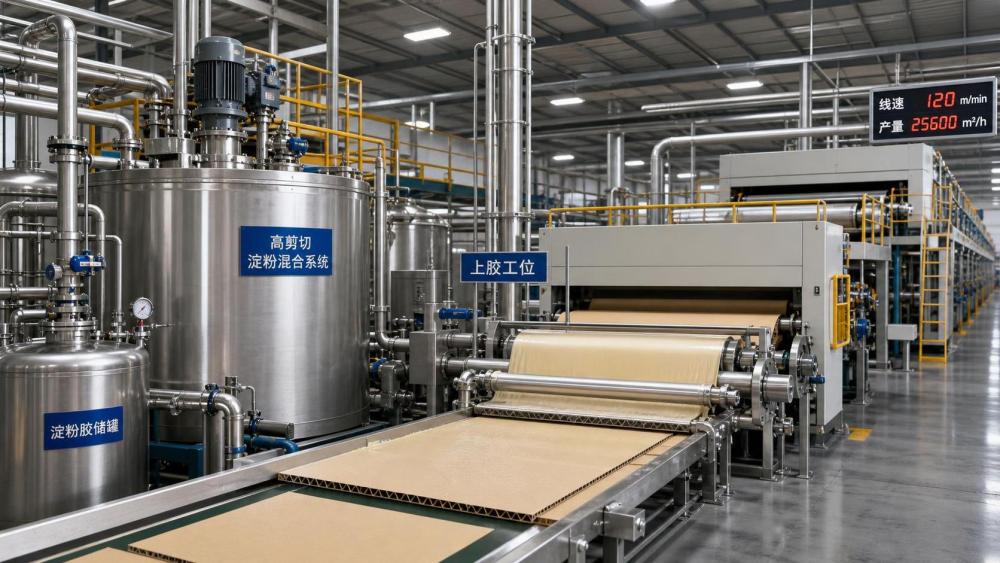
A high shear starch mixer applies much stronger mechanical energy during mixing than a basic agitation system. In plain terms, it breaks apart agglomerates faster, improves wetting of starch particles, and helps distribute ingredients more uniformly through the batch. That does not automatically make every adhesive formula better, but it usually gives the process a more stable starting point.
For corrugator bonding, three effects are especially relevant.
The first is dispersion speed. Faster and more complete dispersion helps plants prepare adhesive in less time and with fewer unmixed solids. This matters when a factory is running multiple order changes, adjusting adhesive demand through the shift, or trying to avoid delays from remaking off-spec batches.
The second is viscosity uniformity. Operators often describe a “good” glue not by laboratory language but by how it runs: whether the glue pan stays stable, whether application remains even across width, whether the line responds normally when speed increases. High shear mixers help because the batch is less likely to contain local concentration differences that show up as erratic flow behavior later.
The third is formulation consistency when additives are involved. Many corrugator adhesives are not just starch and water. Depending on process design, plants may use borax, caustic, carriers, or other chemistry adjustments. High shear mixing can improve the incorporation of these materials, reducing the chance that one batch cooks differently from the next.
Better bonding is really about process stability
It is tempting to say that a high shear mixer “increases bond strength,” but that oversimplifies what usually happens in a corrugator. The mixer does not create bonding by itself. What it does is reduce avoidable variation in the adhesive so the bonding process can perform closer to its intended window.
That distinction matters for technical reviews. If a plant has weak bonding because of worn glue rolls, poor steam balance, paper moisture imbalance, or incorrect adhesive formulation, changing the mixer alone will not solve the root cause. But if the plant is fighting recurring variation in adhesive preparation, then high shear mixing can remove one of the more frustrating sources of instability.
In practice, improved bonding often shows up in smaller operational signs before it shows up in formal lab results. The line may need fewer operator corrections after startup. Bond quality may remain steadier as speed increases. The adhesive may respond more predictably when ambient temperature changes. Plants running lightweight papers or recycled liners often notice this more clearly because those grades leave less room for process drift.
The connection with steam response and board quality
In corrugating, adhesive performance cannot be separated from heat. Starch must gelatinize correctly in the bonding section, and the timing of that reaction affects pin adhesion, warp tendency, and final board integrity. When the adhesive batch is inconsistent, steam settings become harder to manage because the line is trying to compensate for glue variation with thermal adjustment.
A more uniform adhesive from a high shear system usually gives the plant a cleaner thermal response. That does not mean lower steam consumption in every case; too many variables are involved, including paper moisture, line speed, and machine configuration. But it often means operators can tune the process with fewer surprises. If the adhesive reaches the paper in a more consistent condition, the double facer has a better chance of producing stable bonding without forcing excess glue or unnecessary heat into the board.
This is especially relevant for plants that evaluate equipment as part of a broader automation and uptime strategy. CPCS often frames corrugator systems in terms of total operating behavior rather than isolated machine features. That is the right way to think about mixers too. A starch system should be judged by how it supports glue control, board quality, waste reduction, and line continuity, not only by mixing horsepower or tank size.
Where technical teams should look during evaluation
When comparing high shear starch mixers, the biggest mistake is to focus only on whether the machine can mix quickly. Speed matters, but not in isolation. A useful evaluation usually includes the following questions.
- Can the system handle the plant’s actual starch recipes and batch sizes without leaving dead zones or requiring excessive manual correction?
- How stable is the finished adhesive from batch to batch under normal operator practice, not ideal test conditions?
- What is the cleanability of the mixer, piping, and recirculation path? Poor cleaning can erase the benefit of better mixing.
- How well does the control system integrate with the rest of the corrugator utility setup, especially if the plant wants more traceability or recipe management?
- What maintenance points exist around seals, wear parts, motor load, and operator safety?
Those questions sound basic, but they often separate equipment that looks good on a specification sheet from equipment that supports stable daily production. In packaging factories moving toward more connected production management, even a glue kitchen increasingly becomes part of the data environment. Batch records, consumption visibility, alarms, and repeatability are becoming more relevant, especially for larger operations with multiple shifts.
Common misunderstandings
One misunderstanding is that more shear is always better. It is not that simple. Excessive mechanical input, poor control logic, or a mismatch between mixer design and adhesive recipe can create other problems. The right target is controlled dispersion, not maximum turbulence.
Another is that a better mixer eliminates the need for process discipline. It does not. Water quality, recipe accuracy, temperature management, operator training, and glue application hardware still matter. If a plant upgrades the mixer but keeps weak batching practice, the improvement may be smaller than expected.
There is also a purchasing mistake that shows up in broader packaging machinery decisions: evaluating a subsystem only by purchase price. Corrugated plants today are increasingly looking at long-term operating value, which is sensible. A cheaper mixing setup that causes adhesive instability, cleanup delays, or repeated bond complaints may cost more through waste, downtime, and production caution than the initial savings suggest.
Why this matters more now than it did before
As e-commerce packaging volumes grow and order profiles become more fragmented, corrugator plants are under pressure to run faster while changing jobs more often. At the same time, many mills and converters are dealing with variable paper characteristics, labor constraints, and tighter expectations on traceability and quality consistency. Under those conditions, glue preparation that is “good enough most of the time” becomes a weak point.
That is why technical information platforms serving commercial print and corrugated packaging, including CPCS, increasingly discuss adhesive systems in the same conversation as automation, converting, inspection, and line efficiency. A corrugator is not just a collection of major modules. Supporting systems shape whether the line can actually deliver the performance that buyers expect from the headline speed.
For teams trying to understand high shear starch mixers at a basic level, the practical conclusion is fairly straightforward. These mixers improve bonding mainly by making adhesive preparation more repeatable. More uniform dispersion, steadier viscosity, and cleaner response under heat give the corrugator a better chance to hold bond quality across shifts, grades, and speed changes. The real value is not in the mixer as a standalone component. It is in how much process variation it removes from one of the most sensitive points in corrugated board production.
If a plant is reviewing corrugator performance or planning an upgrade, the right next step is usually not to ask whether high shear mixing sounds advanced. It is to look at the actual adhesive-related losses in the operation: bond instability, remakes, startup waste, excessive glue usage, difficult steam tuning, or frequent operator intervention. If those symptoms are recurring, the mixer deserves a closer technical review.
Related News
 How Steam Joints for Corrugator Rolls Prevent Heat LossSteam joints for corrugator rolls prevent heat loss, stabilize roll temperatures, improve condensate drainage, and support consistent board quality. Learn key maintenance practices.Corrugated Thermodynamics Architect
 When to Replace Single Facer Rolls to Prevent Corrugator DowntimeReplacement single facer rolls: learn the warning signs, inspection steps, and planning strategies that prevent corrugator downtime and protect board quality.Corrugated Thermodynamics Architect
 When Replacement Single Facer Rolls Can Restore Board QualityReplacement single facer rolls can restore flute definition, bonding consistency, and board quality. Learn when replacement helps reduce waste, stabilize production, and protect uptime.Corrugated Thermodynamics Architect
 When Wear Resistant Glue Rollers Deliver a Lower Total CostWear resistant glue rollers can reduce total cost by improving adhesive film stability, minimizing downtime, waste, and bond-quality risks.Corrugated Thermodynamics Architect
 When Should You Replace Industrial Single Facer Rolls?Industrial single facer rolls: discover the warning signs that demand replacement, from profile wear and runout to heat loss, quality defects, waste, and costly downtime.Corrugated Thermodynamics Architect
 When Should Corrugating Rolls Be Replaced?When should corrugating rolls be replaced? Discover key wear signs, inspection methods, and cost-saving steps to protect board quality, bonding, and uptime.Corrugated Thermodynamics Architect