Which Linerboard Grade Is Best for High-Speed Corrugating?
The best linerboard grade for high-speed corrugating is not simply the strongest or heaviest sheet. In most demanding applications, a consistent-performance kraft linerboard—often virgin-fibre or a high-virgin-content blend—is the safest choice for the liner position exposed to the greatest tension, heat, and converting stress. But the correct specification still depends on flute profile, board construction, moisture conditions, print requirements, and the actual operating window of the corrugator.
High-speed production exposes weaknesses that may remain hidden on slower lines. A liner that appears acceptable in a laboratory strength test can still create web breaks, poor bonding, warp, uneven caliper, score cracking, or excessive waste when subjected to rapid preheating, tension changes, starch application, and double-backer heat. The practical question is therefore not “Which linerboard grade is strongest?” but “Which grade runs predictably at the required speed while delivering the finished-board performance the customer needs?”
Start with the liner’s job in the board structure
Linerboard forms the outer and inner facings of corrugated board. Its role changes according to its position. The outer liner must often provide print surface quality, puncture resistance, stacking performance, and appearance. The inner liner may face lower visual requirements but still contributes to board stiffness, compression strength, and dimensional stability.
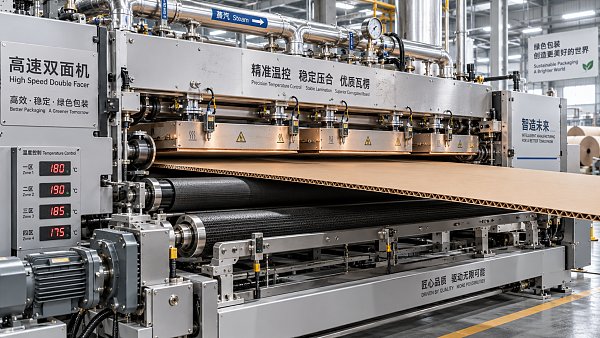
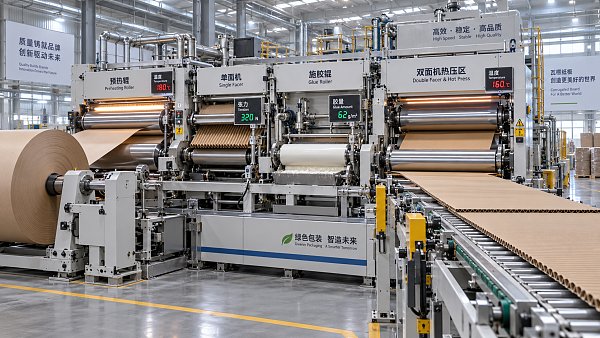
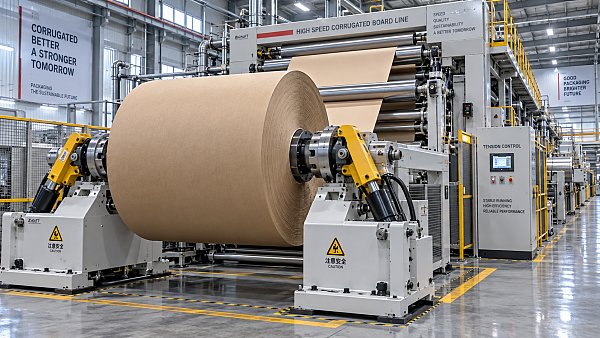
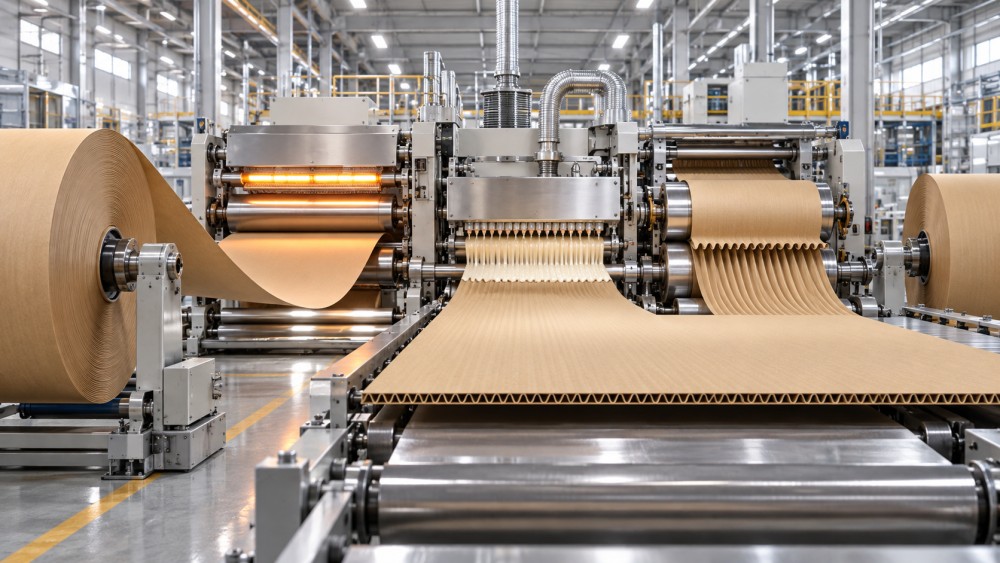
At high corrugator speeds, the liner also functions as a moving web. It must travel through braking systems, preheaters, wrap arms, glue stations, and the double backer without unstable tension behavior. This is where nominal basis weight alone becomes a poor guide. Two papers with the same grammage can behave very differently if their fibre composition, formation, moisture profile, caliper consistency, or surface treatment differs.
A useful starting principle is:
- Use the most runnability-critical liner where the line applies the highest tension and where finished-board failure would be most costly.
- Use lower-cost recycled or lighter grades only where their compression, surface, moisture, and converting limits are understood.
- Specify both finished-board requirements and corrugator-running requirements. A board-strength target alone does not define a suitable high-speed liner.
Kraft linerboard: usually the most forgiving high-speed option
Virgin kraft linerboard is widely selected for applications requiring high tensile strength, good puncture resistance, stable stiffness, and dependable moisture behavior. Long virgin fibres generally provide stronger fibre bonding than recycled furnish, which supports web strength during high-tension running and improves resistance to rough distribution environments.
For high-speed corrugating, its main advantage is not that every kraft liner has the same superior performance. It is that a well-made kraft grade can offer a wider operating window. It is more likely to tolerate rapid heating, tension fluctuations, and demanding converting conditions without becoming the limiting factor in line performance.
This makes kraft liner particularly suitable when the board will be used for:
- heavy-duty shipping cases and industrial packaging;
- long distribution routes or humid logistics conditions;
- high stacking loads;
- large-format boxes where panel stiffness matters;
- aggressive die-cutting, folding, or high-speed flexographic post-printing;
- lighter-weight board designs that still need to retain compression performance.
However, “kraft” is not a complete specification. Grades differ in basis weight, burst or ring-crush performance, tensile properties, surface smoothness, sizing, recycled content, and moisture target. A purchasing decision based only on a kraft label may therefore create avoidable variation between suppliers or production lots.
Test liner can run well—but grade discipline matters more
Test linerboard, generally made with recycled fibre, can be an effective choice for high-speed production when the application is less demanding and the material is consistently manufactured. It is commonly used for secondary packaging, standard transport cartons, and internal distribution cases where visual appearance and extreme moisture resistance are not the primary requirements.
The challenge is that recycled fibre quality is more sensitive to furnish variability, repeated fibre processing, contamination control, and seasonal moisture changes. Recycled fibres are shorter and may provide lower tensile reserve than virgin fibres at the same basis weight. That does not make test liner unsuitable for modern corrugators; it means the grade must be matched more carefully to the speed, board design, and end-use environment.
A stable, well-controlled test liner can perform reliably on high-speed equipment. A low-cost grade with broad variation in moisture, caliper, or strength can create a false economy. The paper price saving may be outweighed by breaks, lower running speed, increased starch use, warp-related downgrades, poor die-cutting performance, or claims caused by weak box compression.
Where test liner is being evaluated, the key question is not whether it meets a minimum strength value on a specification sheet. The more useful question is whether its performance remains stable across deliveries. High-speed corrugating requires repeatability.
Strength numbers matter, but they do not tell the whole story
Linerboard specifications often include basis weight, burst strength, ring crush, tensile strength, short-span compression strength (SCT), moisture, Cobb value, and caliper. Each may be relevant, but no single number identifies the best grade for a high-speed corrugator.
Basis weight influences fibre content, stiffness, and cost, but heavier paper does not automatically produce better board. Excess basis weight can raise material cost, change heat transfer, and create an unnecessarily heavy case. Conversely, lightweight grades may be entirely suitable if their fibre strength and formation are sufficient for the required board design.
Tensile strength is especially relevant to web handling. A liner with inadequate tensile reserve is more vulnerable to breaks during acceleration, splicing, tension adjustments, or uneven heating. Cross-direction tensile characteristics also matter because web handling and downstream converting do not load the sheet in only one direction.
SCT and ring-crush-related measures help indicate the liner’s contribution to compression performance. They are valuable when boxes must resist stacking loads, but they should be interpreted with the complete board construction in mind. Flute type, medium quality, adhesive bond, moisture content, and converting damage all influence actual box compression.
Caliper and formation consistency are frequently underestimated. Uneven caliper can affect heat transfer, glue contact, nip pressure response, score quality, and finished-board flatness. Poor formation may also create localized weak zones that lead to web breaks or non-uniform print appearance.
Moisture content and moisture profile are central to high-speed performance. Paper that enters the corrugator too dry may absorb heat differently, become brittle, or require more conditioning. Paper that is too moist can reduce stiffness, change adhesion behavior, and contribute to warp. Equally important is moisture uniformity across the reel width and from reel to reel.
Surface properties affect both bonding and printability
A liner’s surface is not merely an aesthetic issue. The side contacting the starch adhesive must allow reliable bonding without excessive penetration or inconsistent wetting. The outward-facing side may need to support flexographic print quality, coating, laminating, or a clean natural-kraft appearance.
Highly porous surfaces can absorb adhesive rapidly, potentially reducing the effective glue line if process settings are not adjusted. Very closed or heavily treated surfaces may require close attention to starch formulation, glue viscosity, application rate, and heat transfer. Neither condition is inherently wrong, but both must be compatible with the corrugator’s adhesive and temperature control.
For printed cases, surface smoothness, shade consistency, cleanliness, and water resistance may be as important as compression strength. A liner selected only for runnability can create downstream problems such as uneven ink density, poor barcode contrast, washboarding, or variable print gloss. White-top linerboard may be appropriate when visual presentation is critical, but its top ply, print surface, and corrugating-side characteristics should be evaluated separately rather than assumed from the white surface alone.
The outside liner and inside liner do not always need the same grade
Using identical liners on both faces is operationally simple, but it is not always the most efficient design. The outer liner may require higher tensile strength, better surface quality, or greater puncture resistance. The inner liner may be selected primarily for compression contribution and cost control. Combining grades can reduce total board cost while preserving performance where it matters.
That approach must be used carefully. Large differences in moisture response, stiffness, or thermal behavior between the two liners can increase warp risk. A board with a high-strength kraft outer liner and a lighter recycled inner liner may be technically sound, but only if the machine settings, paper conditioning, and flute combination are controlled to maintain balanced shrinkage and drying.
High-speed lines amplify this issue because paper dwell time is shorter and process adjustments have less room to compensate for inconsistent material. If a mixed-liner construction is planned, it should be validated at commercial running conditions rather than judged only from sample sheets or isolated board tests.
Choose the grade around the corrugator’s operating window
The linerboard must fit the machine, not only the box specification. Important operating variables include preheater configuration, wrap angle control, steam system stability, brake response, web tension control, starch system capability, double-backer length, belt condition, and intended running speed. A grade that performs well on one corrugator may require different conditioning or may reveal limitations on another line.
Reel quality also matters. Reel hardness, winding uniformity, edge condition, splice quality, and moisture protection during transport can all affect uninterrupted operation. A technically suitable grade arriving with damaged edges or uneven reel build can still create costly stops.
When comparing suppliers, a useful review should include more than a technical data sheet:
- strength and stiffness values at the supplied moisture level;
- acceptable ranges, not only target values, for moisture and caliper;
- machine-direction and cross-direction properties;
- surface sizing and Cobb characteristics where relevant;
- reel diameter, width tolerances, splice practices, and edge quality;
- lot-to-lot consistency and change-control procedures;
- performance after storage in the destination climate.
For export supply chains, this final point deserves particular attention. Linerboard can travel through different humidity conditions before reaching the corrugator. The delivered state of the reel—not only the mill test result—affects how the paper responds to preheating and bonding. Storage conditions at ports, warehouses, and plants can alter moisture balance before production begins.
A practical grade-selection sequence
Begin with the required box performance: stacking load, puncture exposure, print needs, storage duration, humidity exposure, and customer appearance requirements. Then define the board construction, including flute profile, target caliper, medium grade, and whether the outside and inside liners serve different functions.
After that, define the corrugator constraints. Identify the target operating speed, common web-break locations, moisture-control limitations, adhesive system characteristics, and order-change frequency. This reveals whether the line needs a broad-runnability kraft grade or whether a controlled test liner can meet the requirement economically.
The final decision should be based on production trials that measure more than board strength. Track web breaks, speed reductions, glue consumption, warp, bond quality, trim waste, print performance, die-cutting behavior, and finished-box compression after conditioning. A liner grade that allows stable production at the planned speed can be more valuable than a cheaper grade that repeatedly forces conservative settings.
The best grade is the one that protects usable output
For high-speed corrugating, premium virgin kraft linerboard is often the preferred choice where machine speed, compression performance, moisture resistance, and converting reliability are all demanding. High-quality test liner can be the better commercial choice for controlled, less severe applications. White-top and specialty liners should be selected when print, appearance, coating, or end-use requirements justify their additional complexity.
The deciding factor is not the grade name printed on the specification. It is whether the liner maintains consistent web handling, adhesive bonding, dimensional stability, and finished-board performance under the actual heat, tension, moisture, and speed conditions of production. In corrugating, the lowest paper cost per tonne is not necessarily the lowest material cost per saleable square metre of board.
Related News
 What Determines Compression Section Price in Corrugator ProjectsCompression section price depends on width, speed, pressure control, heating, automation, and integration. Learn how to compare quotes and maximize corrugator ROI.Corrugated Thermodynamics Architect
 How a Servo Driven Folder Gluer Machine Improves Carton AccuracyDiscover how a servo driven folder gluer machine improves carton accuracy through synchronized motion, repeatable folding, precise glue placement, and faster changeovers.Corrugated Thermodynamics Architect
 How Carton Making Machines Improve Output in High-Mix PlantsCarton Making Machines help high-mix plants increase sellable output with faster changeovers, lower waste, reliable quality control, and smoother workflow integration.Corrugated Thermodynamics Architect
 Corrugator Control Systems That Improve Board Quality and UptimeCorrugator Control Systems improve board quality, reduce waste, and increase uptime with coordinated heat, moisture, tension, glue, and speed control.Corrugated Thermodynamics Architect
 How High Speed Feeder Systems Support Faster Corrugator OutputHigh speed feeder systems help corrugator plants improve stable throughput, reduce feeding delays, protect board quality, and maximize converting efficiency.Corrugated Thermodynamics Architect
 Heavy Duty Unwind Stands That Stabilize High-Speed CorrugatorsHeavy duty unwind stands stabilize high-speed corrugators with precise tension control, secure reel handling, and smoother roll changes. Discover how to reduce breaks, waste, and downtime.Corrugated Thermodynamics Architect