What Affects Steam Joint Prices for High-Speed Corrugator Lines?
Steam joint prices for high-speed corrugator lines depend on the operating duty, sealing arrangement, condensate connection, and installation requirements. A quotation for a bare replacement joint can look attractive beside a complete assembly that includes a siphon, supports, and connection hardware. Until those differences are resolved, the unit prices offer a weak basis for purchasing.
A higher price is justified when the design addresses a documented operating requirement or reduces a credible maintenance burden. It is harder to justify when the premium buys pressure capacity, materials, or accessories the application does not need. Procurement teams can make a sound comparison by defining the duty at each installation point, checking what each quotation includes, and evaluating the cost of keeping that position in service.
The operating duty explains much of the price difference
“For a high-speed corrugator” is not a complete specification. A joint serving a heated rotating roll must accommodate the conditions at that particular position. Different roll diameters, operating pressures, speed profiles, and condensate arrangements can require different solutions, even within the same line.
Translate line speed into joint speed
Corrugator production speed is generally expressed as a linear speed, while a rotary joint operates at a rotational speed. For a roll running at the paper’s surface speed, a smaller diameter produces a higher rotational speed at the same line speed. Suppliers therefore need the relevant roll diameter and maximum operating rpm, or enough machine information to establish them.
Speed affects the demands on sealing faces, support components, alignment, and heat management. However, a catalog’s maximum speed should not be considered independently of its pressure and temperature limits. Ask whether the proposed joint can operate at the specified combination of conditions continuously. Separate maximum ratings do not necessarily establish suitability when those limits occur together.
Pressure, temperature, and operating cycles
The pressure and temperature envelope influences the body construction, sealing materials, gaskets, and connection design. A joint must suit the actual steam conditions and required equipment rating. Specifying a substantially higher rating without an engineering reason can increase cost without improving production performance.
Give bidders the normal operating conditions, maximum expected conditions, and relevant startup or shutdown behavior. Frequent heating and cooling, long periods at temperature, and changes between production and standby duty can affect component selection. A pressure figure alone leaves too much room for suppliers to quote different interpretations of the same application.
Steam condition also matters. Wet steam, contamination, or unstable supply conditions may affect sealing performance and condensate handling. More expensive joint materials cannot be assumed to correct problems elsewhere in the steam system. If repeat failures are driving the purchase, investigate the failure mechanism before requesting a higher specification.
Seal and support design
Seal-face materials, loading arrangements, and the method used to support or guide the rotating components can change both purchase price and maintenance requirements. Different designs may have different tolerances for alignment variation, friction, wear, and operating conditions. A familiar material description by itself does not establish equivalent performance.
Ask suppliers to identify the proposed seal arrangement and explain its suitability for the stated duty. Maintenance requirements should be equally explicit: whether lubrication is required, which parts are replaceable, and whether servicing can be performed by plant maintenance staff. A premium design becomes easier to assess when its benefit is tied to a specific operating or maintenance requirement.
Condensate removal and installation can change the scope substantially
A steam joint provides a connection between stationary piping and rotating equipment. On installations that also return condensate through the joint, the internal arrangement and its interface with the siphon are central to selection. Two products with similar external dimensions may handle steam supply and condensate return differently.
Single-flow and dual-flow arrangements are not interchangeable purchasing options. The required configuration depends on how the roll receives steam and discharges condensate. Within a return arrangement, the siphon design, support method, internal clearances, and connection details must also fit the roll and its operating conditions.
Condensate removal depends on the wider system, including the available pressure differential and downstream drainage arrangement. An unsuitable setup can contribute to uneven heating, restricted heat transfer, or unstable operation. Those symptoms can affect board production, but they should not automatically be attributed to the joint.
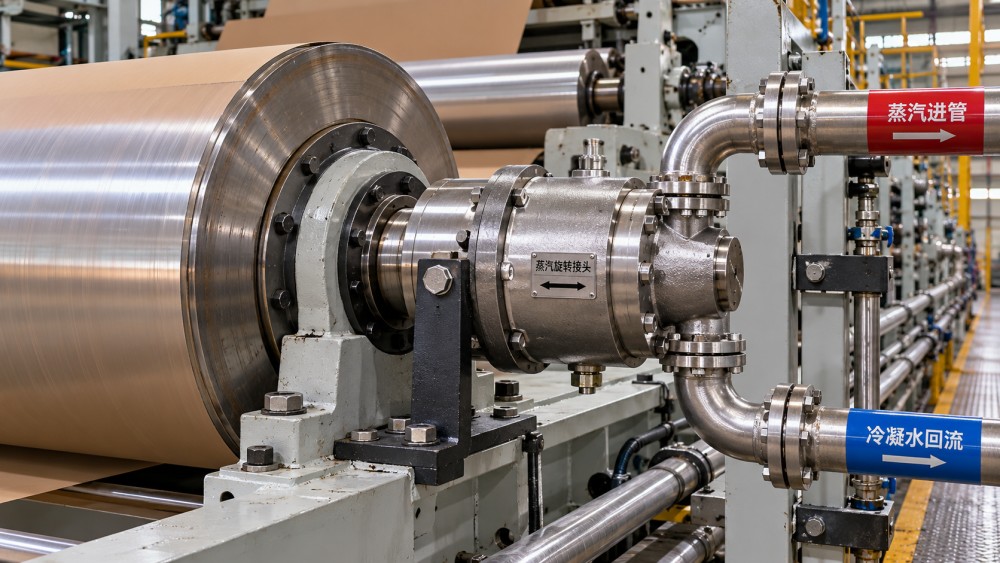
A sectional drawing showing the joint, roll journal, steam passage, condensate return, and siphon connection is particularly useful during quotation review. It exposes differences that a product photograph or model designation can conceal. It also helps establish whether a supplier is pricing a direct replacement or an assembly that requires modifications.
Installation compatibility extends beyond the nominal connection size. Thread form, flange details, mounting dimensions, available space, anti-rotation arrangements, and the path for removing service parts can all influence the work required. Piping must also accommodate movement and thermal expansion without imposing loads outside the joint’s installation limits.
A nominally interchangeable joint may therefore have a different installed cost. Adapters, revised supports, piping changes, or additional shutdown work can outweigh a small saving on the component. Conversely, a supplier’s higher quotation may already include hardware omitted by another bidder.
For a replacement purchase, provide the existing assembly drawing, identification details, and photographs of the installed connections. Record any modifications made since the original installation. Buying solely against an old part number can reproduce an unresolved mismatch or overlook changes to the machine.
Make quotations comparable before negotiating the unit price
A useful request for quotation gives every bidder the same duty and asks each to state the boundaries of supply. This reduces the chance that one supplier prices a complete operating assembly while another quotes only the joint body.
The specification should cover a concise set of purchasing inputs:
- Installation point and operating envelope: roll identification, diameter, rotational speed, steam pressure, temperature, and relevant operating cycles.
- Flow arrangement: steam inlet and condensate return configuration, siphon interface, and whether siphon components are included.
- Mechanical interface: connection standards, mounting dimensions, support requirements, orientation, and space restrictions.
- Supply scope: joint assembly, seals, gaskets, adapters, supports, connection hardware, and any installation services.
- Maintenance support: recommended inspection tasks, available repair kits, replacement parts, and repair options.
- Commercial terms: delivery time, freight, taxes or duties where applicable, warranty scope, and documentation supplied.
Request a drawing with the quotation and ask suppliers to identify deviations explicitly. A statement that a product is “equivalent” leaves important questions unanswered if the connection dimensions, flow passages, or maintenance procedure differ.
Materials and manufacturing quality need context
Body materials, corrosion resistance, machining accuracy, and seal-face quality can influence price. Their value depends on the service conditions. Selecting a more costly material everywhere is not a reliable purchasing rule; the chosen materials need to suit the steam, condensate, mechanical loads, and surrounding environment.
Quality documentation should correspond to the plant’s actual requirements. Depending on the application and jurisdiction, buyers may need material identification, pressure-test records, traceability, or documentation demonstrating compliance with applicable requirements. Specify these at the inquiry stage because documentation and inspection scope can affect both cost and delivery.
Broad claims such as “premium quality” provide little help in comparing offers. More useful evidence includes a defined operating envelope, clear installation limits, documented inspection or testing, and an identifiable spare-parts structure.
Order quantity, customization, and availability
Standard configurations and repeat orders may reduce procurement complexity, while unusual connections, modified dimensions, or special inspection requirements can add engineering and manufacturing work. An urgent replacement may also carry additional freight or expediting costs.
Keeping a common joint type across suitable positions can simplify spare holdings and maintenance training. That benefit depends on genuine compatibility. Forcing standardization across positions with different flow arrangements or operating demands can create installation compromises and erase the intended savings.
Check spare-parts availability separately from the lead time for a new assembly. A competitively priced joint can become expensive to support if a routine seal replacement requires a complete imported unit or a lengthy repair cycle.
Compare the cost of keeping the roll in service
Once the technical scope is aligned, steam joint price comparisons should include installation and support costs. A practical ownership estimate combines the delivered purchase cost, installation work, planned servicing, replacement parts, and the financial exposure associated with failures over a common evaluation period.
Use the same assumptions for every offer. Where plant maintenance records exist, they provide a stronger basis than an unsupported service-life claim. Where records are limited, compare scenarios and show which assumptions change the purchasing decision.
A cheaper joint may remain the better purchase when it meets the duty, fits directly, and has economical service parts. A more expensive assembly may earn its premium through easier maintenance, better local availability, or a design suited to a troublesome installation. Neither conclusion follows from price alone.
Assess downtime at the installation point
The consequence of a failure depends on the machine position and the plant’s ability to recover. Consider whether leakage requires an immediate stop, how accessible the assembly is, whether the roll must cool before work, and whether a ready spare allows a straightforward replacement.
For a bottleneck operation, a modest component saving can be outweighed by one extended interruption. That does not justify accepting any premium. It supports examining the proposed joint’s service procedure, replacement availability, and compatibility more closely.
Warranty terms also need a practical reading. Establish what the supplier will replace or repair, what operating and installation conditions apply, and who pays for freight or field work. A replacement-parts warranty should not be valued as though it covers the plant’s lost production.
Treat energy and service-life claims as conditional
Leak prevention and effective condensate removal can support stable heating performance. Quantified savings, however, depend on the starting condition and the rest of the steam system. Ask what baseline supports any energy claim and whether the claimed improvement comes from the joint, the siphon arrangement, corrected piping, or several changes together.
Service-life estimates need similar scrutiny. They should be tied to operating conditions, installation quality, maintenance practices, and a clear definition of end of life. A long calendar-life claim provides little purchasing value if the duty behind it is unspecified.
The final comparison should leave a short, visible explanation for each meaningful price difference: a required design feature, a broader supply scope, lower installation work, stronger service support, or an unresolved assumption. When a premium cannot be connected to one of those factors, ask for the quotation to be clarified. When the lowest offer leaves a critical interface or maintenance requirement undefined, resolve that gap before issuing the purchase order.
Related News
 KPS to Acquire 70% of MM Packaging at €2.4 Billion Enterprise ValueKPS will acquire 70% of MM Packaging at a €2.4 billion enterprise value. Explore what the deal means for the packaging business and its customers.Corrugated Thermodynamics Architect
 How to Size Bridge Conveyors for a Corrugator LineSize Bridge Conveyors for your corrugator line with practical guidance on web accumulation, sheet throughput, layout, and controls. Avoid costly bottlenecks.Corrugated Thermodynamics Architect
 Nine Dragons Paper Raises Chongqing Corrugated Paper Price by 50 Yuan per TonneNine Dragons Paper raises Chongqing corrugated paper prices by 50 yuan per tonne. See when the increase takes effect and what it means for packaging costs.Corrugated Thermodynamics Architect
 How Automatic Warp Control Systems Improve Corrugated Board FlatnessDiscover how automatic warp control systems improve corrugated board flatness, reduce production waste and support more reliable converting.Corrugated Thermodynamics Architect
 How to Evaluate a Sheet Stackers Factory for Your Production LineEvaluate a sheet stackers factory with confidence. Compare capacity, line integration, acceptance tests and service to choose the right supplier for your production line.Corrugated Thermodynamics Architect
 What to Ask a Starch Mixer Manufacturer Before OrderingChoosing a starch mixer manufacturer? Ask these essential questions about capacity, pricing, automation and support before you order.Corrugated Thermodynamics Architect