How to Evaluate a Sheet Stackers Factory for Your Production Line
The strongest sheet stacker supplier is not necessarily the one quoting the highest speed or the lowest equipment price. A credible factory can show how its system will handle the actual sheet range, maintain flow during order changes, and communicate with the corrugator and downstream conveying equipment. It should also accept measurable performance conditions rather than relying on a nominal capacity figure.
Begin the evaluation with the production line, not the supplier’s standard model list. Define where sheets enter and leave the stacker, which combinations of board and order sizes must run, and what happens when the next conveyor or pallet-handling station is unavailable. Those conditions determine whether a proposal is technically suitable and whether its price covers a complete, operable installation.
Define the stacking duty before comparing machines
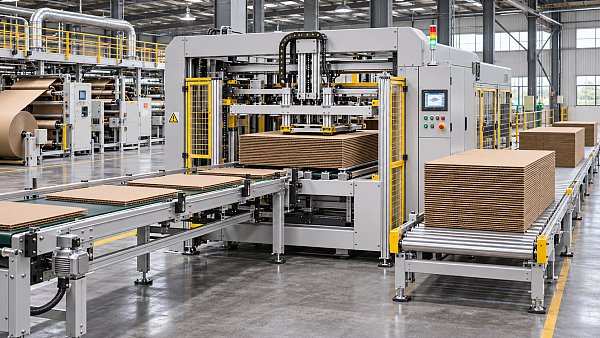
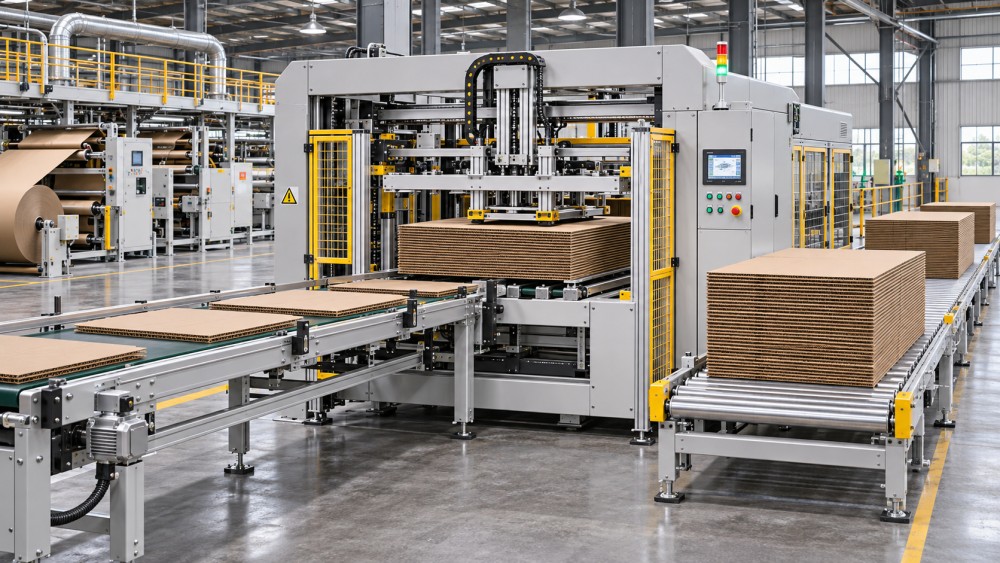
A stacker receives sheets from an upstream process and forms them into piles for transfer or further handling. On a corrugated board line, the interface with the cut-off, order control and takeaway system is especially important. A stacker for printed or converted sheets may face different requirements, including protection of the printed surface or more delicate edges. A supplier’s experience with one application should not automatically be treated as proof of capability in another.
Give each shortlisted factory the same operating envelope. At a minimum, include sheet length and width ranges, board construction and flute types, sheet condition, expected line speeds, desired stack heights or counts, and the way completed stacks leave the machine. Identify which combinations occur together: the maximum sheet size, maximum speed and maximum stack height may not be required simultaneously, but the supplier needs to know the combinations that are.
Order patterns are equally important. A long run of one sheet size places different demands on the delivery system from frequent order changes with small quantities. Ask the factory to explain how the machine separates orders, forms the final partial stack and resumes stacking after a change. If an operator must intervene, establish how often that intervention is expected and whether upstream production must slow or stop.
Pay particular attention to board condition. Warp, variation in stiffness and damaged edges can affect alignment and transfer. Rather than asking whether a machine “handles warped board,” agree on representative samples or a practical description of the expected condition, and identify any limits the supplier places on performance.
Test capacity as a system, not as a headline number
Advertised speed can refer to conveyor speed, upstream line speed or the rate at which individual sheets are handled. These are not interchangeable. A useful proposal states the applicable sheet dimensions, board characteristics, stack configuration and operating mode behind each capacity claim.
Short sheets can create a high sheet arrival rate even when the line speed is unchanged. At the same time, small order quantities can increase the frequency of stack discharge or order separation. The decisive limitation may therefore be the stacker’s transfer cycle or the downstream conveyor’s ability to clear stacks, rather than the speed of the infeed belt.
Request a capacity assessment for representative and demanding combinations, including the shortest sheet at its required line speed, the largest sheet that must be stacked, and a frequent-changeover scenario. The assessment should explain any required speed reduction, minimum gap, buffer or operator action. Avoid accepting a single maximum figure as a guarantee across the entire product range.
Downstream availability also affects usable capacity. If a full stack cannot leave, establish whether the machine buffers sheets, pauses the upstream equipment or requires manual clearing. Ask how the line restarts after a blockage and whether unfinished stacks retain their order identity. A high-speed stacker adds little value if its normal discharge cycle repeatedly interrupts the rest of the line.
Examine the factory’s integration capability
The equipment boundary should be documented before commercial comparison. A layout drawing needs to show the infeed and discharge elevations, machine footprint, conveyor direction, access zones and interfaces with existing equipment. Check the route for stacks through doors, columns and other plant constraints, as well as the space needed for maintenance and safe access.
Mechanical fit alone is insufficient. The controls must coordinate sheet arrival, stack count, order changes, discharge readiness and fault conditions. A supplier should identify the signals it requires from the upstream machine and the signals it provides downstream. For a retrofit, confirm who will obtain the existing control documentation, modify the old system if necessary, and test communication between suppliers’ equipment.
An interface matrix can expose gaps before they become commissioning disputes:
- Sheet and order data: source of dimensions, quantities and changeover commands; manual entry where data is unavailable.
- Run permissives: how the stacker confirms readiness and how upstream equipment responds when it cannot accept sheets.
- Discharge coordination: stack-ready and downstream-ready signals, conveyor ownership and the response to a blocked transfer.
- Safety interfaces: defined emergency-stop and protective-device interactions, with responsibilities for validation of the complete installation.
- Utilities and services: electrical supply, compressed air where required, network connections, extraction if applicable, and installation responsibilities.
Do not assume that a common communication protocol resolves the integration task. Both sides still need agreed signal definitions, control logic and responsibility for testing. If the supplier proposes an upgrade to an existing controller or additional hardware, include it in the scope and schedule rather than treating it as a commissioning detail.
Look beyond the factory demonstration
A factory visit is most useful when it establishes what the supplier actually controls. Determine which functions are designed and assembled in-house, which components or subsystems come from third parties, and who supports them after installation. Outsourcing is not inherently a weakness; unclear technical ownership is. The factory should be able to identify the party responsible for drawings, software changes, spare parts and fault diagnosis.
Review a comparable installation or operating reference where access is available. Comparability matters more than a large reference list: a system handling similar sheet dimensions, board types, order patterns and downstream transfers provides stronger evidence than one with only a similar quoted speed. Ask what scope was supplied and whether the reference includes the same integration functions being proposed.
Agree on a factory acceptance test before placing the order. Where representative material and an appropriate upstream simulation or feed are available, the test can demonstrate sheet handling, alignment, stack count, order separation and discharge sequences. Record sheet specifications, speeds, sample duration and acceptance criteria. Include fault and recovery scenarios, not just uninterrupted running.
A factory test has limits. If the actual corrugator, existing control system or downstream conveyor is not present, the test cannot prove complete line integration. List those functions as site acceptance items and specify how they will be tested after installation. If representative board cannot be supplied for the factory test, state the resulting limitation and agree on a site test using production material.
Turn quality and reliability claims into acceptance terms
Stack quality should be described in terms the receiving process needs. Relevant measures can include count accuracy, stack stability, edge alignment, damage and the ability to transfer a stack without manual correction. Define how each will be assessed, under which material conditions and over what test period. Alignment requirements that are acceptable for warehouse transport may be inadequate for a downstream automatic feeder.
Reliability claims need the same discipline. A stated availability percentage is difficult to compare unless the contract defines the observation period, operating schedule and treatment of scheduled maintenance, material-related stops and upstream or downstream faults. If a formal availability guarantee is required, agree on measurement and remedies before contract signature. Otherwise, use a documented site trial to expose repeat faults and confirm that the supplier will correct them.
Safety should be reviewed as a property of the complete installation. Moving conveyors, stack lifts, transfer mechanisms and access points create hazards that cannot be assessed solely from a machine brochure. Require a documented risk assessment, guarding and access arrangements, emergency-stop design and relevant conformity documentation for the destination market. Applicable obligations depend on the jurisdiction and project scope; establish who is responsible for assessing and documenting the integrated line.
Compare delivered scope and project risk
Two quotations can differ substantially because they cover different boundaries. One may include discharge conveyors, installation, control integration and commissioning; another may price only the stacker. Normalize the offers against a common scope before comparing their totals.
Include foundations or floor preparation, lifting and unloading, utility connections, wiring, network work, software integration, travel, training, initial spares and site acceptance support. Identify exclusions and allowances, and ask who carries the cost if an existing machine needs modification. Where local contractors are involved, establish who coordinates their work and accepts the completed interfaces.
The schedule deserves the same scrutiny. Ask for milestones covering design approval, interface information, manufacture, factory testing, shipment, installation and commissioning. A short quoted delivery period is not useful if it excludes engineering approval or assumes an outage window that the plant cannot provide. For retrofit work, agree on the sequence for removing or bypassing existing equipment and the conditions needed before the line can restart.
Service arrangements affect the cost of ownership after acceptance. Request a recommended spare-parts list with component identification, expected supply routes and any items requiring supplier-specific software or configuration. Clarify remote diagnostic access, language and working-hour coverage, site support arrangements, software backup, and who can change parameters. These details are more informative than a general promise of “after-sales service.”
Warranty terms should distinguish equipment defects from damage caused by material, utilities, unauthorized changes or connected equipment. Also define the process for reporting a fault, supplying replacement parts and deciding whether a site visit is required. Performance remedies and warranty obligations should not disappear simply because the machine has been powered on; tie acceptance to the agreed tests and outstanding corrective actions.
Make the decision against the real operating envelope
Separate mandatory conditions from preferences. A proposal that cannot handle a required sheet combination, fit the available layout or integrate safely with existing controls is not made suitable by a lower price. Among technically compliant offers, compare the strength of supporting evidence, completeness of scope, service arrangements and exposure to unresolved interfaces.
Before committing, close the remaining assumptions in a controlled document: material range, operating scenarios, exclusions, test methods, responsibilities and acceptance criteria. The most defensible choice is the factory that can demonstrate how its stacker will work under those agreed conditions—and that has a credible plan for the functions that cannot be proven until the complete line is running.
Related News
 KPS to Acquire 70% of MM Packaging at €2.4 Billion Enterprise ValueKPS will acquire 70% of MM Packaging at a €2.4 billion enterprise value. Explore what the deal means for the packaging business and its customers.Corrugated Thermodynamics Architect
 How to Size Bridge Conveyors for a Corrugator LineSize Bridge Conveyors for your corrugator line with practical guidance on web accumulation, sheet throughput, layout, and controls. Avoid costly bottlenecks.Corrugated Thermodynamics Architect
 Nine Dragons Paper Raises Chongqing Corrugated Paper Price by 50 Yuan per TonneNine Dragons Paper raises Chongqing corrugated paper prices by 50 yuan per tonne. See when the increase takes effect and what it means for packaging costs.Corrugated Thermodynamics Architect
 How Automatic Warp Control Systems Improve Corrugated Board FlatnessDiscover how automatic warp control systems improve corrugated board flatness, reduce production waste and support more reliable converting.Corrugated Thermodynamics Architect
 How to Evaluate a Sheet Stackers Factory for Your Production LineEvaluate a sheet stackers factory with confidence. Compare capacity, line integration, acceptance tests and service to choose the right supplier for your production line.Corrugated Thermodynamics Architect
 What to Ask a Starch Mixer Manufacturer Before OrderingChoosing a starch mixer manufacturer? Ask these essential questions about capacity, pricing, automation and support before you order.Corrugated Thermodynamics Architect