How to Choose Paper Reel Stands for Stable Corrugator Feeding
A paper reel stand is not a passive roll holder. It is the first control point in the corrugator’s web-handling chain, and its behavior affects tension stability, splice quality, paper waste, operator safety, and the ability of the line to sustain speed. A stand that appears adequate on a capacity sheet can still become a production constraint if its braking response is slow, its arms are not rigid enough for the reel width, or its control system cannot work cleanly with the preheater and web-tension sections downstream.
The most important purchasing decision is therefore not simply “how many tonnes can the stand carry?” It is whether the reel stand can maintain controlled unwinding across the paper grades, roll dimensions, line speeds, and changeover routines that the corrugator will actually run. The correct specification begins with the production envelope, not with the supplier’s standard model.
Start with the real operating envelope
Paper reel stands should be specified against the heaviest, widest, and largest-diameter reels expected in normal production—not only the rolls currently purchased. A corrugator may run lightweight flute papers one day and heavier testliner or kraft grades the next. These papers create very different inertia, tension, and braking requirements even when roll width is similar.
Key operating data should be collected before issuing an RFQ:
- Maximum and minimum reel width, diameter, and weight
- Expected paper grades, basis-weight range, and moisture sensitivity
- Core diameter and whether multiple core standards must be accommodated
- Maximum corrugator speed and normal production speed
- Number of paper webs required by the corrugator configuration
- Frequency of reel changes and whether splicing occurs at speed
- Available floor space, loading direction, and reel-delivery method
- Control interface requirements with the corrugator, preheater, and production system
Maximum load capacity remains essential, but it should not be assessed in isolation. A stand rated for a heavy roll may still be unsuitable if that rating only applies at a narrow web width, at a limited arm extension, or under slow handling conditions. The supplier should state the permitted reel mass, width, diameter, and centerline position as a combined operating range. This avoids a common procurement error: comparing nominal “maximum load” figures that are not measured under equivalent conditions.
Minimum reel diameter matters as well. As a reel becomes smaller, its rotational behavior changes and braking control becomes more sensitive. If the plant regularly consumes rolls down to a small remaining diameter, the stand must maintain stable tension near the end of the reel rather than allowing slack web, oscillation, or sudden tension peaks.
Shaftless versus shafted designs: choose around handling and control
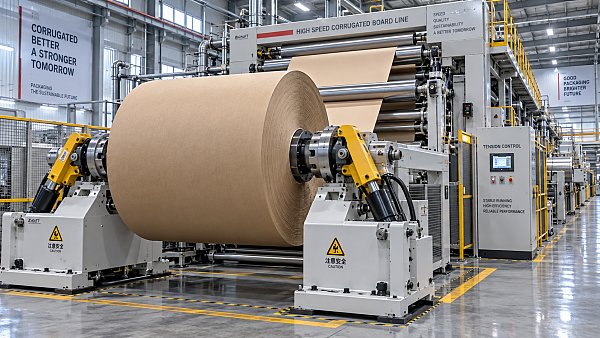
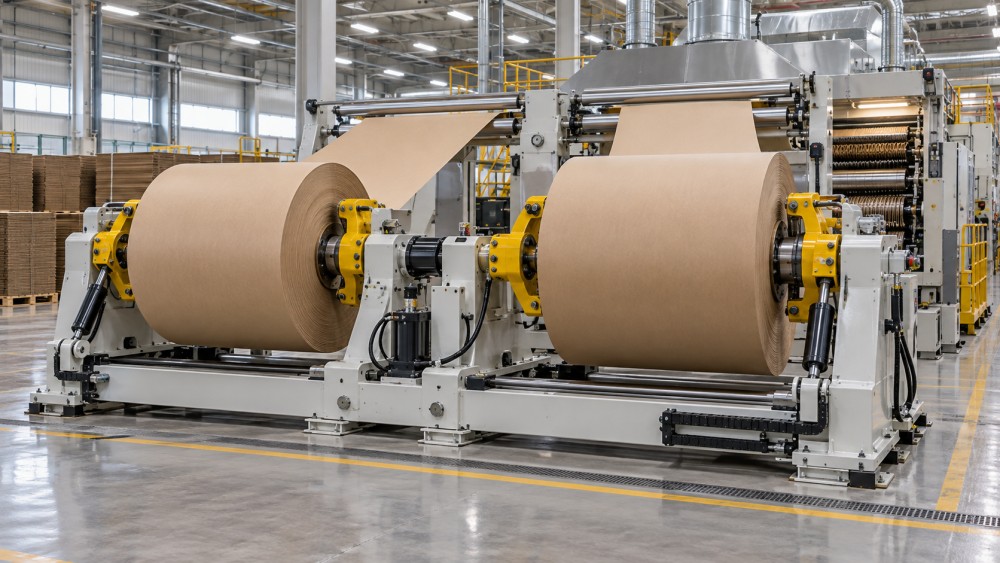
Most modern corrugator installations use shaftless paper reel stands. Each reel is supported by two independently moving chucks that enter the paper core from both sides. This arrangement reduces the need to install and remove a heavy shaft for every roll, supports faster loading, and is generally better suited to large reels and frequent changeovers.
For a corrugator with regular production changes, shaftless designs also offer practical advantages in reel centering and web alignment. Hydraulic or electromechanical arm movement can position the reel accurately, while expanding chucks can accommodate approved core diameters without manual shaft preparation. The value is operational rather than cosmetic: fewer handling steps reduce the opportunity for damaged cores, incorrect positioning, and unsafe manual intervention.
Shafted stands may still be appropriate where reel dimensions are highly standardized, roll weights are modest, changeover frequency is low, or an existing plant layout is designed around shaft handling. They can be mechanically straightforward, but their suitability should be judged against the full handling sequence. If operators must repeatedly lift, insert, store, and transport shafts, the apparent lower equipment cost can be offset by slower reel changes and higher handling exposure.
Where more than one core size is used, purchasers should confirm how the stand accommodates each size. “Compatible with multiple cores” can mean very different things: replaceable chucks, adjustable mechanical components, adapters, or a limited set of optional parts. The practical question is whether changes can be made safely and quickly during normal production, and whether the required accessories are included in the base scope.
Braking performance determines whether capacity becomes usable production speed
A reel stand must apply enough braking torque to prevent a large reel from over-running, but it must do so smoothly enough to avoid damaging the paper web. This balance becomes more difficult as reel diameter, paper weight, and line speed increase. A brake that responds too slowly can produce slack web and unstable tracking. A brake that reacts too aggressively can create tension spikes, web breaks, wrinkles, or uneven moisture and heat transfer later in the corrugator.
Brake selection should be evaluated through control behavior, not only brake type. Pneumatic brakes, hydraulic systems, and electrically controlled braking arrangements can all be used in reel handling, but their suitability depends on response time, repeatability, maintenance requirements, and integration with the line’s tension-control architecture.
Questions worth putting directly into the technical clarification process include:
- How is unwinding tension measured or calculated?
- Is braking torque automatically adjusted as reel diameter decreases?
- Can the stand maintain stable control during acceleration, deceleration, and emergency stops?
- What is the response behavior when paper tension changes suddenly downstream?
- Are brake components accessible for inspection and replacement?
- What air, hydraulic, electrical, or cooling utilities are required?
A system that uses closed-loop tension control generally offers more consistent behavior than one relying primarily on fixed manual brake settings. In a closed-loop arrangement, feedback from tension sensors, dancer mechanisms, load cells, or related line-control signals adjusts braking force to match changing reel conditions. The value is especially clear where paper grades vary frequently or where the corrugator runs at high speed with limited tolerance for web instability.
However, control sophistication does not eliminate the need for mechanical quality. A well-designed controller cannot compensate fully for worn chucks, arm deflection, inconsistent pneumatic supply, poor reel centering, or a brake system with excessive hysteresis. Procurement evaluation should consider the stand as a mechanical and control assembly, not as a separate frame plus an automation option.
Match tension control to paper quality and corrugator configuration
Corrugator feeding involves more than keeping paper tight. The web must enter downstream sections at a tension level appropriate for the grade, moisture condition, and process route. Excessive tension can stretch lighter papers or encourage web breaks. Insufficient tension can lead to wandering, wrinkles, delayed brake response, and unstable travel through preheaters and single facers.
Paper grade variation is a major reason why nominally similar reel stands perform differently in practice. Lightweight recycled papers, high-strength kraft liners, coated grades, and moisture-sensitive medium can differ in stiffness, surface properties, splice behavior, and susceptibility to edge damage. If a facility uses a broad paper portfolio, the control system should allow repeatable grade-specific settings rather than forcing operators to correct tension manually during each order.
For multi-ply corrugated board production, coordination between several reel stands also matters. Each web may require separate tension behavior, yet all stands must remain synchronized with the overall speed of the corrugator. The technical scope should clarify whether tension recipes can be stored by paper grade or order, how signals are exchanged with the main line PLC, and whether the system supports automatic adjustments during speed changes.
It is also important to separate tension control from web guiding. A reel stand may include reel-centering functions, but this does not automatically mean it provides active web guiding. If the corrugator requires edge-position control or web alignment correction, purchasers should identify which equipment package supplies that function, where the sensors are located, and which party is responsible for commissioning the complete control loop.
Changeover speed depends on the entire reel-handling arrangement
A double reel stand is often selected to allow a prepared reel to be available while the active reel is running. Its commercial value depends on how the plant changes rolls. If reels are changed only after the line stops, a double position improves readiness but may not materially reduce lost production time. If the line uses a splicing system designed for continuous running, the reel stand must support precise preparation, reliable braking, accurate web positioning, and safe operator access.
“Automatic” and “semi-automatic” changeover descriptions should be examined carefully. A supplier may describe automatic reel centering, automated arm movement, or a powered trolley system as automation, while splice preparation and paper threading remain manual. That may be entirely suitable, but it should be understood before comparing quotations.
The most useful review is a step-by-step mapping of the actual changeover sequence: reel delivery, loading, core engagement, lateral positioning, web preparation, splice setup, removal of the exhausted reel, and transfer of the new reel into production. Each manual action has implications for time, staffing, safety, and consistency. The purchase specification should identify which activities are included in the equipment scope and which depend on plant-side equipment such as floor conveyors, reel cars, overhead lifting, or roll-storage systems.
Mechanical rigidity and alignment are quality issues, not just construction details
At higher running speeds, small mechanical deviations can become web-handling problems. Reel stand arms must resist deflection under load, chucks must grip cores without damaging them, and lateral positioning must remain stable as the reel rotates. Poor rigidity or alignment can contribute to edge wandering, uneven tension across the web, accelerated bearing wear, and difficult splicing.
Suppliers should provide clear information on arm construction, chuck design, bearing arrangement, reel-lifting mechanism, and lubrication requirements. Where hydraulic motion is used, questions should cover leak prevention, hose routing, service access, and how the system behaves in the event of pressure loss. Where electric drives are used, the review should include motor protection, gearbox serviceability, encoder feedback where applicable, and the availability of replacement components.
Floor conditions deserve early attention. A reel stand is only as stable as its foundation and installation geometry. Civil requirements, anchor layout, leveling tolerances, pit requirements if any, and maintenance access should be confirmed before delivery. A layout that looks compact in a quotation drawing can become difficult to operate if there is insufficient clearance for reel handling equipment, splice preparation, or safe removal of damaged rolls.
Safety should be specified as operating safeguards
Reel stands handle concentrated loads and rotating paper rolls, so safety evaluation must go beyond the presence of emergency-stop buttons. The relevant safeguards include secure chuck engagement, protection against unintended arm movement, clear operating zones, accessible emergency controls, controlled lowering functions, and safe procedures for maintenance and jam clearing.
Interlocks should be reviewed in relation to real operating tasks. Can the arms move while a person is in the loading area? What prevents a reel from being released if the core is not properly engaged? Is there a defined safe state after power loss? Can operators verify chuck locking status visually or through the control interface? These questions are more useful than accepting general statements that the equipment is “safe” or “standard compliant.”
For cross-border procurement, the required electrical configuration, machine documentation, guarding expectations, language of manuals, and applicable destination-market requirements should be agreed in the contract rather than treated as commissioning details. Responsibility for any site-specific guarding or integration work should also be explicit.
Evaluate lifecycle risk, not only the purchase price
The lowest-priced reel stand can become the more expensive option if brake consumables are difficult to source, proprietary control components are unavailable locally, or service support is limited during a line stoppage. Critical spare parts normally include brake elements, seals, hydraulic components where fitted, chuck expansion parts, sensors, switches, bearings, and control-system items that cannot be substituted easily.
A useful supplier comparison separates the initial equipment price from the operating conditions behind it: included accessories, spare-parts recommendations, commissioning scope, control integration, training, documentation, warranty boundaries, and remote or on-site service capability. It should also identify whether the quoted stand is proven at the required roll mass and corrugator speed, rather than being an adapted version of a lighter-duty platform.
Paper reel stands are often treated as a minor item beside the single facer, double facer, or slitter-scorer. That view underestimates their influence. Stable feeding begins with controlled reel unwinding. When reel capacity, braking response, web-tension control, changeover design, mechanical rigidity, and safety provisions are specified as one operating system, the stand is far more likely to support consistent board quality and sustained corrugator uptime rather than becoming the first weak point in the line.
Related News
 What Determines Compression Section Price in Corrugator ProjectsCompression section price depends on width, speed, pressure control, heating, automation, and integration. Learn how to compare quotes and maximize corrugator ROI.Corrugated Thermodynamics Architect
 How a Servo Driven Folder Gluer Machine Improves Carton AccuracyDiscover how a servo driven folder gluer machine improves carton accuracy through synchronized motion, repeatable folding, precise glue placement, and faster changeovers.Corrugated Thermodynamics Architect
 How Carton Making Machines Improve Output in High-Mix PlantsCarton Making Machines help high-mix plants increase sellable output with faster changeovers, lower waste, reliable quality control, and smoother workflow integration.Corrugated Thermodynamics Architect
 Corrugator Control Systems That Improve Board Quality and UptimeCorrugator Control Systems improve board quality, reduce waste, and increase uptime with coordinated heat, moisture, tension, glue, and speed control.Corrugated Thermodynamics Architect
 How High Speed Feeder Systems Support Faster Corrugator OutputHigh speed feeder systems help corrugator plants improve stable throughput, reduce feeding delays, protect board quality, and maximize converting efficiency.Corrugated Thermodynamics Architect
 Heavy Duty Unwind Stands That Stabilize High-Speed CorrugatorsHeavy duty unwind stands stabilize high-speed corrugators with precise tension control, secure reel handling, and smoother roll changes. Discover how to reduce breaks, waste, and downtime.Corrugated Thermodynamics Architect