How to Choose Corrugator Belts for a Double Facer
Choosing corrugator belts for a double facer requires more than matching belt dimensions to the machine. The belt must apply and transmit pressure consistently, withstand the thermal and mechanical load, and allow moisture to escape without compromising traction or service life. A belt that performs well on one corrugator may be a poor choice on another with different paper grades, heating conditions, pressure systems, or operating speeds.
The strongest specification starts with the board quality and production limits the belt must support. Permeability, construction, seam design, and dimensional compatibility can then be evaluated together rather than treated as independent catalogue values.
Start with the double facer’s operating window
In a double facer, the belt carries the board through the heating and downstream sections while working with the machine’s pressure system to keep the components in contact as the starch adhesive develops its bond. The belt is part of that process, but it does not control it alone. Steam supply, hot plate condition, adhesive application, web moisture, alignment, and pressure settings all affect the result.
Before requesting a belt recommendation, define the range of work the line must handle, not just its maximum rated speed. A useful operating profile includes:
- Normal and peak running speeds, including how long the machine operates at each speed.
- Board structures, flute profiles, liner and medium grades, and basis-weight ranges.
- Steam and hot plate operating conditions, together with known temperature limitations.
- The pressure arrangement, including pressure rolls, shoes, or other loading devices.
- Current quality restrictions, such as weak bonds, washboarding, warp, belt marks, or speed-related instability.
- Existing belt dimensions, seam arrangement, tensioning range, and installation constraints.
Include unusual but commercially important jobs. A belt selected around lightweight, fast-running board may not provide the same operating margin on heavy multiwall structures, where heat and moisture take a different path through the combined board. Conversely, specifying only for the heaviest product can result in a belt whose characteristics are not the best match for the line’s everyday mix.
Balance moisture release with heat and bonding requirements
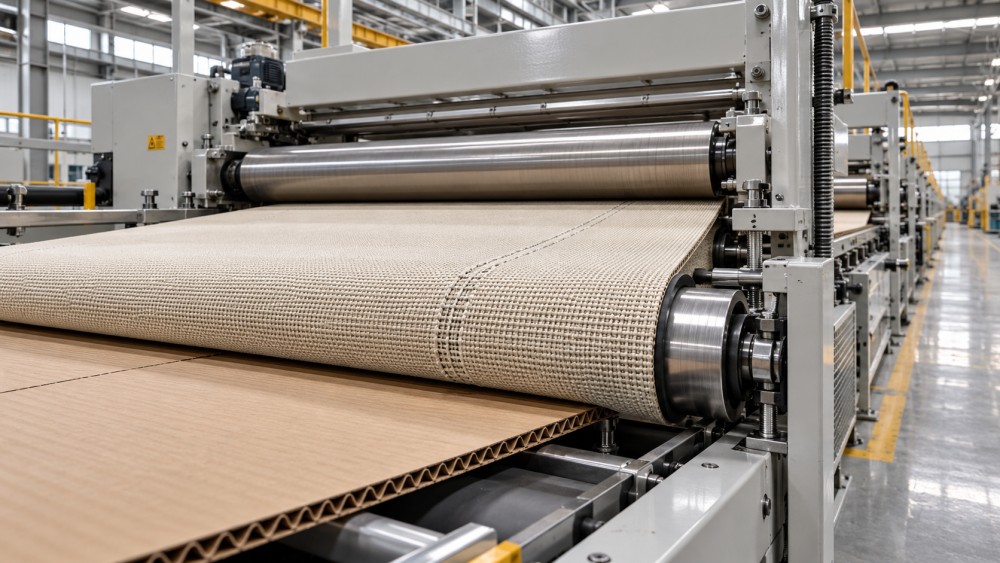
Permeability describes the belt’s ability to allow air to pass through it and is often used as an indicator when assessing moisture-release potential. In the double facer, moisture movement depends on the complete assembly: paper, adhesive, belt construction, pressure, temperature, and the available drying path. A permeability number alone cannot predict bonding performance.
A belt that restricts moisture removal can contribute to a narrow operating window when the board enters the section with a high moisture load. Symptoms may include soft board, delayed bond development, or a need to reduce speed. But those symptoms can also result from excessive adhesive, insufficient heat, or wet paper. Replacing the belt without checking these variables risks transferring an unresolved process problem to a new consumable.
Higher permeability is not automatically better. Construction choices that change airflow can also change surface contact, strength, contamination behaviour, or durability. Ask suppliers to explain the intended trade-off for the proposed belt rather than presenting airflow as a standalone quality ranking.
Comparisons are meaningful only when the permeability figures use the same test method, units, pressure differential, and belt condition. A value measured on a new, clean sample is not necessarily representative after starch, dust, and paper fibres accumulate. Request information on how the supplier measures permeability and how cleaning or wear may affect it over service life.
Heat transfer also needs careful interpretation. The hot plates supply heat to the board, while the belt influences contact, pressure distribution, and moisture movement. A belt’s thickness and construction can affect the thermal behaviour of the system, but a claim of “better heat transfer” should be tied to a defined machine configuration and operating condition. Ask what is being measured: belt temperature, heat flow, bond development, or a change in production speed.
Match belt construction to the pressure system
A double facer belt must be strong enough to carry operating tension while remaining sufficiently stable across its width. If the belt stretches unevenly or tracks inconsistently, it can create edge wear, frequent steering corrections, and variations in contact. Construction should therefore be evaluated in relation to machine width, tensioning equipment, roller geometry, and the pressure applied over the heating section.
Surface condition matters as much as nominal strength. The board-facing surface should provide appropriate contact without introducing repeated impressions or damaging sensitive liners. For thin liners and fine-flute work, ask how the belt and seam surface are finished and whether the proposed construction has limitations for marking-sensitive products. A smooth-looking sample is useful for inspection, but it is not proof of mark-free performance under heat, pressure, and production tension.
Wear resistance should be assessed against the actual source of wear. A belt exposed to abrasive dust, damaged roller surfaces, misaligned edges, or deposits may fail early even if its material is well suited to normal operation. Review whether the current belt wears uniformly or shows localized damage. Edge fraying points to different corrective actions than centre wear, surface glazing, or seam deterioration.
Do not interpret a thicker or heavier belt as inherently more durable. Added material may change flexibility around rollers, heat behaviour, tension requirements, and handling during installation. The relevant question is whether the construction has adequate strength and wear resistance within the machine’s available operating envelope.
Check the seam as a running component, not just a joint
The seam passes through the machine repeatedly and must tolerate bending, tension, heat, and pressure. Its geometry can influence belt tracking, board marking, cleaning, and the time required for installation or repair. The acceptable seam type depends on the equipment layout and the belt manufacturer’s design; it should not be selected solely because it is convenient to join.
Obtain a clear description of the seam profile and its compatibility with the smallest rollers and pressure elements in the belt path. Confirm the joining procedure, required tools, expected installation time, and whether specialist support is needed. If a seam can be repaired on site, establish what damage is repairable and what would require belt replacement.
For quality-sensitive board, ask how seam thickness and surface continuity are controlled. A seam-related mark may repeat at intervals corresponding to the belt circuit length, but a repeating defect is not conclusive evidence by itself: rollers and other rotating components can also produce periodic marks. Measure the defect spacing and compare it with the relevant machine circumferences before assigning the cause.
Confirm fit and speed compatibility before approval
Correct width and endless length are essential, but they are not the whole fit specification. Confirm the measurement method, permitted dimensional tolerances, direction of travel if applicable, and the machine’s available take-up travel. The replacement must fit during installation and remain within the tensioning range as it beds in and changes over its service life.
Check the belt path against drawings and the equipment manufacturer’s requirements. Roller diameter, steering arrangement, edge guides, cleaning devices, and access points can all affect suitability. A belt with the right nominal dimensions can still create problems if its seam cannot pass through the available opening or its construction is incompatible with the machine’s rollers.
Speed capability should be stated for the intended application rather than inferred from a general product description. Ask whether the proposed belt is suitable at the required continuous speed, belt tension, operating temperature, and roller configuration. A maximum speed claim without those conditions offers limited basis for comparison.
For a line running several board grades, assess the belt at the speed where each important grade is actually constrained. A belt that enables a higher speed on one product is not necessarily the better choice if it creates tracking or bonding limitations on the rest of the schedule.
Separate belt problems from process problems
Before using an existing defect as the basis for a new specification, establish whether it changes with the belt’s condition or with other process variables. Weak bonding, for example, can arise from inadequate heat, incorrect adhesive preparation or application, moisture variation, insufficient contact, or excessive line speed. Belt contamination or an unsuitable construction may contribute, but neither should be assumed to be the sole cause.
Compare production records around the defect: board grade, speed, steam conditions, adhesive settings, paper moisture where measured, and the location of the defect across the sheet. Inspect the belt for deposits, uneven wear, seam damage, and tracking marks. Check hot plates and pressure components under the plant’s maintenance procedures. This evidence helps distinguish a specification issue from a maintenance or operating issue.
Warp requires similar caution. Uneven moisture and temperature through the board are central considerations, and the belt is only one part of the drying and cooling path. A belt change may alter the balance, but it should not be sold internally as a guaranteed warp correction without evidence from the complete process.
Evaluate cleaning, installation, and lifetime cost together
Starch, fibre, and dust deposits can change the belt’s surface and reduce the practical benefit of its original permeability. Ask what cleaning methods are approved, which chemicals or mechanical treatments are prohibited, and whether cleaning can be performed in place. An aggressive cleaning method that restores appearance but damages fibres or the seam can shorten service life.
Installation is also a production decision. Compare not only quoted delivery times but the resources needed for shutdown, belt handling, joining, tracking adjustment, and restart. Confirm whether the supplier provides joining instructions, commissioning support, and replacement seam materials appropriate to the site’s maintenance capability.
A useful cost comparison includes the belt price, freight, installation labour, planned downtime, cleaning requirements, and the expected cost of replacement. Add the value of differences in saleable output or waste only where a defensible production baseline exists. Do not treat a supplier’s projected service life or speed increase as a guaranteed saving; use a range and identify the assumptions behind it.
Set acceptance criteria before a production trial
When two belts appear technically suitable, a controlled trial can provide better evidence than catalogue comparisons. Record a baseline for the current belt at comparable board grades, paper sources, line speeds, and process settings. Include bond quality, visible marking, waste, tracking corrections, cleaning frequency, and downtime. Document the condition of the old belt, since comparing a new belt with an end-of-life belt can exaggerate the apparent improvement.
Agree in advance on trial duration, operating range, inspection points, and the method for recording results. Avoid changing adhesive formulation, pressure settings, and steam conditions at the same time unless those adjustments are necessary for safe and stable operation. If changes are unavoidable, log them so that a result is not attributed to the belt without qualification.
The final specification should describe the machine constraints, required operating range, belt dimensions and tolerances, construction, seam, measurement methods, and support arrangements. Acceptance should depend on stable performance across the relevant production mix—not on a single permeability figure, a maximum-speed claim, or the lowest purchase price.
Related News
 KPS to Acquire 70% of MM Packaging at €2.4 Billion Enterprise ValueKPS will acquire 70% of MM Packaging at a €2.4 billion enterprise value. Explore what the deal means for the packaging business and its customers.Corrugated Thermodynamics Architect
 How to Size Bridge Conveyors for a Corrugator LineSize Bridge Conveyors for your corrugator line with practical guidance on web accumulation, sheet throughput, layout, and controls. Avoid costly bottlenecks.Corrugated Thermodynamics Architect
 Nine Dragons Paper Raises Chongqing Corrugated Paper Price by 50 Yuan per TonneNine Dragons Paper raises Chongqing corrugated paper prices by 50 yuan per tonne. See when the increase takes effect and what it means for packaging costs.Corrugated Thermodynamics Architect
 How Automatic Warp Control Systems Improve Corrugated Board FlatnessDiscover how automatic warp control systems improve corrugated board flatness, reduce production waste and support more reliable converting.Corrugated Thermodynamics Architect
 How to Evaluate a Sheet Stackers Factory for Your Production LineEvaluate a sheet stackers factory with confidence. Compare capacity, line integration, acceptance tests and service to choose the right supplier for your production line.Corrugated Thermodynamics Architect
 What to Ask a Starch Mixer Manufacturer Before OrderingChoosing a starch mixer manufacturer? Ask these essential questions about capacity, pricing, automation and support before you order.Corrugated Thermodynamics Architect