How corrugator warp control systems Prevent Board Distortion
A board can look acceptable at the stacker and still become a converting problem an hour later. It may curl toward one liner, arch across the flute direction, or twist diagonally after cooling. At that point, printing registration becomes less stable, die-cutting can lose accuracy, and operators may have to slow the line or isolate affected bundles. Corrugator warp control systems prevent board distortion by keeping heat, moisture, web tension, and adhesive application balanced between the two faces of the board. They do not “correct” a warped sheet at the end of the process; they reduce the imbalance that creates warp while the board is being formed and dried.
The practical response is to identify the direction and timing of the warp before changing machine settings. A board that consistently curls toward one side usually points to an imbalance between liners. A board that changes shape from order to order may be reacting to paper grade, incoming moisture, preheater wrap, or speed changes. Good warp control starts with a stable process baseline, then makes measured adjustments rather than treating every distortion with more heat or more glue.
Warp is a balance problem, not a single-machine problem
Corrugated board is made from paper webs that enter the corrugator with different moisture contents, basis weights, fiber orientations, and stored stress. During production, the medium is fluted, adhesive is added, liners are bonded, and the finished web passes through heat and pressure. Each component expands, absorbs moisture, dries, and contracts at a slightly different rate. When one side of the board leaves the process in a different condition from the other, the sheet bends toward the side with the stronger pull.
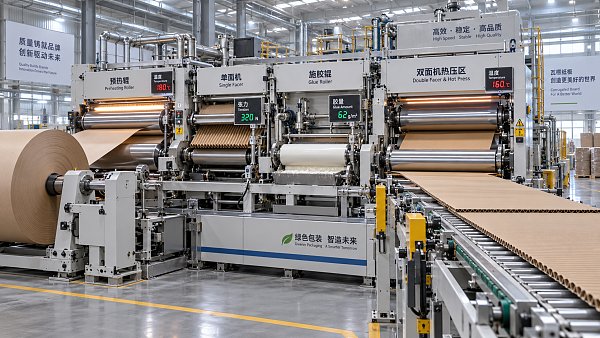
Operators often see warp described by its visible shape, but the shape is only the symptom. The useful question is: which side of the board is leaving the corrugator drier, wetter, hotter, or under greater tension? A corrugator warp control system brings together the adjustment points that influence that condition. Depending on the line design, those points may include preheater wrap control, steam showers, moisture application, brake and tension settings, adhesive metering, hot plate zones, belt pressure, and cooling conditions.
A stable board does not require both liners to have identical properties. It requires the process to account for their differences. Heavy kraft liner paired with a lighter or more moisture-sensitive liner, for example, may need different preconditioning on each side. The same applies when a recycled liner is substituted for a grade that had a different moisture profile or stiffness.
Read the board before touching the controls
Warp direction provides a fast starting point, provided the board is evaluated after it has had time to cool under normal handling conditions. Looking only at a hot sheet near the delivery can be misleading because the web is still releasing heat and moisture. Check several sheets from different positions across the machine width, and separate a persistent pattern from an isolated sheet defect.
Do not assume that the side toward which the board curls is simply the “wet side.” Paper behavior depends on the combined effect of moisture gain, drying rate, fiber structure, and restraint through the machine. The table is therefore a diagnostic guide, not a fixed rule. It helps narrow the search so that adjustments can be made with a reason.
Start with the incoming paper condition
Warp control becomes difficult when the corrugator is asked to compensate for unstable paper. Rolls stored in very different conditions can enter with unequal moisture content even when they carry the same grade description. A roll with uneven edge moisture, telescoping, loose winding, or local damage may create a recurring issue that no downstream setting can fully eliminate.
Before changing heat settings, verify that the correct paper has been loaded and that roll positions match the order setup. Compare the affected board against a stable order made with known material combinations. Examine the liner and medium for edge waviness, slack areas, tight edges, damaged roll ends, or noticeable variation across width. These signs can indicate moisture or tension problems before the paper reaches the single facer or double backer.
Paper should also have sufficient time to equalize to the plant environment before running. This is not a recommendation to delay every roll unnecessarily; it is a reminder that sudden temperature and humidity differences can show up as dimensional instability. When the board problem begins immediately after a paper change, retain samples and record the roll identity, position, and observed warp direction. That record is more useful than a general note that the board “ran badly.”
Use preconditioning to equalize the two faces
Preheaters and moisture-conditioning devices are among the most responsive tools in corrugator warp control systems. Their purpose is not simply to make paper hot. Preheating changes how quickly paper accepts adhesive, how it travels through the hot section, and how much drying demand reaches each board component. Steam or water-based conditioning, where fitted and correctly maintained, can restore flexibility to an over-dry web or help equalize moisture before bonding.
Preheater wrap angle affects the amount of contact between paper and the heated drum. More wrap generally increases heat transfer, but the appropriate setting depends on line speed, paper grade, incoming condition, and the stage of the process. Raising wrap on both liners whenever warp appears can make the board less stable, especially if one liner was already over-conditioned.
A more controlled approach is to make one change on the side suggested by the warp pattern, then allow enough board to pass for the change to be visible after cooling. Record the previous and new setting, production speed, and result. Rapidly changing wrap, steam, and hot plate settings at the same time makes it impossible to identify which action improved or worsened the board.
Signs that preconditioning is being used poorly
- Warp direction reverses repeatedly after operators make large heat adjustments.
- Board flatness improves briefly but bonding becomes inconsistent.
- The center of the board is flat while both edges lift, suggesting uneven cross-width conditioning.
- Stable board is achieved only by running slower than the planned operating speed.
- The same recipe behaves differently after a paper supplier, roll storage, or seasonal condition changes.
These conditions do not automatically mean the preheater is at fault. They indicate that the process needs to be checked as a linked system rather than adjusted by one control alone.
Adhesive settings affect warp even when bond looks acceptable
Starch adhesive introduces water into the board, and that water must be managed through the drying section. Excessive application can increase drying demand and create moisture imbalance, particularly when one face receives more adhesive effect than the other. Insufficient application, however, can create weak bonding, loose flute tips, and uneven contact that also changes drying behavior.
Inspect adhesive application at both single facer and double backer stages. Check that glue rolls, metering systems, doctor settings, and applicator gaps are clean and consistent across the width. A board may show good average adhesion while still having localized areas of excessive or insufficient glue. Those local variations often appear as edge curl, cross-machine bow, or a distortion that changes across the sheet.
Adhesive formulation and temperature also matter, but operators should avoid changing chemistry to solve a problem that is actually caused by paper moisture or heat transfer. Verify the established adhesive operating conditions first. If glue pickup must be changed, do so in small controlled increments and monitor bond quality alongside flatness. A flatter board with marginal bonding is not a successful correction.
Control the drying section without overheating one side
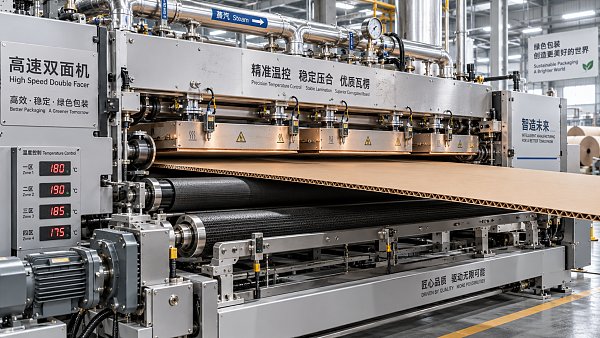
The double backer is where small upstream differences can become permanent board distortion. Hot plates, pressure belts, contact time, steam settings, and machine speed determine how the combined board is cured and dried. A change in speed changes dwell time through the hot section. If the heat and moisture settings remain fixed while speed changes significantly, the balance that produced flat board at one condition may no longer hold.
When warp appears after acceleration, first determine whether the board is under-dried, over-dried, or unevenly dried. Under-drying may be accompanied by poor bond development, soft board, or moisture retained in one face. Over-drying can leave the board brittle, excessively curled, or prone to cracking during scoring. Uneven drying can be more subtle: board flatness may vary from operator side to drive side, or from leading edge to trailing edge.
Check that hot plates are heating evenly and that pressure belts provide uniform contact. Worn belts, contamination, poor tracking, uneven pressure loading, or damaged plate surfaces can create cross-width differences that cannot be corrected by a general steam setting. Edge areas deserve particular attention because they lose heat differently and may be affected by trim width, paper alignment, or reduced belt contact.
Tension errors often look like moisture errors
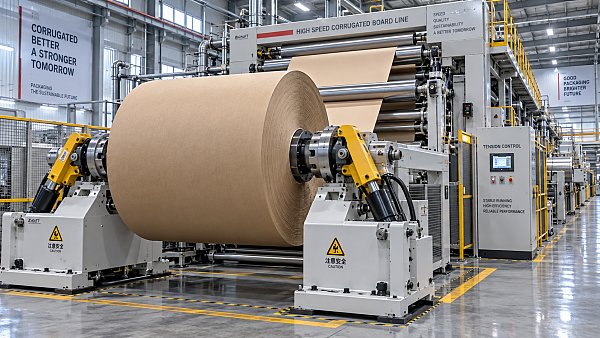
A tight paper web can shrink or recover differently from a relaxed web after heating. This is why tension should be considered whenever warp is accompanied by web breaks, unstable tracking, flute damage, or frequent changes in roll diameter. Brake settings that are too aggressive may create side-to-side stress. Unstable brake response can create changing tension that makes board behavior inconsistent from one portion of the roll to another.
Look beyond the numerical tension setpoint. Confirm that brakes respond smoothly, dancer or load-cell feedback is functioning, rolls are correctly aligned, and the web path is free from dragging guides or contaminated rollers. A paper web may also enter with internal tension from winding. In that case, reducing downstream tension alone may not fully remove the effect, but it can prevent the corrugator from adding more stress.
Diagonal warp is especially worth investigating for alignment and tension issues. Check whether the web tracks squarely through preheaters, single facers, bridges, and the double backer. A slight skew combined with uneven moisture can create twist that seems random until the web path is examined.
A practical adjustment sequence during production
When output must continue, the aim is not to adjust every available control. Use a sequence that protects board quality and makes the response traceable.
- Confirm the symptom. Identify warp direction, whether it is machine-direction, cross-direction, or diagonal, and whether it occurs across the whole width or near an edge.
- Check the recent change. Review paper roll changes, grade substitutions, speed increases, order transitions, adhesive preparation, and steam or heating alarms.
- Inspect the board condition. Compare liner appearance, bond quality, flute formation, moisture feel, edge condition, and flatness after cooling.
- Select one primary correction. Adjust the conditioning, heat exposure, or tension on the side most likely to be out of balance. Avoid simultaneous changes unless a clear equipment fault requires immediate action.
- Wait for a meaningful response. Evaluate sheets after the process has stabilized, not just the first sheet leaving the machine.
- Verify converting suitability. Check whether the board remains flat through stacking, transport, printing, scoring, or die-cutting conditions relevant to the order.
- Document the usable setting. Record the material combination, speed range, relevant controls, and final board behavior so the next setup starts closer to a proven condition.
This sequence is slower than making broad corrections by instinct, but it usually reduces waste because it preserves the link between cause and result. It also helps distinguish a repeatable recipe issue from a mechanical problem that needs maintenance attention.
When control settings cannot solve the distortion
Some warp problems are symptoms of equipment condition rather than recipe selection. Persistent cross-width bow can indicate uneven steam distribution, blocked nozzles, poor condensate removal, non-uniform hot plate performance, or pressure-belt wear. Repeated edge curl on the same side may be related to alignment, heat loss, damaged sealing, or a local applicator issue. A sudden change in behavior with no material or setup change may justify inspection of sensors, valves, brake feedback, or control-loop response.
Automation is most useful when it supports consistent observation. Moisture, temperature, tension, speed, and recipe data can help operators see whether an adjustment produced the expected process change. Yet measured values should be compared with the physical board. A sensor may report a normal condition while a dirty applicator, poor contact surface, or uneven paper roll creates a local defect outside that measurement point.
Flat board is the result of controlled balance, not maximum drying or maximum pressure. Once operators connect the visible warp pattern to paper condition, conditioning, adhesive water, heat exposure, and web tension, corrugator warp control systems become practical production tools rather than a collection of isolated settings.
Related News
 What Determines Compression Section Price in Corrugator ProjectsCompression section price depends on width, speed, pressure control, heating, automation, and integration. Learn how to compare quotes and maximize corrugator ROI.Corrugated Thermodynamics Architect
 How a Servo Driven Folder Gluer Machine Improves Carton AccuracyDiscover how a servo driven folder gluer machine improves carton accuracy through synchronized motion, repeatable folding, precise glue placement, and faster changeovers.Corrugated Thermodynamics Architect
 How Carton Making Machines Improve Output in High-Mix PlantsCarton Making Machines help high-mix plants increase sellable output with faster changeovers, lower waste, reliable quality control, and smoother workflow integration.Corrugated Thermodynamics Architect
 Corrugator Control Systems That Improve Board Quality and UptimeCorrugator Control Systems improve board quality, reduce waste, and increase uptime with coordinated heat, moisture, tension, glue, and speed control.Corrugated Thermodynamics Architect
 How High Speed Feeder Systems Support Faster Corrugator OutputHigh speed feeder systems help corrugator plants improve stable throughput, reduce feeding delays, protect board quality, and maximize converting efficiency.Corrugated Thermodynamics Architect
 Heavy Duty Unwind Stands That Stabilize High-Speed CorrugatorsHeavy duty unwind stands stabilize high-speed corrugators with precise tension control, secure reel handling, and smoother roll changes. Discover how to reduce breaks, waste, and downtime.Corrugated Thermodynamics Architect