How a Servo Driven Folder Gluer Machine Improves Carton Accuracy
Accuracy Is Controlled Through Motion, Not Just Mechanical Adjustment
A carton can be die-cut accurately and still fail at the folder gluer. Uneven folding, drifting blanks, glue lines that move relative to the panel, or a poorly controlled transfer through the carrier section can produce cartons that look acceptable when flat but run poorly on a customer’s packing line. For technical evaluators, the practical question is whether a servo driven folder gluer machine can hold the folding and gluing relationship more consistently than a conventional mechanically linked system under the plant’s actual mix of board, carton styles, and production speeds.
In many applications, it can. Servo control gives the machine independent, programmable control over transport sections, folding carriers, side guides, glue-related timing, and delivery functions. That control can reduce the small positional variations that accumulate as a blank moves from feed to pre-fold, final fold, compression, and delivery. The benefit is most visible where cartons have tight visual requirements, complex folding geometry, short repeat orders, or a high cost of downstream packing disruption.
It is not an automatic guarantee of better cartons. A servo system cannot correct poor creasing, warped blanks, unstable board moisture, unsuitable adhesive, worn belts, or inadequate setup discipline. Its value comes from making the machine’s movements repeatable and adjustable, so those remaining process variables can be identified and managed instead of being hidden inside a largely mechanical drive arrangement.
Where Carton Accuracy Is Lost in the Folding Process
Folder gluer accuracy is often discussed as though it were a single number. In operation, it is a chain of relationships. The blank must enter squarely, travel at a controlled speed, reach the glue application point in the intended position, fold on the correct score lines, and remain aligned while adhesive is compressed and set. A deviation at one stage can be amplified at the next.
Consider a straight-line carton with a narrow glue flap. If the blank enters the machine slightly skewed, the flap may meet the opposing panel with an inconsistent overlap. If the left and right folding actions do not remain synchronized with the blank’s travel, the carton can show a diagonal body, unequal panel widths, or a glue joint positioned too close to an edge. For lock-bottom, crash-lock, four-corner, six-corner, and other complex styles, the sequence is even more sensitive. Multiple panels must reach their folding positions at the right moment and with the right relative speed.
Mechanical systems can achieve good output when they are well maintained and run stable, repeated work. Their limitation emerges when adjustments require physical repositioning, when product geometry changes frequently, or when sections of the machine must behave differently from one another. Gear trains, shafts, clutches, cams, and manually set carriers introduce coupling between functions. An adjustment intended to improve one section may influence another. Fine tuning then depends heavily on operator experience and may take several trial runs before acceptable cartons are produced.
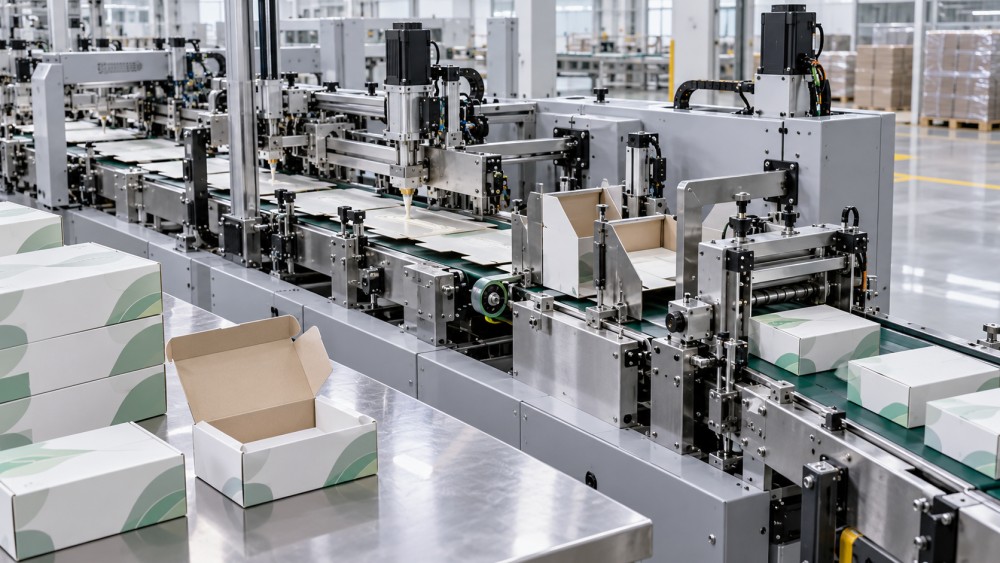
A servo driven folder gluer machine replaces part of that fixed relationship with electronically coordinated motion. Each driven section still requires robust mechanical construction, but its speed, phase, position, acceleration, and timing can be controlled through the machine program. The machine can maintain a defined motion relationship between sections rather than relying only on a shared mechanical transmission path.
How Servo Control Improves Folding Repeatability
The most important contribution of servo technology is synchronized motion. A folding operation works well when the blank’s linear movement and the action of the folding components remain predictable relative to each other. Servo drives use feedback from encoders to monitor motor position and speed, allowing the control system to correct deviations from the commanded movement. This is especially useful when the machine accelerates, decelerates, changes product format, or operates at a speed where small timing errors become visible in the finished carton.
Independent drive zones also allow a more deliberate approach to carton handling. The feeder may need to maintain stable blank spacing; the folding section may require a carefully controlled differential to guide a panel into position; and the delivery section may need to match the carton stream without scuffing or opening the glue seam. A common mechanical speed relationship is efficient for standard work, but it offers less freedom when a particular carton style needs different behavior in different stages.
For evaluators, the useful question is not simply how many servo motors a machine has. It is which motions are servo-controlled and why. Servo-driven carrier sections, transport belts, pre-fold devices, back-folding units, and delivery systems can each affect accuracy differently. A machine with servo control concentrated only in setup functions may shorten adjustments, yet offer less improvement in dynamic folding stability than a design with synchronized control across the critical production sections.
Servo control can also make controlled speed differentials more repeatable. Some cartons benefit from a slight relative-speed adjustment between carriers to keep a panel under tension or to bring a fold into alignment. Applied carelessly, a differential can stretch, buckle, scuff, or distort the board. Applied consistently, it can help maintain panel alignment through the fold. Programmable motion makes these settings easier to reproduce, provided they are validated for the board grade and carton construction in use.
Glue Placement Benefits From Better Sheet Positioning
Glue application is frequently treated as a separate subject from folding accuracy. In reality, the two are closely linked. A glue bead may be dispensed consistently from the applicator, yet still appear misplaced on the carton if blank transport is unstable. A carton that shifts laterally, changes pitch, or twists slightly before reaching the glue station will change the relationship between the adhesive pattern and the glue flap.
Servo-synchronized transport can improve this relationship by stabilizing sheet position and timing through the relevant section. It is particularly useful where adhesive placement has narrow tolerance, where a carton contains windows or internal structures, or where excess adhesive creates quality problems. Carton accuracy in these jobs is more than final squareness. It includes clean glue boundaries, sufficient bond area, absence of squeeze-out, and repeatable panel overlap after compression.
That said, servo motion does not replace adhesive process control. No drive system can compensate for a nozzle that is partially blocked, an adhesive viscosity outside its operating range, a poorly maintained applicator, or board contamination in the bond area. Evaluation should treat glue control as a combined system: blank registration, applicator response, adhesive condition, glue pattern verification, folding geometry, and compression time.
Where product risk justifies it, inspection should be considered alongside the folder gluer rather than after packing. Cameras or other verification methods can detect visible glue defects, carton orientation errors, flap position problems, or missing features, depending on the inspection design. The purpose is not to assume every carton can be inspected in the same way, but to establish whether the quality requirement needs confirmation beyond machine settings and periodic manual checks.
Faster Changeovers Matter Because Setup Errors Are Accuracy Errors
Servo systems are often promoted for faster job changes. The stronger technical argument is that recipe-based adjustment can make a correct setup easier to recover. For plants processing frequent short runs, the quality loss during changeover can exceed the apparent time loss. Operators may need to reset carrier positions, belt speeds, folding guides, pre-fold configuration, glue timing, and delivery compression. Each adjustment has the potential to create a carton that is nearly correct but outside the customer’s functional tolerance.
Stored job parameters can reduce dependence on memory and manual estimation. When the same approved carton returns, a servo-controlled machine may recall relevant electronic positions, timing relationships, and operating values. Mechanical guides, support rails, feed settings, and tooling may still require manual work; “automatic setup” should therefore be read carefully in supplier specifications. The useful distinction is between settings that are genuinely motorized and recipe-controlled, settings that are manually adjusted but indicated digitally, and settings that remain entirely dependent on operator judgment.
A good evaluation should ask how the machine manages correction after the first cartons are checked. If an operator finds that one panel is closing slightly early or the glue flap overlap needs refinement, can the relevant parameter be adjusted independently and repeatably? Can the approved correction be saved with the job? Is access controlled so a temporary workaround does not become the permanent setting for future production? These questions reveal more about practical accuracy than a generic claim of “fully servo driven.”
Accuracy Gains Depend on the Carton and the Upstream Process
Servo-driven motion produces the greatest value where the folding process is a meaningful source of variation. Examples include cartons with narrow glue flaps, high graphic sensitivity, complex pre-folds, multi-panel structures, heavy ink coverage prone to scuffing, or dimensions that must run reliably in automated filling equipment. It can also be relevant for carton plants with a wide job mix, recurring short orders, and several operators who need to reproduce approved settings consistently.
For simple, high-volume cartons made from stable material on a well-maintained conventional folder gluer, the incremental benefit may be smaller. A mechanical machine that is correctly selected, set, and maintained can produce satisfactory results. Investing in servo capability only makes commercial sense when its improved setup control, repeatability, capacity flexibility, or reduced waste addresses a measurable production constraint.
Upstream die-cut and crease quality remain fundamental. Score depth, crease rule condition, grain direction, board caliper variation, die-cut registration, stripping quality, and blank flatness all influence the way a carton folds. A servo-driven folder gluer can repeat a folding path accurately, but it cannot make inconsistent creases behave identically. In some cases, a plant investigating folder gluer inaccuracy will find the root cause in die-cutting or board conditioning rather than in the gluer itself.
What to Verify During a Technical Evaluation
Technical evaluation should move beyond an unloaded machine demonstration. Request representative blanks, including the difficult carton styles and board grades that drive complaints, rework, or slow running. The purpose is to observe stability across a realistic production sequence: startup, speed increase, normal operation, adjustment, stoppage, restart, and job change.
- Identify each servo axis and the production function it controls. Ask whether it affects runtime accuracy, setup repeatability, or both.
- Review the machine’s feedback architecture, alarm handling, fault recovery method, and the availability of diagnostic information for maintenance teams.
- Check how recipes are created, protected, recalled, and revised after quality approval. A large recipe library is of limited use without disciplined version control.
- Measure finished cartons against the dimensions and functional requirements that matter to the customer, including squareness, flap overlap, glue joint position, opening behavior, and performance in any downstream packing process.
- Observe output at more than one operating speed. A carton that is acceptable at a conservative speed may reveal transport or folding instability as speed rises.
- Clarify which adjustments remain manual. Assess access, scale readability, repeatability, and the time needed to return those elements to an approved position.
- Evaluate support for belts, rollers, sensors, encoders, drives, and control components. Motion accuracy degrades when routine wear is treated as an unexpected failure.
It is also useful to distinguish positional accuracy from production capability. A supplier may show precise electronic positioning, but carton quality depends on the whole mechanical path: frame rigidity, belt tracking, carrier design, fold rail geometry, glue system consistency, compression section behavior, and delivery control. Servo technology improves how the machine moves; it does not remove the need for sound mechanical engineering.
The Practical Investment Case
The most defensible investment case is usually built around avoidable variation. Plants can examine how much time is spent reaching approved setup, how often cartons require manual correction after restart, how much material is consumed during adjustment, and whether folding defects create sorting, customer complaints, or disruption at packing. Those operational losses are more useful than a broad claim that automation always improves quality.
A servo driven folder gluer machine is best viewed as a control platform for repeatable conversion, not as a substitute for process discipline. It can tighten the relationship between blank transport, glue application, folding, and delivery. For cartons where those relationships determine functional fit or visual acceptance, the improvement can be substantial. For evaluators, the decision should rest on the carton portfolio, the sources of present variation, the machine’s actual controlled axes, and evidence that approved settings can be reproduced across operators and repeat jobs.
Related News
 KPS to Acquire 70% of MM Packaging at €2.4 Billion Enterprise ValueKPS will acquire 70% of MM Packaging at a €2.4 billion enterprise value. Explore what the deal means for the packaging business and its customers.Corrugated Thermodynamics Architect
 How to Size Bridge Conveyors for a Corrugator LineSize Bridge Conveyors for your corrugator line with practical guidance on web accumulation, sheet throughput, layout, and controls. Avoid costly bottlenecks.Corrugated Thermodynamics Architect
 Nine Dragons Paper Raises Chongqing Corrugated Paper Price by 50 Yuan per TonneNine Dragons Paper raises Chongqing corrugated paper prices by 50 yuan per tonne. See when the increase takes effect and what it means for packaging costs.Corrugated Thermodynamics Architect
 How Automatic Warp Control Systems Improve Corrugated Board FlatnessDiscover how automatic warp control systems improve corrugated board flatness, reduce production waste and support more reliable converting.Corrugated Thermodynamics Architect
 How to Evaluate a Sheet Stackers Factory for Your Production LineEvaluate a sheet stackers factory with confidence. Compare capacity, line integration, acceptance tests and service to choose the right supplier for your production line.Corrugated Thermodynamics Architect
 What to Ask a Starch Mixer Manufacturer Before OrderingChoosing a starch mixer manufacturer? Ask these essential questions about capacity, pricing, automation and support before you order.Corrugated Thermodynamics Architect