How Steam Pressure and Capacity Affect Boiler Prices for Corrugators
Steam pressure and capacity affect steam boiler price through different engineering requirements. Pressure determines the saturation temperature available to heat corrugating rolls, preheaters, and double-facer hot plates. Capacity determines how much steam the boiler can supply as those surfaces transfer heat into paper and adhesive. A sound specification establishes the required pressure at the corrugator, then calculates the steam flow needed across the production range, including credible peak loads.
Comparing quotations by rated steam output alone leaves significant differences unresolved. The quoted output must be tied to operating pressure, feedwater temperature, fuel, and steam condition. The installed price also includes the equipment needed to deliver that output reliably: distribution piping, pressure controls, condensate handling, water treatment, and combustion auxiliaries.
Start with pressure at the heating surface
For saturated steam, temperature rises with absolute pressure. The pressure available inside a heating cylinder or hot plate therefore sets the steam-side temperature from which heat flows into the board. Actual surface temperature also depends on heat-transfer resistance, condensate drainage, and production load. A boiler pressure reading alone cannot establish whether the corrugator receives adequate heat.
Three pressure values need separate identification: boiler operating pressure, pressure at the machine inlet, and pressure within each controlled heating zone. Pipe friction, fittings, control valves, and separators consume part of the available pressure difference. These losses increase as steam flow rises, so an installation that performs adequately during slow running can lose process pressure during a demanding production run.
The pressure specification should state the required machine-inlet pressure at the maximum simultaneous steam flow. It should also identify whether values are gauge or absolute pressure. Steam tables use absolute pressure for thermodynamic relationships; mixing the two conventions produces incorrect temperature and volume calculations.
Higher steam pressure does not automatically improve board quality. Required heat input changes with paper basis weight, incoming moisture, flute construction, adhesive application, wrap angle, and line speed. Excessive heating can disturb the moisture balance and contribute to warp. Separate pressure control for heating zones allows the heat profile to follow the board construction without forcing every zone to operate at the boiler header pressure.
Where higher pressure adds purchase cost
Design pressure governs the pressure-containing structure. Raising it can require thicker material, different component ratings, revised connections, and additional fabrication or inspection work under the applicable construction rules. The cost increase is not necessarily proportional to the pressure increase: crossing a design or component-rating boundary can change the quotation more sharply than a small adjustment within an existing design range.
Maximum allowable pressure and normal operating pressure serve different purposes. A boiler offered with a higher allowable pressure does not necessarily deliver more useful heat during normal production. Quotations need to identify the intended operating band, control settings, and the relationship between operating pressure and protective devices.
Pressure also affects equipment beyond the boiler shell. Stop valves, strainers, separators, pressure-reducing stations, instruments, and portions of the condensate system must suit their actual pressure and temperature exposure. A quotation covering only the boiler package conceals these consequences until piping and installation are priced.
There is a countervailing distribution effect: at higher pressure, steam occupies less volume per unit mass. For a given mass flow, this can reduce the pipe diameter needed to satisfy velocity and pressure-drop limits. Any resulting saving must be assessed against higher-rated components and downstream pressure reduction. It does not establish that a higher-pressure installation will cost less overall.
Convert corrugator demand into a defined steam rating
Boiler capacity should represent a mass flow under stated conditions, commonly expressed as kilograms or tonnes of steam per hour. Some quotations instead use thermal output, boiler horsepower, or equivalent evaporation. These ratings cannot be compared directly without converting them to the same basis.
The governing heat balance is:
Steam-generation heat duty = steam mass flow × (outlet steam enthalpy − feedwater enthalpy).
This relationship explains why feedwater temperature belongs in a quotation. At the same steam output and pressure, colder feedwater requires more heat input. Fuel consumption then depends on boiler efficiency at the relevant load, using a declared fuel heating-value basis. Comparing one efficiency stated on a lower heating value with another stated on a higher heating value creates a misleading result.
Corrugator demand should be assembled from the actual heating duties: preheaters and preconditioners, heated rolls, double-facer hot plates, and other connected steam consumers. Useful inputs include working width, production speed, paper combinations, incoming paper condition, and the machine supplier’s steam-consumption data. A generic consumption-per-board-area figure is insufficient unless its operating conditions resemble the proposed production mix.
Measured demand from an existing line provides stronger evidence when the operating context is recorded alongside it. Steam flow, header pressure, board grade, speed, and stoppages should share a common time reference. Otherwise, an average flow value can conceal the peak that causes pressure to collapse during acceleration or a grade change.
Separate sustained production from short demand peaks
Cold startup and steady production place different demands on the steam system. Startup heats metal, pipework, and equipment that have cooled during shutdown. Production demand follows heat transfer into the moving paper and adhesive. Adding every possible startup duty to the highest production load produces an oversized specification if those events do not actually coincide.
A load profile should distinguish continuous requirements from temporary peaks and identify their duration. Staggered warmup can reduce simultaneous demand where the production schedule permits it. Where a rapid peak is unavoidable, the boiler’s response rate and stored thermal energy matter alongside its nameplate capacity.
A steam accumulator is another possible response to brief, intermittent demand, but its usable storage depends on the permitted pressure swing. It requires pressure-vessel space, controls, and integration work. It also needs sufficient time and spare generation capacity to recharge between peaks. An accumulator cannot compensate for a sustained production load that exceeds boiler output.
Capacity reserve needs a stated purpose. Future line expansion, a defined startup requirement, and equipment redundancy are different design objectives. Combining allowances for all three without identifying their overlap inflates both capital cost and low-load operating exposure.
Oversizing changes the operating economics
A larger boiler generally requires more equipment, space, and supporting infrastructure. Its operating penalty becomes pronounced when production frequently falls below the burner’s minimum stable firing rate. Repeated starts and stops introduce purge losses and increase cycling of ignition and control components.
Burner turndown describes the relationship between maximum and minimum firing rates, but it does not fully describe the boiler’s useful operating range. Stable combustion, emissions performance where specified, pressure control, and efficiency must remain acceptable at the proposed low load. A headline turndown ratio alone does not demonstrate that performance.
Frequent short orders and reduced-speed running make the lower end of the demand profile especially relevant. A boiler sized around the most demanding board combination can spend much of its service life at partial load. Fuel comparisons should therefore use the expected operating hours at several loads, rather than relying exclusively on full-load efficiency.
Multiple boilers offer staged capacity and maintenance flexibility, at the cost of additional valves, controls, connections, and installation work. Their value depends on how closely the available stages match actual demand. Redundancy must be stated explicitly: two installed units do not provide full production backup if both are required to meet the normal load.
Resolve delivery problems before adding capacity
Low corrugator pressure can originate in generation or distribution. If boiler pressure remains stable while machine-inlet pressure falls, the restriction is likely downstream: undersized piping, a control valve with inadequate flow capacity, or an obstructed strainer are possible causes. Increasing boiler capacity will not remove that restriction.
Heating problems also occur with adequate pressure. Condensate retained inside heated equipment reduces effective heat transfer. Drainage depends on the pressure difference available across traps or other discharge devices, including return-line backpressure. When a temperature-control valve reduces steam pressure, the available drainage differential can disappear. That condition calls for a drainage assessment, potentially including pumping arrangements.
Wet steam creates another source of confusion. Entrained water reduces useful heat delivered per unit mass and can disrupt control or contribute to water hammer. Boiler water level, rapid load changes, water chemistry, and outlet separation affect carryover. A larger nameplate rating is of limited value if acceptable steam quality cannot be maintained during demand changes.
Make the installed-price comparison technically equivalent
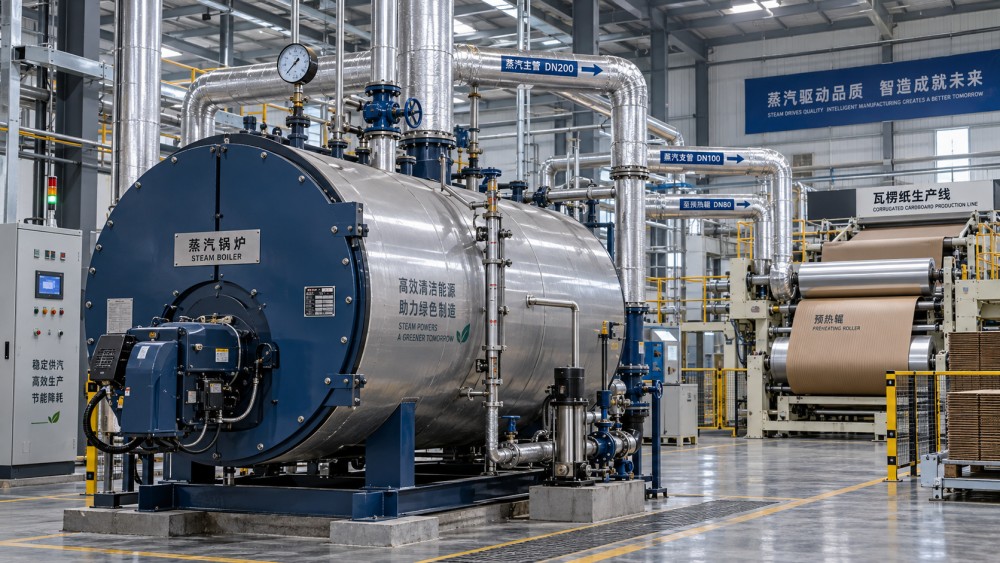
A meaningful steam boiler price comparison uses a common scope boundary. The boiler package, burner, feedwater system, water treatment, blowdown equipment, economizer, fuel supply equipment, flue, controls, and site connections need explicit inclusion or exclusion. Pressure and capacity selections change several of these items together, so comparing only the vessel price understates the investment difference.
Condensate return deserves particular attention. Hot returned condensate reduces the heat needed to generate steam, but the assumed return temperature and quantity must reflect the actual plant arrangement. Flashing during pressure reduction, venting, and return-pipe losses affect what reaches the feedwater system. An optimistic return assumption makes projected fuel consumption look better without changing boiler performance.
Acceptance conditions should connect the quoted equipment to the required operating result: sustained steam output, pressure stability during an agreed load change, fuel consumption on a declared basis, and specified steam quality. Measurements need defined locations because boiler-outlet performance and machine-inlet performance describe different boundaries. With those conditions fixed, the price difference between proposals becomes traceable to pressure capability, usable capacity, and the equipment required to deliver both.
Related News
 KPS to Acquire 70% of MM Packaging at €2.4 Billion Enterprise ValueKPS will acquire 70% of MM Packaging at a €2.4 billion enterprise value. Explore what the deal means for the packaging business and its customers.Corrugated Thermodynamics Architect
 How to Size Bridge Conveyors for a Corrugator LineSize Bridge Conveyors for your corrugator line with practical guidance on web accumulation, sheet throughput, layout, and controls. Avoid costly bottlenecks.Corrugated Thermodynamics Architect
 Nine Dragons Paper Raises Chongqing Corrugated Paper Price by 50 Yuan per TonneNine Dragons Paper raises Chongqing corrugated paper prices by 50 yuan per tonne. See when the increase takes effect and what it means for packaging costs.Corrugated Thermodynamics Architect
 How Automatic Warp Control Systems Improve Corrugated Board FlatnessDiscover how automatic warp control systems improve corrugated board flatness, reduce production waste and support more reliable converting.Corrugated Thermodynamics Architect
 How to Evaluate a Sheet Stackers Factory for Your Production LineEvaluate a sheet stackers factory with confidence. Compare capacity, line integration, acceptance tests and service to choose the right supplier for your production line.Corrugated Thermodynamics Architect
 What to Ask a Starch Mixer Manufacturer Before OrderingChoosing a starch mixer manufacturer? Ask these essential questions about capacity, pricing, automation and support before you order.Corrugated Thermodynamics Architect