How Paper Reel Handling Systems Reduce Corrugator Downtime
Paper reel supply interruptions can disrupt a corrugator’s schedule, increase waste, and put delivery commitments at risk. Paper Reel Handling Systems coordinate reel transport, positioning, and changeovers at the wet end.
For project managers and engineering leaders, the investment is most compelling when delayed reel delivery or unreliable preparation causes measurable production losses. Integration and operating discipline determine the result.
Where Do Reel Handling Systems Prevent Corrugator Downtime?
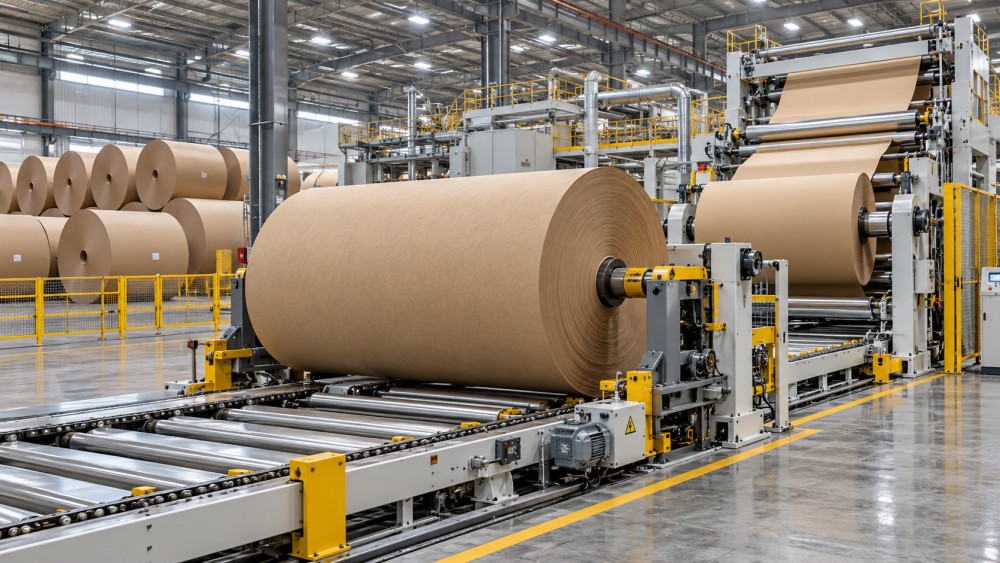
A corrugator needs a continuous supply of liner and medium reels to several unwind positions. An interruption at one position can affect the entire board line.
A typical supply sequence begins with identifying the next reel, moving it from storage, preparing it for use, and delivering it to the correct stand.
The reel is then loaded, aligned, and prepared for splicing. Once the running reel is nearly depleted, the splicer joins the new web to maintain production.
Handling systems support that sequence with equipment such as conveyors, transfer cars, reel loading devices, staging positions, and controls. Their configuration varies by plant.
They reduce downtime when they make the next usable reel available before the splice window closes. They can also reduce speed losses caused by uncertain supply.
However, handling equipment cannot independently guarantee a successful splice. Paper condition, splice preparation, tension control, operator practices, and splicer performance remain important.
Project teams should therefore define the problem as a complete reel supply process, not simply as the movement of heavy rolls from one location to another.
Which Reel Supply Problems Have the Greatest Production Impact?
The most visible loss occurs when a required reel arrives late and the corrugator must slow down or stop before the next splice can be completed.
Late delivery may result from long transport distances, shared forklift routes, congested staging areas, or insufficient coordination between warehouse staff and the wet end.
A second common problem is incorrect sequencing. The next reel may be physically available but unsuitable for the scheduled grade, width, or production order.
In that situation, operators must locate a replacement, adjust the schedule, or run with an incorrect material if procedures allow it. Each option carries a cost.
Reel damage is another concern. Impacts, crushed edges, and damaged cores can make loading difficult or compromise web running, creating delays beyond the handling operation itself.
Finally, a reel can reach the stand on time but remain unprepared. Delayed wrapping removal, tape preparation, or identification checks can consume the available changeover window.
These problems should be separated in the project baseline. A conveyor may address transport delays, while preparation delays may require different equipment, staffing, or procedures.
How Does a System Improve Changeover Reliability?
Automated or coordinated transport reduces dependence on repeated manual movements. A defined route and staging position make it easier to deliver reels in the required order.
Reel conveyors and transfer cars can serve different stand layouts. Their value depends on whether available capacity matches the frequency and timing of reel changes.
Positioning equipment can present a reel to the stand in a consistent orientation. This reduces avoidable repositioning, although alignment tolerances depend on the equipment design.
Preparation stations allow selected tasks to occur before the reel reaches the stand. They can protect the splice window when space and staffing support parallel work.
Some installations use reel identification and production scheduling data to direct materials. This can reduce selection errors, provided records, labels, and operator confirmations remain accurate.
Integration with reel stands and splicers can coordinate availability signals, loading permissions, and interlocks. The exact functions depend on the control interfaces supplied by each vendor.
A well-designed system also provides a controlled response to exceptions. Operators need clear procedures for rejected reels, missing labels, equipment faults, and manual recovery.
How Should Project Managers Measure the Opportunity?
Start with a representative production period and record stops and speed reductions attributed to reel supply. Include different shifts, paper grades, reel widths, and order patterns.
For each event, capture its duration, affected stand, immediate cause, and underlying cause. Distinguish late delivery from preparation failures, splice faults, and downstream constraints.
Measure the time from reel request or release to arrival at the stand. Compare that distribution with the available time before the running reel requires replacement.
Average delivery time alone can conceal risk. Repeatedly long deliveries may cause stoppages even when the average appears acceptable, so examine the longest delays and their frequency.
Track related indicators such as reel handling incidents, damaged reels, failed splices, paper waste, and labor hours. Use consistent definitions before and after implementation.
Confirm that the corrugator can use any recovered time. If converting, staffing, or order availability already limits output, fewer wet-end stops may not produce additional saleable board.
Separate direct observations from estimates. A reliable baseline gives suppliers a realistic design target and prevents the business case from crediting unrelated production improvements.
How Can You Estimate Payback Without Overstating Benefits?
Build the financial model around losses the proposed system can plausibly address. Apply an explicit reduction assumption to the measured baseline, then test conservative and optimistic cases.
For example, assume reel supply causes 40 hours of annual downtime and the project could prevent 25% of those hours. The estimated recovery is 10 hours.
If each recovered hour generates $2,000 in incremental contribution, the illustrative annual contribution benefit is $20,000. This assumes the plant can sell and produce the additional volume.
That figure is not a supplier performance guarantee. Validate the contribution rate, available demand, production mix, and ability of downstream operations to absorb additional output.
Add other supportable benefits separately, such as reduced reel damage, lower waste, or labor redeployment. Avoid counting the same recovered production time in multiple categories.
Include equipment, civil works, electrical infrastructure, controls integration, installation, commissioning, training, and planned shutdown costs. Allow for contingency based on site conditions and project maturity.
Annual costs may include maintenance, spare parts, inspections, software support, and energy. Compare those costs with the current process, rather than treating every new expense as incremental.
A simple payback estimate divides total investment by annual net benefit. For larger projects, also assess cash flow timing, equipment life, residual value, and financial risk.
What Integration Requirements Should Be Defined Before Procurement?
Begin with the physical layout. Map reel storage, traffic routes, staging capacity, stand positions, access points, maintenance clearances, and the floor area available for expansion.
Specify the full range of reel diameters, widths, weights, core sizes, and paper grades. Include partially used reels and damaged reels if the system must handle them.
Confirm throughput against the most demanding operating conditions. Short reels, high line speed, multiple stands, and frequent grade changes can create a much higher delivery rate.
Ask suppliers to show how the system handles simultaneous requests. Staging capacity and transport priorities matter when several stands need replacement reels within a short period.
Define mechanical and electrical interfaces with existing stands, splicers, and warehouse equipment. Identify who owns each connection, signal list, control change, and acceptance test.
Where scheduling or inventory systems exchange data, specify the source of reel identity, order sequence, and status information. Establish how discrepancies are detected and resolved.
Design safety functions around the actual movement paths and site risk assessment. Guarding, access control, emergency stops, and restart procedures require coordination across equipment boundaries.
Plan degraded operation as carefully as normal operation. The team should know how reels can be supplied during a conveyor fault, network interruption, or maintenance activity.
What Should Be Included in Supplier Evaluation and Acceptance?
Request a proposed layout and operating sequence for representative production scenarios. Include simultaneous reel requests, rejected reels, changeovers, and recovery after a controlled stop.
Compare suppliers on demonstrated capacity, interface scope, maintainability, local service support, spare parts availability, and documented assumptions. Purchase price alone does not describe project exposure.
Ask for evidence from comparable installations, while checking whether their reel sizes, line configuration, operating speed, and staffing model resemble the proposed application.
Agree on factory and site acceptance criteria before ordering. Tests should cover equipment functions, safety interfaces, communication signals, operating modes, and recovery procedures.
Define measurable site performance tests using realistic reels and production sequences. State the observation period, responsibilities, exclusions, and method for recording failures or delays.
Downtime reduction should also be evaluated after a suitable operating period. Production mix and unrelated faults can affect results, so compare against the agreed baseline carefully.
How Can Implementation Minimize Disruption?
Appoint one project owner to coordinate the corrugator team, warehouse, maintenance, safety personnel, controls specialists, and equipment suppliers. Interface decisions should have named owners.
Survey the site early for floor loading, utilities, obstructions, and access restrictions. Verify drawings against actual conditions before finalizing equipment dimensions and installation plans.
Develop a shutdown and commissioning schedule with the production team. Where practical, complete civil work, wiring, and controls preparation before the main line interruption.
Train operators and maintenance staff on normal operation, fault response, isolation, and manual recovery. Include shift coverage and update work instructions before handover.
After startup, review incidents daily during stabilization. Assign corrective actions, track recurring faults, and adjust staging rules using observed production data rather than assumptions.
When Is the Investment Most Justified?
The strongest candidates have measurable reel supply losses, frequent changes, constrained labor or traffic routes, and enough demand to benefit from recovered corrugator capacity.
A smaller intervention may be more appropriate when the main issue is poor scheduling, inconsistent preparation, or inventory accuracy. Those problems should be corrected before automating them.
Paper Reel Handling Systems create value by making the right reel available, prepared, and positioned when the corrugator needs it. Their benefit depends on the complete workflow.
For an investment decision, establish the baseline, verify physical and controls interfaces, and test the economics against realistic operating conditions. A reliable process matters more than automation alone.
Related News
 KPS to Acquire 70% of MM Packaging at €2.4 Billion Enterprise ValueKPS will acquire 70% of MM Packaging at a €2.4 billion enterprise value. Explore what the deal means for the packaging business and its customers.Corrugated Thermodynamics Architect
 How to Size Bridge Conveyors for a Corrugator LineSize Bridge Conveyors for your corrugator line with practical guidance on web accumulation, sheet throughput, layout, and controls. Avoid costly bottlenecks.Corrugated Thermodynamics Architect
 Nine Dragons Paper Raises Chongqing Corrugated Paper Price by 50 Yuan per TonneNine Dragons Paper raises Chongqing corrugated paper prices by 50 yuan per tonne. See when the increase takes effect and what it means for packaging costs.Corrugated Thermodynamics Architect
 How Automatic Warp Control Systems Improve Corrugated Board FlatnessDiscover how automatic warp control systems improve corrugated board flatness, reduce production waste and support more reliable converting.Corrugated Thermodynamics Architect
 How to Evaluate a Sheet Stackers Factory for Your Production LineEvaluate a sheet stackers factory with confidence. Compare capacity, line integration, acceptance tests and service to choose the right supplier for your production line.Corrugated Thermodynamics Architect
 What to Ask a Starch Mixer Manufacturer Before OrderingChoosing a starch mixer manufacturer? Ask these essential questions about capacity, pricing, automation and support before you order.Corrugated Thermodynamics Architect