How Much Does Linerboard Moisture Affect Corrugated Board Warp?
A sheet may leave the corrugator looking flat, then develop a visible curl or diagonal twist before it reaches the die-cutter. The usual reaction is to blame the adhesive, the double facer, or the last order change. Those factors matter, but linerboard moisture is often the condition that makes the problem appear. A moisture imbalance between liners, across the web, or between the board and the plant environment can create enough differential movement to distort the sheet.
How much does linerboard moisture affect board warp? Potentially a great deal: it is not the absolute moisture reading alone that determines warp, but the difference in moisture and drying history between the top and bottom liners, the medium, and different areas of the sheet. When one side gains or loses moisture more quickly than the other, it changes dimension at a different rate. Because the layers are bonded together, the board bends, curls, bows, or twists instead of moving freely.
For a corrugated sheet plant, the practical question is not whether moisture affects warp. It is how to identify whether moisture is the dominant cause before changing steam settings, increasing glue, or making an unnecessary mechanical adjustment.
Why the board bends when moisture is unbalanced
Paper is hygroscopic: it exchanges moisture with surrounding air. As its moisture condition changes, its dimensions and stiffness change as well. The effect is usually stronger across the paper web than in the machine direction because fiber orientation restricts movement differently in each direction. In corrugated board, liners and fluting medium are held in a layered structure by adhesive bonds. A liner that wants to expand or shrink cannot do so independently once the board is bonded.
Imagine that the top liner enters the corrugator relatively dry while the bottom liner is more moist, or that one liner receives substantially more heat during production. The two facings do not respond identically to preheating, single-facing, adhesive application, and double-backing. Once the board exits the hot section and cools, each component attempts to reach a new equilibrium. The side with greater dimensional change can pull the sheet toward itself or force the opposite side outward.
Moisture becomes even more influential when it is combined with other process variables. Heat changes the rate of moisture movement. Web tension can temporarily hold the paper flat while it passes through the machine, only for warp to emerge after tension is released. Adhesive introduces water, particularly at the bond lines. Ambient humidity can then reverse or amplify what happened on the corrugator. This is why a board may look acceptable at the stacker but become unstable in storage or during converting.
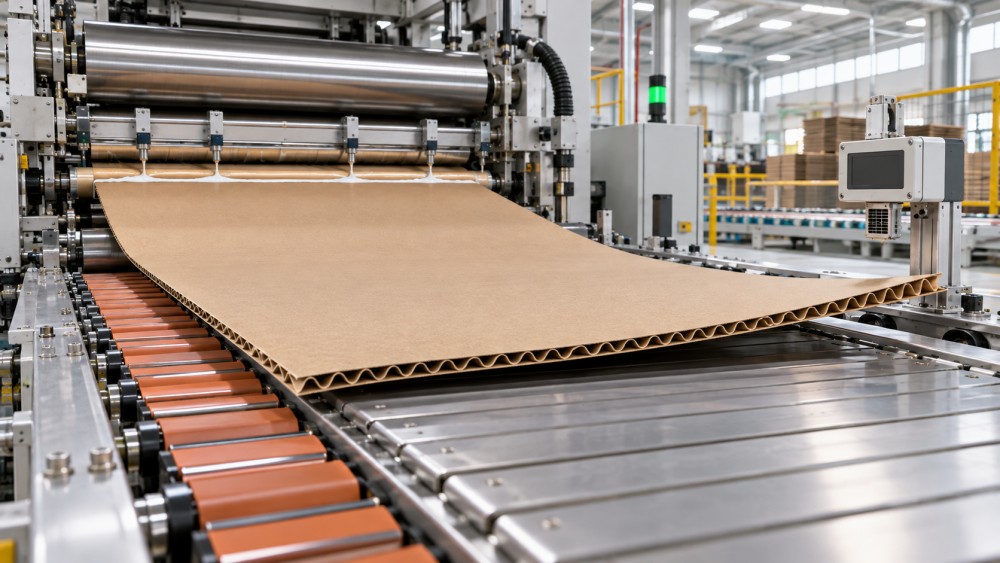
The shape of the warp gives useful clues
Warp is not a single defect. Its direction and timing can narrow the investigation. The following patterns are useful diagnostic signals, although no pattern should be treated as proof until moisture and process conditions are checked.
The direction of curl can also suggest which facing is changing more, but that interpretation must account for the production sequence and the board construction. A single facer can contribute moisture and heat history that remains hidden until the double facer stage. For this reason, checking only the final board surface is rarely enough.
Do not judge the problem from one moisture reading
A handheld moisture measurement on one face of one sheet can be useful, but it does not describe the condition that produced the warp. Board moisture is a profile, not a single number. A meaningful review compares top liner, bottom liner, and where possible the medium; it also considers the center and both edges, as well as samples taken soon after production and after conditioning.
The most valuable comparison is usually the difference between components and locations, measured with a repeatable method. If readings are taken from different sheet temperatures, at random locations, or after one sample has been exposed to the room longer than another, the result can be misleading. Warm board continues to cool and exchange moisture, while a freshly cut sample may not represent the stack several minutes later.
When a recurring warp complaint appears, record the following before making corrections:
- Paper grade, basis weight, roll position, and whether the issue is tied to a particular liner or supplier lot.
- Top and bottom liner moisture condition before entering the corrugator, using consistent sampling locations.
- Cross-web moisture variation, especially near the edges after trim and near any repeated defect zone.
- Preheater wrap, steam settings, hot plate engagement, belt pressure, machine speed, and adhesive application condition.
- Time from corrugator discharge to measurement, stack height, cooling conditions, and warehouse exposure.
- Whether the defect changes with flute type, board combination, order length, or a change in ambient conditions.
This record does more than identify a moisture issue. It separates a stable material-related pattern from an intermittent machine condition. A problem that follows one liner across several jobs calls for a different response than one that appears only at higher speeds or at one side of the machine.
Where linerboard moisture becomes unbalanced in production
Before the paper reaches the single facer
Roll storage is an overlooked starting point. Paper acclimatized in a different temperature or humidity environment may behave differently after it enters the plant. A roll brought from a cooler or drier area can have a moisture profile that is not obvious from its outer wraps. Uneven exposure at the roll edges can also create a cross-web condition before the paper sees any process heat.
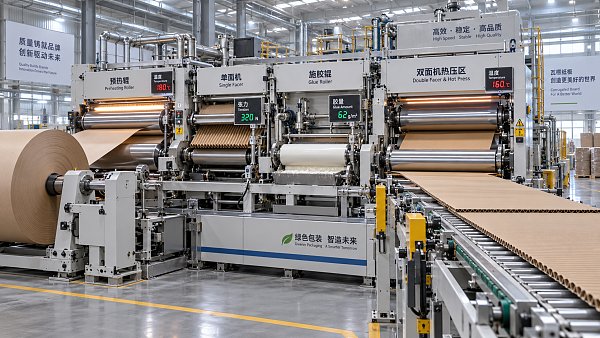
Preheater settings are intended to prepare the web for bonding and forming, not simply to make the paper hotter. Excessive heating can drive moisture out too quickly, while insufficient or uneven conditioning may leave the web unable to respond consistently to adhesive and hot plate drying. Wrap angle, web contact, steam control, and paper travel all influence this step. A setting that worked for a heavy liner may overdry a lighter or more moisture-sensitive grade.
At the single facer and glue station
The medium and the first liner already acquire a distinct thermal and moisture history at the single facer. Starch adhesive adds water at the flute tips, and the board must receive enough heat for proper bond development without creating a severe moisture gradient. Raising adhesive application to address a bond concern can unintentionally increase moisture load and contribute to later warp. Conversely, trying to cure a warp issue by reducing adhesive may weaken bonding if the real cause is uneven heat transfer or liner condition.
Check adhesive application for uniformity rather than looking only at average volume. A metering issue, roll condition, contamination, or incorrect setup can create differences across the web. The same principle applies to pressure and contact. Local variations may produce a sheet that is flat in one area and bowed at the edges.
Through the double facer
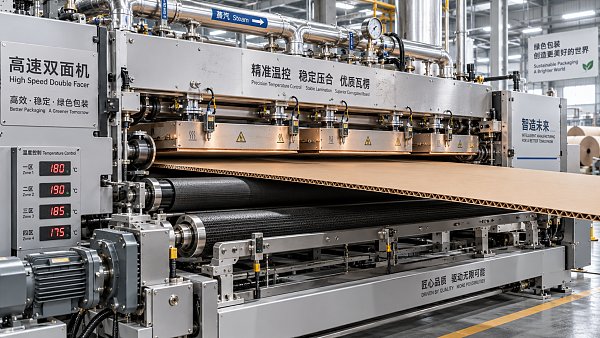
The double facer is where separate components become a finished board, so it is also where moisture imbalance is often locked into the structure. Hot plate temperature distribution, plate contact, belt condition, pressure loading, and dwell time affect how quickly each facing loses moisture. High speed may reduce residence time, but low speed can create overexposure when settings are not adjusted. Neither direction is automatically safer; the concern is whether the paper combination receives even, controlled energy.
A board that appears dry enough at the exit may still contain a large difference between the facings. Surface feel is not a dependable substitute for controlled measurement. Excessive surface drying can also make the sheet temporarily rigid, masking warp until the board relaxes during cooling.
A practical correction sequence
When warp is visible, resist the temptation to adjust several variables at once. Multiple changes may hide the immediate symptom but make the root cause impossible to identify. Work from material condition toward machine settings, and allow enough production time for each controlled change to show its effect.
- Confirm the warp pattern. Lay representative sheets on a known flat surface. Identify whether the defect is machine-direction bow, cross-direction curl, twist, edge lift, or a combination. Examine sheets from the beginning, middle, and end of the run.
- Separate immediate warp from delayed warp. Compare samples at discharge, after cooling, and after normal internal handling. A delayed change points strongly toward conditioning, residual moisture imbalance, or storage exposure.
- Compare the two liners before changing machine settings. Review roll condition and moisture consistency. If one facing is materially drier or wetter than the other, compensate through controlled conditioning rather than relying only on the double facer to correct it.
- Inspect uniformity across the machine. A center-to-edge difference requires a different response from a whole-sheet problem. Look for uneven preheater contact, side-to-side steam variation, belt wear, local pressure differences, and edge exposure.
- Review heat, speed, and adhesive together. Check whether the current combination is creating too much drying on one facing or retaining too much moisture at the bond. Make one change with a defined reason, then re-measure.
- Verify converting behavior. Flatness should be judged not only at the stacker but also at slitting, scoring, printing, die-cutting, and folding. Board that is marginally warped may still feed poorly or score inconsistently at the next stage.
The corrective action may be as simple as better roll conditioning or a more balanced preheat profile. It may also reveal a mechanical issue, such as unequal pressure, poor belt condition, a steam-control variation, or a tension imbalance. Moisture data are useful because they show whether an apparent mechanical defect is actually causing a material response.
Why “drying it harder” often makes the result worse
When board has a wet feel or weak bond, operators may instinctively increase heat. That can be appropriate in a controlled situation, but it is not a universal warp cure. More heat can reduce total moisture while increasing the difference between top and bottom liners. The board may become flatter for a short period and then curl more severely as the drier side later absorbs moisture from the environment.
Similarly, attempting to equalize a wet liner by overprocessing the opposite liner is unreliable. The goal is balanced conditioning and stable bonding, not forcing every paper grade to behave like another grade. Changes should consider liner absorbency, coating or surface treatment, basis weight, flute profile, adhesive behavior, and production speed.
Plant humidity control also deserves attention. A corrugator can produce a balanced sheet, but a dry warehouse, an open dock, or unequal air movement around stacked board can change its condition before conversion. Keep storage practices consistent, protect board from rapid environmental shifts where possible, and avoid treating freshly produced board as fully stabilized if the application is sensitive to flatness.
When moisture is not the main cause
Not every warped sheet is a moisture problem. Board construction can create inherent imbalance when the two liners differ greatly in stiffness, basis weight, or shrinkage behavior. Mechanical factors such as uneven web tension, misalignment, distorted hot plates, unequal belt pressure, poor slitter condition, or stacking stress may create a similar shape. Score patterns and converting pressure can also make a previously flat blank appear distorted.
The distinction is important: a moisture-related warp often changes with conditioning time, paper combination, heat input, or room conditions. A mechanical pattern may remain fixed at the same machine side or repeat regardless of paper moisture. When measurements show no meaningful component or cross-web difference, inspect the machine geometry, pressure distribution, tension control, and downstream handling before continuing to modify the thermal profile.
Consistent flatness comes from controlling the difference between paper layers, not merely chasing a final moisture reading. A balanced liner pair, uniform heat transfer, stable adhesive application, sensible tension, and adequate cooling give the board fewer reasons to move after it leaves the corrugator. That approach reduces warp at its source and protects converting accuracy without sacrificing bond quality.
Related News
 What Determines Compression Section Price in Corrugator ProjectsCompression section price depends on width, speed, pressure control, heating, automation, and integration. Learn how to compare quotes and maximize corrugator ROI.Corrugated Thermodynamics Architect
 How a Servo Driven Folder Gluer Machine Improves Carton AccuracyDiscover how a servo driven folder gluer machine improves carton accuracy through synchronized motion, repeatable folding, precise glue placement, and faster changeovers.Corrugated Thermodynamics Architect
 How Carton Making Machines Improve Output in High-Mix PlantsCarton Making Machines help high-mix plants increase sellable output with faster changeovers, lower waste, reliable quality control, and smoother workflow integration.Corrugated Thermodynamics Architect
 Corrugator Control Systems That Improve Board Quality and UptimeCorrugator Control Systems improve board quality, reduce waste, and increase uptime with coordinated heat, moisture, tension, glue, and speed control.Corrugated Thermodynamics Architect
 How High Speed Feeder Systems Support Faster Corrugator OutputHigh speed feeder systems help corrugator plants improve stable throughput, reduce feeding delays, protect board quality, and maximize converting efficiency.Corrugated Thermodynamics Architect
 Heavy Duty Unwind Stands That Stabilize High-Speed CorrugatorsHeavy duty unwind stands stabilize high-speed corrugators with precise tension control, secure reel handling, and smoother roll changes. Discover how to reduce breaks, waste, and downtime.Corrugated Thermodynamics Architect