How High Speed Feeder Systems Support Faster Corrugator Output
A corrugator can only turn speed into saleable board when material reaches every downstream process in a controlled, continuous flow. That is why high speed feeder systems have become more relevant to capacity decisions: they address the interruptions, handling delays, sheet damage, and unstable presentation that can prevent a fast line from delivering its theoretical output.
For a plant considering expansion, feeder automation is rarely a stand-alone productivity purchase. Its value depends on whether the corrugator, buffering, converting equipment, labor model, and order profile can use the additional flow. A well-matched system can improve usable throughput and order turnaround. A poorly matched one may simply move the production constraint to the next machine.
Corrugator speed is only one part of production capacity
Nameplate speed is an incomplete measure of corrugator performance. Finished-board output is shaped by paper quality, heat and moisture control, adhesive consistency, web tension, order changes, cut-off accuracy, stacking, material movement, and the ability of downstream operations to accept board without delay. When any of these stages forces the line to slow down or stop, the gap between planned capacity and actual shipments grows.
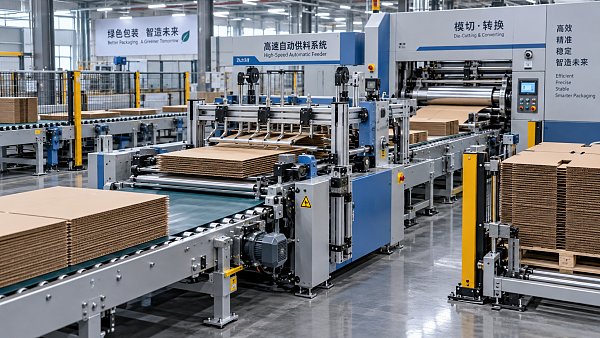
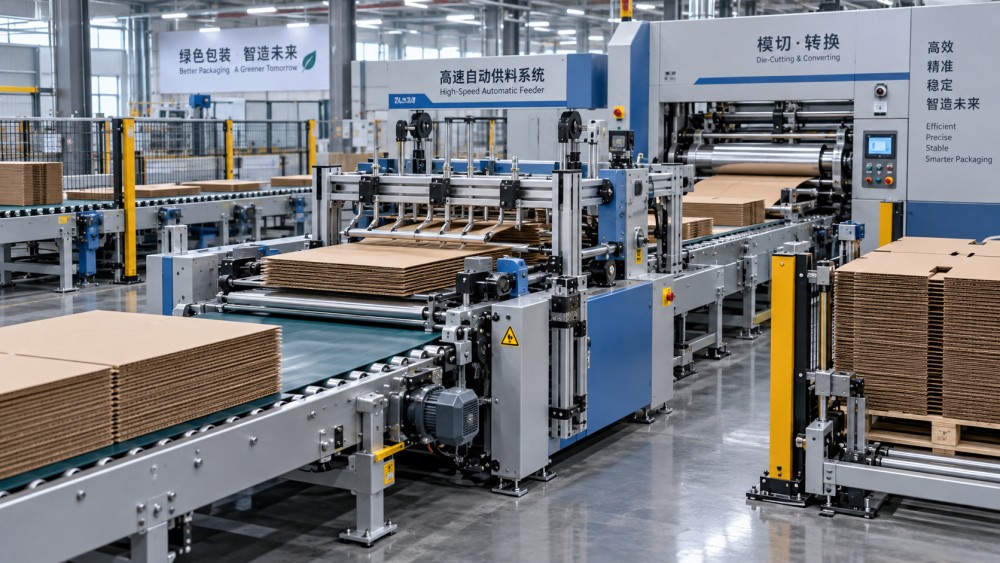
A high speed feeder system supports output by controlling how sheets, blanks, or board stacks are separated, aligned, and presented to the next process. In a corrugated operation, that may mean supplying converting equipment with a reliable stream of board at the required orientation and spacing. In an integrated plant, it can also support cleaner handoffs between board production, printing, die-cutting, folding, gluing, and palletizing.
The commercial implication is important. Faster feeding does not automatically make every order faster. It reduces a category of avoidable losses: waiting for material, inconsistent sheet entry, operator-led replenishment, double feeds, skewed blanks, and repeated stops to restore stable flow. Those losses are especially costly when they occur around equipment already capable of running at high rates.
A feeder should therefore be assessed as part of the available production window. If a downstream flexographic folder gluer or die-cutter regularly pauses because operators cannot keep it supplied, the line’s limitation may sit in material presentation rather than in the converting section itself. Improving that point can release capacity without changing the primary machine. If the converting machine is already constrained by tooling changes, drying time, inspection rejects, or delivery congestion, a faster feeder alone will have a narrower effect.
Where feeder automation creates the most operational value
The strongest case tends to arise where volume and repeatability coexist with enough order variation to make manual handling disruptive. High-volume transport packaging, e-commerce shipper production, and plants supplying multiple downstream converting lines can all experience this pressure. Board needs to move quickly, but it also needs to arrive consistently enough to protect print registration, die-cut accuracy, crease quality, and glue application.
Manual feeding can appear flexible because operators can react to uneven stacks or changing board conditions. That flexibility has limits at higher line speeds. Physical handling becomes a source of variation: stack position changes, sheet edges are damaged, replenishment timing differs by shift, and operators must divide attention between material supply and machine monitoring. A feeder system is valuable when it turns these recurring actions into a more stable, measurable process.
For decision-makers, the first question is not “How fast can the feeder run?” It is “What production loss will it remove under our actual order mix?” The answer may differ significantly between plants.
- A sheet plant producing long runs of similar board grades may value uninterrupted supply and reduced labor dependency.
- A box plant with frequent short orders may place more value on fast setup, recipe recall, stack changeover, and recovery after a stop.
- A producer handling lighter, warped, moisture-sensitive, or highly printed board may need gentler separation and more precise alignment before pursuing higher feed rates.
- A facility adding robotics or automated palletizing may need the feeder to work as part of a defined flow-control architecture rather than as an isolated machine upgrade.
This distinction matters because speed is often the visible feature, while control is the element that protects quality. Corrugated board is not a uniform rigid substrate. Flute profile, liner characteristics, moisture condition, caliper variation, score pattern, warp, stack compression, and surface finish can all affect how a sheet behaves at the infeed. Equipment that performs well with one board specification may require different settings or mechanical support for another.
The output gain comes from stability, not peak speed alone
High-speed feeder systems are sometimes presented as a direct path to faster corrugator output. That description is incomplete. Their practical contribution is usually greater consistency at the operating speed a plant can sustain. The distinction is material because peak speed is easy to demonstrate, while stable output over a full production shift is what determines cost per usable square meter and delivery reliability.
Stable feeding supports several linked results. Sheets enter downstream equipment with more consistent timing. Registration and positioning systems have a better starting condition. Operators spend less time correcting material flow. Stops associated with missed or doubled sheets may decline when the system is correctly set up and maintained. The downstream machine can then spend a larger share of scheduled time producing acceptable output.
None of those effects should be assumed automatically. A feeder that is too aggressive for the board condition can introduce scuffing, edge damage, sheet skew, or double feeding. A system with insufficient stack management may create short interruptions during replenishment. Controls that are difficult to adjust can leave a plant dependent on a small number of experienced operators. The objective is controlled acceleration, not simply pushing material through the infeed at the highest possible rate.
That is why an evaluation should include recovery behavior. Decision-makers often focus on normal running speed, but the financial impact of disruptions is shaped by how quickly the equipment identifies a fault, stops safely, clears material, returns to alignment, and resumes stable production. Frequent minor interruptions can consume more available time than a small difference in rated speed.
Feeder investment changes the labor equation, but does not eliminate the operating requirement
Reducing manual handling is a central reason plants investigate automated feeding. It can reduce repetitive lifting, make staffing less dependent on constant physical intervention, and allow operators to focus on inspection, process adjustment, order preparation, and exception management. In a facility facing variable staffing availability, that operational resilience may matter as much as direct labor savings.
Still, automation changes labor work rather than removing the need for it altogether. Feeders require setup, material checks, adjustment for board variation, scheduled cleaning, wear-part inspection, and competent response when a feed fault occurs. If the equipment is connected to conveyors, stackers, printing lines, or robotic cells, operators and maintenance teams also need a shared understanding of interlocks and restart procedures.
The most credible labor assessment separates physical touchpoints from supervision requirements. A system may reduce the number of people required at the infeed, yet increase the value of trained technicians who can maintain sensors, drives, vacuum or friction-feed elements, and software settings. Plants should plan for that shift before assigning savings to the project.
The same principle applies to maintenance. High-speed operation raises the importance of routine inspection because small mechanical issues can become repeated process losses. Wear surfaces, belts, wheels, suction components, bearings, sensors, and alignment devices should be considered within a preventive maintenance plan. Access for cleaning and replacement is not a minor design detail; it affects whether the equipment remains reliable after the initial commissioning period.
Integration determines whether faster feeding improves the whole line
Feeder performance cannot be separated from the equipment before and after it. The feeder must accept the stack format, board dimensions, and stack quality delivered from upstream processes. It must then present material at a rate and orientation that the downstream machine can process without building unstable queues or causing stops.
Plants often need to examine four interfaces before committing to a system:
- Material interface: supported board sizes, flute combinations, caliper range, warp tolerance, stack height, printed surfaces, and edge condition.
- Mechanical interface: conveyor elevation, physical footprint, access space, guarding, stack-loading arrangement, and the path for rejected or damaged material.
- Control interface: communication with upstream and downstream equipment, speed matching, buffer logic, stop signals, fault reporting, and order-level recipes.
- Operating interface: how replenishment, changeover, cleaning, setup verification, and fault recovery fit into the plant’s normal workflow.
A useful project review maps the entire material path rather than treating the feeder as a boxed piece of equipment. Consider what happens when the corrugator produces faster than converting can accept, when a downstream inspection system rejects sheets, or when the next order requires a different board format. Without clear buffer rules and controls, faster feeding can move congestion downstream and make recovery harder.
This is also where production data gains relevance. Basic visibility into run speed, stop reasons, feed errors, rejected sheets, replenishment events, and changeover duration gives management a way to distinguish equipment availability from process availability. The goal is not data collection for its own sake. It is to identify whether the planned increase in capacity is being lost to feeding, board condition, converting, logistics, or order scheduling.
Short-run production changes the buying criteria
Long-run capacity remains important in corrugated packaging, but many plants also face more frequent order changes, varying artwork, shorter delivery windows, and a wider mix of board formats. Under these conditions, a feeder’s value is increasingly tied to how quickly it can transition between jobs without creating excessive setup waste or demanding lengthy manual adjustment.
For shorter runs, the decision should include setup behavior alongside top speed. Can operators repeat settings for common jobs? How much intervention is required when stack height, board size, or surface condition changes? Are adjustments accessible and understandable? Does the feeder reach stable production quickly after an order change? Those questions can matter more than an impressive maximum sheet rate that is only achievable on a narrow set of conditions.
Order variability also increases the importance of board-quality discipline. Faster automated handling cannot compensate for inconsistent upstream slitting, poor stack formation, excessive warp, or unstable moisture. A feeder project may expose those underlying issues because it removes some of the manual compensation that operators previously applied. That is not necessarily a reason to avoid the investment; it is a reason to include upstream quality controls in the implementation scope.
A practical investment test for decision-makers
The investment case is strongest when it is built around production losses that can be observed and measured internally. Instead of relying on headline speed claims, management can examine where time and material are currently being lost: infeed starvation, manual replenishment, stops caused by poor sheet separation, board damage, downstream waiting, or inconsistent shift performance.
Suppliers should be asked to demonstrate the relevant operating conditions, not only an idealized run. A meaningful acceptance discussion covers material range, feeding accuracy, changeover steps, fault handling, integration responsibilities, and the performance measures that will be used after commissioning. For an integrated project, accountability for controls and communication between machines should be explicit from the beginning.
High speed feeder systems will continue to attract attention as corrugated producers seek more output from constrained labor, floor space, and delivery windows. Their strategic role is becoming clearer: they are flow-control assets that help connect corrugator capacity to converting capacity. The plants that gain the most will be those that evaluate them against the full operating system, with equal attention to board quality, downstream balance, changeover demands, and the ability to sustain performance after installation.
Related News
 What Determines Compression Section Price in Corrugator ProjectsCompression section price depends on width, speed, pressure control, heating, automation, and integration. Learn how to compare quotes and maximize corrugator ROI.Corrugated Thermodynamics Architect
 How a Servo Driven Folder Gluer Machine Improves Carton AccuracyDiscover how a servo driven folder gluer machine improves carton accuracy through synchronized motion, repeatable folding, precise glue placement, and faster changeovers.Corrugated Thermodynamics Architect
 How Carton Making Machines Improve Output in High-Mix PlantsCarton Making Machines help high-mix plants increase sellable output with faster changeovers, lower waste, reliable quality control, and smoother workflow integration.Corrugated Thermodynamics Architect
 Corrugator Control Systems That Improve Board Quality and UptimeCorrugator Control Systems improve board quality, reduce waste, and increase uptime with coordinated heat, moisture, tension, glue, and speed control.Corrugated Thermodynamics Architect
 How High Speed Feeder Systems Support Faster Corrugator OutputHigh speed feeder systems help corrugator plants improve stable throughput, reduce feeding delays, protect board quality, and maximize converting efficiency.Corrugated Thermodynamics Architect
 Heavy Duty Unwind Stands That Stabilize High-Speed CorrugatorsHeavy duty unwind stands stabilize high-speed corrugators with precise tension control, secure reel handling, and smoother roll changes. Discover how to reduce breaks, waste, and downtime.Corrugated Thermodynamics Architect