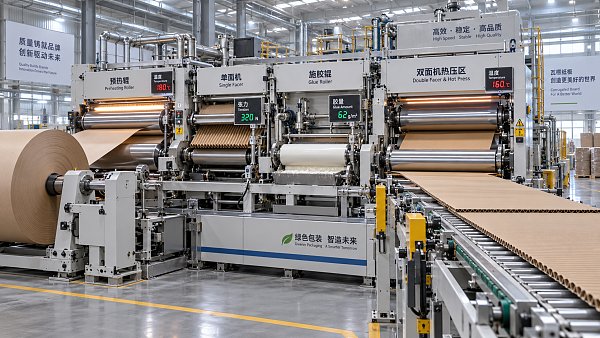
How High Speed Corrugator Control Reduces Waste and Stabilizes Production
High-speed corrugator control has become a direct production-cost issue because waste is rarely created at one point on the line. A roll break, warped board, weak bond, score cracking, unstable cut length, or rejected stack often begins with a small imbalance upstream. At elevated line speeds, that imbalance travels through the process before it is visible at the dry end. The result is not only lost paper: it can include downgraded board, delayed conversion, extra trim, unplanned slowdown, and uncertainty about whether the next order can start cleanly.
The market value of modern control lies in its ability to hold a repeatable process window while paper grades, moisture conditions, flute profiles, order lengths, and production schedules change. Speed alone does not define a high-performing corrugator. A line running slightly below its theoretical maximum with stable heat transfer, web tension, adhesive bond, and cut accuracy can produce more saleable board over a shift than a faster line that repeatedly generates defects or requires recovery time.
Waste begins when process variables lose their relationship
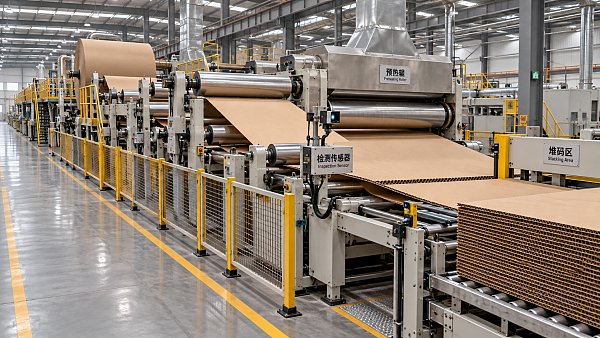
A corrugator is a linked thermal, mechanical, and moisture-management system. Paper enters with variation in basis weight, stiffness, surface condition, initial moisture, roll diameter, and storage history. It then passes through preheaters, single facers, bridge storage, glue stations, the double backer, slitting and scoring, cut-off, and delivery. Each section has its own control task, but the useful outcome comes from coordinating them rather than treating each signal as an isolated target.
Consider a liner entering the single facer. If it is insufficiently conditioned, the flute medium may not form consistently or the web may be more likely to crack under heat and pressure. Excessive heating, however, can remove moisture too early and create a board that later curls, fractures at scores, or responds unpredictably to adhesive. Raising steam pressure may appear to correct a bonding issue, yet the real source could be weak heat transfer at a preheater wrap, poor condensate removal, a contaminated contact surface, or a paper grade whose moisture profile differs from the previous roll.
This distinction matters because the same visible defect can have several causes. Board warp at delivery might be associated with an uneven moisture balance between liners, but it can also result from uneven temperature across the web, adhesive solids variation, an incorrect wrap angle, or a change in paper tension that alters web contact. Treating every warp issue as a steam-setting problem risks making the board drier while leaving the underlying asymmetry unresolved.
High speed corrugator control therefore relies on cause-and-effect logic. The control system needs reliable measurement, stable mechanical response, and operating rules that account for the interaction between speed, grade, and order specification. The purpose is to reduce the period during which material is being made outside the acceptable process window.
Temperature control is a heat-transfer problem, not a single steam setting
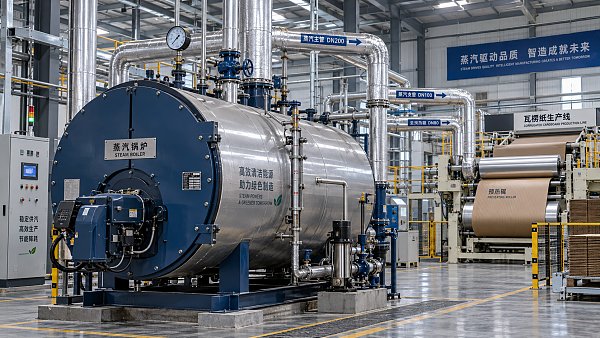
Steam is often discussed as though pressure alone determines board condition. In reality, usable heat at the web depends on steam quality, condensate behavior, roll surface condition, contact time, wrap geometry, and the thermal demand created by paper and line speed. A setpoint can be correct while the web still receives inconsistent energy across its width or along its length.
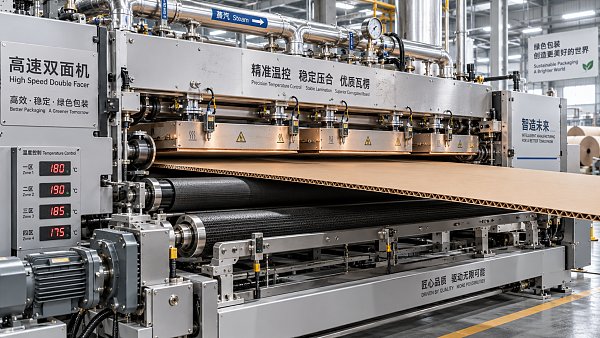
At higher speed, dwell time around preheaters and hot plates declines. Control must respond by managing available heat without over-drying the sheet. Preheater wrap controls are especially important because they change contact area and therefore heat input. Their response should be coordinated with grade data and actual line speed; a fixed wrap position that works for a heavy liner may over-condition a lighter sheet. Similarly, changes made immediately before an order transition can have delayed effects because the conditioned web takes time to reach the next station.
Temperature measurement also needs interpretation. A high surface temperature does not automatically indicate good bond formation. The relevant question is whether the adhesive reaches a sufficient bonding condition at the double backer while the finished board retains a moisture balance suitable for flatness and conversion. Thermal cameras, surface sensors, and zone measurements are most useful when linked to board quality observations and to the location of the material on the machine.
- Localized cold areas can point to a heat-transfer, steam-distribution, condensate, or pressure-contact issue rather than a global shortage of steam.
- A gradual temperature drift after a roll splice may reflect a new paper condition, not a failed temperature loop.
- Rapid temperature correction during a speed change should be judged against board moisture and bond response, since aggressive heating can conceal the original issue and create a later converting defect.
Good control architecture preserves a history of setpoints, measured values, speed, grade, and alarms. Without time-aligned records, a quality investigation often depends on memory after the affected board has already been stacked or converted.
Tension stability protects flute geometry and registration through the line
Web tension is commonly associated with preventing breaks, but its influence reaches further. Excessive tension can stretch a liner, disturb flute formation, change web tracking, and contribute to dimensional variation after the board relaxes. Insufficient tension can create wrinkles, poor web contact, wandering at slitting, and unstable cut-off performance. The correct tension is not a universal number; it changes with paper grade, roll diameter, machine path, web width, and the mechanical condition of brakes, dancers, rollers, and drive sections.
A closed-loop tension system should not be evaluated only by whether its displayed value remains near setpoint. A tightly controlled average may still mask rapid oscillation. Oscillation can produce intermittent defects that are difficult to trace because the board may appear acceptable for part of each cycle. Drive synchronization, feedback quality, brake response, and mechanical inertia all affect whether the loop is calm or continually correcting itself.
Splice events expose weak coordination particularly clearly. The incoming roll may differ in moisture, caliper, stiffness, or winding quality from the outgoing roll. If the tension strategy treats the splice only as a change in roll diameter, it can miss a material change that requires a different response. A short period of reduced speed or a controlled transition profile may create less loss than allowing a tension excursion to propagate into the single facer, bridge, and cut-off.
Web tracking deserves the same attention. Edge-guide corrections that are constantly active may indicate poor roll alignment, uneven winding, roller contamination, or a mechanical path issue. Continual correction is not the same as stable tracking. At high speed, the distinction affects trim consistency, score placement, and whether the board enters downstream converting equipment with predictable dimensions.
Adhesive control must be tied to bonding conditions
Starch adhesive application is often reduced to coat weight, but bond quality depends on several connected conditions: adhesive preparation, solids, viscosity, gel behavior, application uniformity, flute-tip contact, heat delivery, pressure, and paper absorbency. A heavier application can compensate for a marginal condition in the short term, yet it also adds water that must be removed. That added moisture can increase warp risk, reduce drying margin, and make the line less stable when speed changes.
The objective is a consistent, adequate bond with the lowest practical variation in adhesive and water addition. This requires the glue kitchen, pumping system, application rolls, doctor settings, and single-facer or double-backer thermal response to be considered as one process. A board with weak pin adhesion and a board with excess adhesive squeeze-out should not receive the same correction. The first may reflect inadequate bonding energy or poor contact; the second may indicate too much application, unsuitable gap settings, or paper that is absorbing differently.
At the glue machine, cross-machine consistency matters as much as average application. Worn rolls, contamination, uneven pressure, or a poorly maintained metering arrangement can create a bond profile that varies from one side of the web to the other. This may emerge later as edge delamination, uneven warp, or inconsistent performance during die-cutting. Sampling only the center of the sheet can miss that pattern.
Recipe management becomes valuable when it records more than nominal glue settings. A useful recipe connects flute type, liner and medium characteristics, target board construction, speed range, heat settings, wrap positions, adhesive parameters, and known restrictions. Copying a recipe from a similar board grade without checking the actual paper properties can produce a false sense of repeatability.
Moisture balance determines whether good board remains good downstream
Finished board may leave the corrugator looking flat and bonded, then develop curl or score failure after it cools, rests, prints, or enters a folder gluer. That is why moisture control cannot be judged only at the moment of delivery. The board needs enough internal balance to remain dimensionally stable through downstream handling.
Single-face web conditioning, adhesive water, double-backer heating, belt pressure, and ambient conditions all influence this balance. A persistent tendency toward one-direction warp can reveal a mismatch between top and bottom liner treatment. Cross-direction warp may indicate uneven heating, uneven moisture, or pressure variation across the machine. These patterns should be separated before changes are made. A general increase in heat may alter both liners, while the defect may originate on only one face.
Paper storage and roll preparation also affect controllability. Rolls brought from a different humidity condition can behave differently even when grade and basis weight match the job specification. The corrugator cannot fully correct every incoming material condition without trade-offs. Recording roll identity, arrival condition, splice location, and defect timing makes it easier to distinguish machine behavior from paper-related variation.
Changeovers are a major source of hidden material loss
Shorter runs increase the proportion of production time spent transitioning between board grades, widths, cut lengths, score patterns, and speed targets. The material produced while settings are converging is often treated as unavoidable waste. Much of it is avoidable when changeover control is designed around the travel time of material through the line.
A reliable sequence begins before the new order reaches the corrugator. Grade-specific recipes should prepare preheater wraps, steam zones, tension targets, glue parameters, slitter-score positions, cut-off settings, and stacker instructions in the correct order. The system must recognize that a setting change at the wet end affects board arriving at the dry end later. Switching downstream targets too early or too late creates mixed-condition board and confusing quality signals.
Automatic settings do not remove the need for confirmation. Sensors can verify positions, but actual board response still requires observation at the first stable sheets after transition. The most useful quality review asks whether the transition created a repeatable pattern: first-sheet warp, delayed bond stabilization, unstable score location, excessive trim, or cut-length drift. Repeated patterns are candidates for sequence refinement. Random events suggest a different investigation, such as incoming roll condition or mechanical intermittence.
Data should separate a fast line from a stable line
Production reporting can overvalue average speed when it does not show the quality cost of instability. A useful view combines run speed with waste generated during startup, splice recovery, grade transitions, process alarms, and downstream rejection. It also distinguishes planned slowdown from unplanned speed loss. These categories require different remedies: one may be caused by job design or scheduling, while the other may point to control performance, mechanical condition, or material variability.
Alarm volume alone is also a poor health indicator. A line with many brief, self-correcting alarms may be operating close to instability, even if it continues running. Conversely, suppressing alarms can reduce visible noise while allowing defects to continue. The better approach is to identify alarms associated with meaningful quality or recovery events, examine their sequence, and establish whether they are early warnings or merely symptoms.
Condition monitoring supports this effort when it is connected to production consequences. Bearing temperature, drive load, belt condition, roll cleanliness, condensate performance, and sensor drift matter because each can alter control response. Maintenance triggered by a change in process behavior is often more useful than maintenance based only on elapsed time, particularly where a component affects heat transfer, web handling, or adhesive uniformity.
Stabilization is achieved when the line can absorb normal variation without repeatedly converting it into scrap. That requires disciplined recipes, responsive control loops, verified sensors, maintained mechanical systems, and a shared record of what changed when quality moved. The practical result is fewer corrective interventions, less paper consumed during recovery, and board that reaches printing, die-cutting, and converting with more predictable behavior.
Related News
 How Does a Corrugator Control System Reduce Board Line Waste?Discover how a corrugator control system for board line operations reduces waste with smarter tension control, synchronized changeovers, and defect tracking. Learn what to specify.Corrugated Thermodynamics Architect
 How Steam Pressure and Capacity Affect Boiler Prices for CorrugatorsCompare steam boiler price factors for corrugators. Learn how pressure, capacity, and peak loads affect installed costs—and choose the right system without overspending.Corrugated Thermodynamics Architect
 What Determines Compression Section Price in Corrugator ProjectsCompression section price depends on width, speed, pressure control, heating, automation, and integration. Learn how to compare quotes and maximize corrugator ROI.Corrugated Thermodynamics Architect
 How a Servo Driven Folder Gluer Machine Improves Carton AccuracyDiscover how a servo driven folder gluer machine improves carton accuracy through synchronized motion, repeatable folding, precise glue placement, and faster changeovers.Corrugated Thermodynamics Architect
 How Carton Making Machines Improve Output in High-Mix PlantsCarton Making Machines help high-mix plants increase sellable output with faster changeovers, lower waste, reliable quality control, and smoother workflow integration.Corrugated Thermodynamics Architect
 Corrugator Control Systems That Improve Board Quality and UptimeCorrugator Control Systems improve board quality, reduce waste, and increase uptime with coordinated heat, moisture, tension, glue, and speed control.Corrugated Thermodynamics Architect