How Heat Resistant Corrugator Belts Balance Heat and Moisture
How Heat Resistant Corrugator Belts Balance Heat and Moisture
Heat and moisture must stay in balance inside the double facer. The starch adhesive needs enough heat to develop a reliable bond, but excessive drying can leave the board brittle or prone to warp. Heat resistant corrugator belts influence that balance through their dimensional stability, permeability, and contact characteristics. Their job is not simply to survive a hot machine: they must help transport and hold the board consistently while allowing moisture to leave under changing production conditions.
This makes belt selection a process decision, not just a replacement-parts purchase. A belt that works well on a steady run of one board grade may behave differently when the line switches between lightweight liners, heavier combinations, and short orders. The useful question is whether it supports a workable operating window across the plant’s actual product mix.
The belt manages contact and moisture—not just temperature
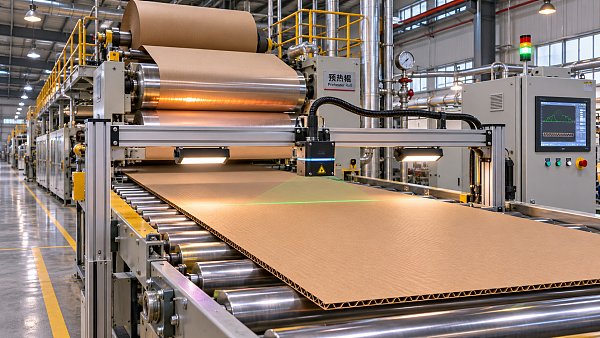
In a conventional hot-plate double facer, heat enters primarily through the liner contacting the heated plates. It then travels through the board structure toward the adhesive bond lines. The upper belt helps convey the board and transmit the loading applied by the machine’s pressure system. Depending on the design, that loading may come from rollers, shoes, or other controlled pressure elements.
The distinction matters. A high belt temperature rating does not demonstrate effective heat transfer into the glue line. Uneven loading, poor plate contact, or condensate problems in the heating system can limit bonding even when the belt itself remains within its temperature limit.
Meanwhile, water introduced with the adhesive must redistribute and partly evaporate as the bond develops. Paper moisture also changes during heating. The belt provides one pathway for moisture release, although evaporation depends on the entire board structure, temperature profile, ventilation, and available residence time. Air permeability is therefore relevant, but it is not a direct measurement of drying performance.
The objective is not maximum moisture removal. It is sufficient bonding with a controlled moisture profile. A sheet can look flat at the cut-off and still warp after stacking as temperature and moisture equalize.
What belt construction changes in practice
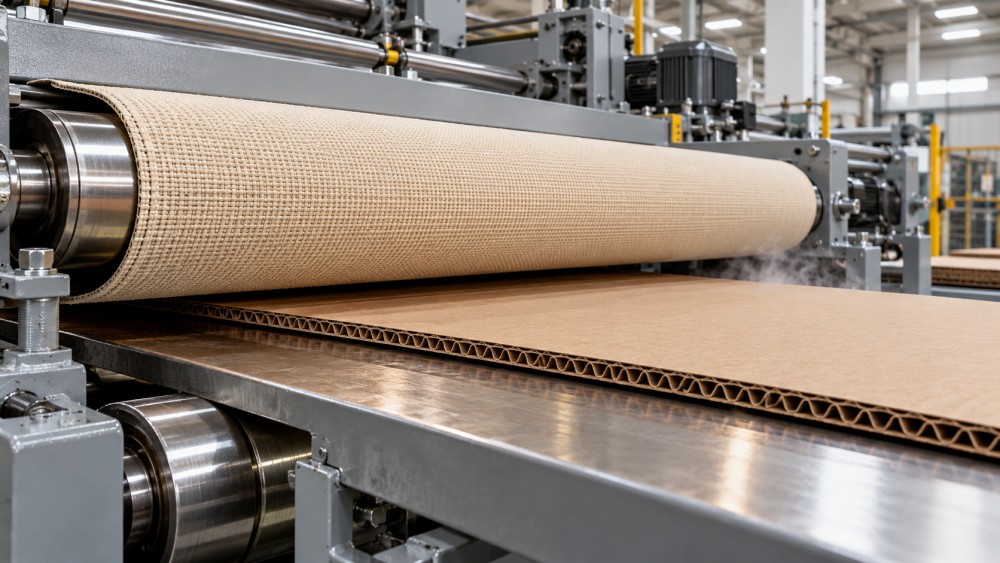
Corrugator belts use different woven structures, fiber combinations, surface treatments, and joint designs. Some incorporate heat-resistant reinforcement or specialized edge construction. Those descriptions are useful starting points, but the finished belt’s behavior matters more than an isolated material name.
Thermal stability must include dimensional stability
A belt may tolerate heat without retaining its original dimensions or mechanical properties indefinitely. Thermal exposure, moisture cycling, tension, and repeated bending can affect elongation, shrinkage, stiffness, and surface condition. Changes in those properties can influence tracking and pressure distribution before obvious physical damage appears.
Ask suppliers to distinguish continuous operating limits from short-duration peak exposure. Also establish what the stated temperature refers to: the surrounding environment, the belt surface, or a laboratory test condition. These are not interchangeable. A temperature figure without exposure duration and test conditions is difficult to use in an engineering comparison.
Permeability needs context
An open structure may offer less resistance to airflow, but higher permeability does not automatically produce better board. The belt must also deliver suitable traction, surface support, and dimensional stability. Its airflow characteristics can change with compression, contamination, and wear.
Compare permeability values only when the test method, pressure differential, units, and specimen conditioning are compatible. Recognized textile air-permeability methods, such as ISO 9237 or ASTM D737, can provide a reporting basis where applicable. Neither standard, by itself, certifies suitability for a particular corrugator or predicts moisture removal under operating load.
Surface contact is a compromise
The board-facing surface needs enough grip for stable transport without unacceptable marking. Belt thickness and compressibility also interact with the pressure system. A construction that compresses differently from the previous belt may require a loading review rather than a straight transfer of old settings.
Excessive loading can damage flute structure, particularly on more vulnerable board combinations. Insufficient or uneven loading can undermine contact and bonding. The splice deserves separate attention: local changes in thickness, stiffness, or permeability may create a repeating disturbance that operators initially mistake for a pressure-system fault.
Why a belt can perform well on one order and struggle on the next
Consider a change from a sustained heavy-board run to a short lightweight order. The machine retains thermal energy, while the new combination has different heating and moisture requirements. Keeping the previous steam, loading, and speed settings can over-dry the lighter board. The belt influences the response, but cannot compensate for an unsuitable thermal profile.
The reverse transition presents a different risk. A heavier construction may need more time or adjusted heat input to develop the bond. Increasing speed before the system stabilizes can expose weak bonding even though the belt tracks correctly and appears dry.
Residence time provides a useful first check: effective heated contact length divided by board speed. It is not a complete bonding model, but it explains why increasing speed reduces the time available for heat transfer. A more permeable belt cannot remove that constraint. Paper temperature entering the double facer, adhesive application, steam-system condition, and loading still have to support the chosen speed.
Lightweight or recycled grades should not be treated as uniform categories either. Absorbency, initial moisture, porosity, and stiffness vary between papers. Record the actual combination when comparing performance; “same flute” is not a sufficiently controlled trial.
Read defects before changing the heat setting
Weak bonding often prompts an immediate increase in heat. That may help when heat input is genuinely insufficient, but it can conceal excess glue application, poor contact, or an upstream problem. Warp is equally easy to misdiagnose because several moisture and tension imbalances can produce similar-looking sheets.
Moisture measurements need consistent sampling positions and timing. Hot moving board, cooled samples, and readings from different instruments may not be directly comparable. Infrared surface temperatures also require care: surface temperature is not the same as glue-line temperature, and instrument setup can affect readings.
Build the acceptance trial around the production mix
For technical evaluation, the strongest evidence is a controlled machine trial with agreed acceptance criteria. Before installation, confirm belt dimensions, tensioning range, tracking compatibility, splice requirements, and installation procedures with both the belt supplier and the equipment manufacturer.
Then select representative orders rather than only an easy, long production run. Include combinations that challenge the existing process: heavier board at sustained speed, a lightweight grade sensitive to drying, or frequent transitions between unlike orders. Record baseline conditions before the change.
- Log paper grades, incoming moisture where available, adhesive settings, speed, heating conditions, and loading.
- Assess bonding, caliper retention, visible marking, and warp after an agreed conditioning period.
- Separate stable-running results from start-up and order-change waste.
- Inspect tracking, edge condition, splice behavior, and tension after the supplier’s specified run-in procedure.
Avoid changing several process variables simultaneously unless production safety or quality requires it. Otherwise, an apparent improvement cannot confidently be attributed to the belt. Energy comparisons also need normalization for product mix and saleable output; lower steam demand during an easier order is not proof of belt-related savings.
Maintenance determines whether the balance lasts
A new belt’s permeability is only a starting condition. Starch deposits, paper dust, and other contamination can obstruct its structure or create uneven surface behavior. Local buildup may alter moisture release and traction across the machine, narrowing the process window without an obvious belt failure.
Cleaning should follow supplier guidance for the specific construction. Aggressive brushing, unsuitable chemicals, or uncontrolled pressure washing can damage fibers or joints. Where wet cleaning is permitted, account for drying and restart requirements. Inspection and cleaning must follow the machine’s isolation procedures; a moving belt is not an inspection platform.
For the equipment-investment perspective covered by Global Commercial Print & Corrugated Packaging Intelligence (CPCS), belt value belongs in the wider production calculation: saleable board, stable running speed, changeover waste, maintenance downtime, and downstream converting performance. A lower purchase price means little if the line needs persistent speed reductions to maintain bond quality.
When comparing heat resistant corrugator belts, request documented test conditions and judge the installed result across representative orders. The better choice is the belt that maintains predictable contact, tracking, and moisture-release behavior within the plant’s operating range—not simply the one carrying the highest temperature rating.
Related News
 KPS to Acquire 70% of MM Packaging at €2.4 Billion Enterprise ValueKPS will acquire 70% of MM Packaging at a €2.4 billion enterprise value. Explore what the deal means for the packaging business and its customers.Corrugated Thermodynamics Architect
 How to Size Bridge Conveyors for a Corrugator LineSize Bridge Conveyors for your corrugator line with practical guidance on web accumulation, sheet throughput, layout, and controls. Avoid costly bottlenecks.Corrugated Thermodynamics Architect
 Nine Dragons Paper Raises Chongqing Corrugated Paper Price by 50 Yuan per TonneNine Dragons Paper raises Chongqing corrugated paper prices by 50 yuan per tonne. See when the increase takes effect and what it means for packaging costs.Corrugated Thermodynamics Architect
 How Automatic Warp Control Systems Improve Corrugated Board FlatnessDiscover how automatic warp control systems improve corrugated board flatness, reduce production waste and support more reliable converting.Corrugated Thermodynamics Architect
 How to Evaluate a Sheet Stackers Factory for Your Production LineEvaluate a sheet stackers factory with confidence. Compare capacity, line integration, acceptance tests and service to choose the right supplier for your production line.Corrugated Thermodynamics Architect
 What to Ask a Starch Mixer Manufacturer Before OrderingChoosing a starch mixer manufacturer? Ask these essential questions about capacity, pricing, automation and support before you order.Corrugated Thermodynamics Architect