How Does a Corrugator Control System Reduce Board Line Waste?
Board line waste often starts long before defective sheets reach the stacker. A tension disturbance at a splice, insufficient heat after acceleration, or a mistimed order change can create a moving length of material that will never become saleable board. By the time operators see the problem, more paper may already be following it through the machine.
A corrugator control system for board line operations reduces these losses by coordinating equipment, adjusting process conditions, and linking defects to their likely causes. For project managers, the important question is not simply whether a supplier offers automation. It is whether the proposed system can detect relevant disturbances, act within the available process window, and demonstrate a measurable improvement in material yield.
Follow the waste, not just the machine speed
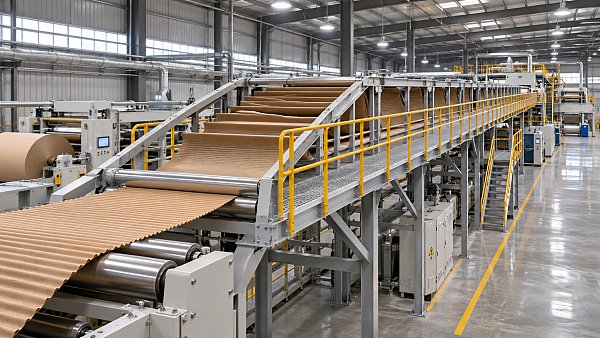
A corrugator combines several processes with different response times. Drives can respond quickly; paper heating and moisture redistribution take longer. Adhesive performance depends on application, temperature, formulation, and contact conditions. Meanwhile, the bridge stores single-face web, creating a delay between upstream production and downstream consumption.
This is why isolated machine controls cannot always prevent line-wide waste. A single facer may run correctly while the double facer receives material under unsuitable conditions. A cutoff may produce accurate lengths while cutting board that has already developed poor bonding.
Before specifying an upgrade, separate losses into categories that controls can influence:
Some losses originate outside the control system. Poor reel condition, worn corrugating rolls, blocked steam traps, or unstable adhesive preparation cannot be corrected by software alone. A credible project identifies these constraints before assigning savings to automation.
How coordinated controls prevent waste from developing
Tension control keeps disturbances from travelling downstream
Paper tension changes as reel diameter decreases, braking conditions vary, and the line accelerates or decelerates. Excessive tension can cause breaks or stretch; insufficient tension can encourage wrinkles, wandering, and unstable feeding.
Depending on the machine design, closed-loop control uses load cells, dancers, drive feedback, or combinations of these signals to regulate braking or drive torque. Reel diameter compensation and coordinated speed ramps help limit disturbances rather than waiting for operators to correct them.
During a splice, synchronization becomes especially important. The controller must coordinate the splicer sequence with web speed and maintain usable tension through the transition. Where material tracking is available, it can also follow the splice toward downstream equipment so affected material can be handled according to plant policy.
Heat and adhesive settings must follow production conditions
A setting that works at steady speed may become unsuitable during a slowdown. Longer exposure to heated surfaces can overdry some papers, while acceleration may leave insufficient heating time for reliable bonding. Changes in paper grade, basis weight, flute combination, and incoming moisture complicate the relationship further.
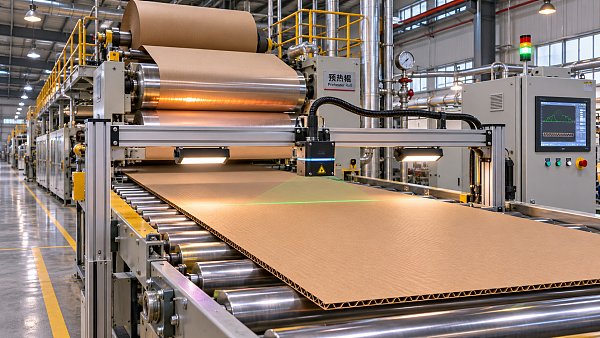
A control system can apply grade-specific recipes and coordinate preheater wrap, steam-related settings, adhesive application, and double-facer pressure or heat transfer, where the equipment supports these adjustments. The aim is a stable process window, not one universal temperature target.
Temperature measurement is not proof of bond quality. Sensor location, paper emissivity, contamination, and response time affect readings. Reliable control also depends on adhesive condition, mechanical alignment, drainage, and maintenance. Advanced moisture or warp feedback may support further correction, but these capabilities should be confirmed rather than assumed.
The bridge is both a buffer and a tracking challenge
Bridge inventory allows the wet end and dry end to operate with some independence. Too little inventory risks interruption; poorly managed accumulation can introduce tension disturbances and complicate order transitions.
Bridge control therefore needs more than a level indication. It should coordinate speed differences and preserve material identity through the accumulated web. Otherwise, a recipe change or defect marker may be applied to the wrong section of board.
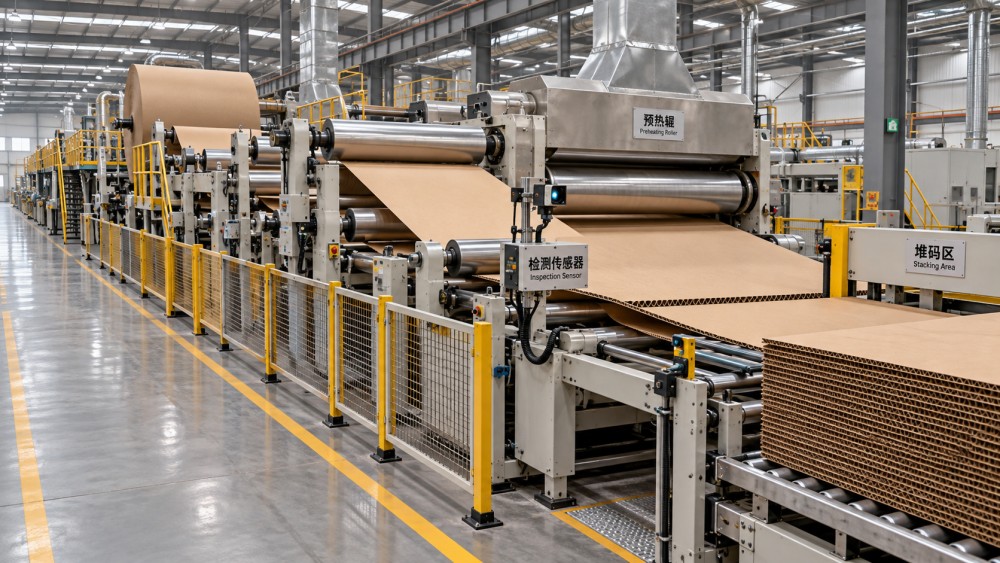
For design reviews, a material-flow diagram is useful: mark each measurement point, actuator, buffer, and tracking reference from reel stand to stacker. Gaps between detection and correction often become obvious when the team follows one section of paper through the entire line.
Order changes: where synchronization becomes saleable board
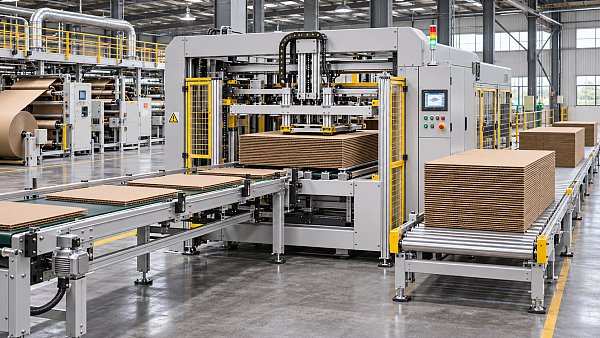
Shorter production runs increase the importance of changeover performance. Even a stable corrugator can lose substantial material if slitter-scorer positioning, cutoff length, order quantities, and stacker routing are not coordinated around the same transition point.
A well-integrated system calculates and tracks that point along the line. It prepares the next order, initiates supported setup movements, and changes cutting or stacking instructions when the appropriate material arrives. The exact sequence depends on machine architecture and whether particular adjustments are possible during production.
Project teams should ask suppliers to explain three situations in detail:
- A routine dimensional change: How are slit widths, scores, cut lengths, and stack destinations synchronized?
- A construction change: How are paper combinations, process recipes, and bridge contents managed?
- An interrupted change: What happens if a paper break, drive fault, or emergency stop occurs halfway through the transition?
The third situation is often the most revealing. Recovery logic must retain or safely re-establish order identity, material position, and production counts. A fast normal changeover has limited value if an interruption leaves operators guessing which settings belong to the board approaching the cutoff.
Trim optimization deserves a separate boundary. Scheduling software can combine compatible orders to improve deckle utilization; machine controls execute those combinations accurately. Controls alone cannot eliminate trim caused by unsuitable order mixes or available reel widths.
Detection only saves paper when it changes the response
Inspection equipment, process sensors, and alarms can reveal deviations earlier, but detection does not automatically prevent waste. Each event needs a defined response: adjust a setting, slow the line, identify a suspect length, divert sheets, or request operator intervention.
For example, an inline inspection system may identify visible surface defects or dimensional deviations. It should not be assumed to detect every weak bond or internal flute defect. Offline tests and sampling remain necessary where inline measurements do not establish product conformity.
Position tracking connects detection to containment. The system needs to know where suspect material will arrive at the cutoff or reject point, accounting for bridge accumulation and transport delay. Without that link, operators may reject too much board—or allow affected sheets into a good stack.
Alarm design matters as well. Repeated nuisance alarms encourage acknowledgement without investigation. Prioritize actionable conditions, show the affected machine zone, and record relevant process values so operators can distinguish a transient disturbance from a developing fault.
Specify the integration before accepting the savings estimate
A corrugator control system for board line upgrades may span existing PLCs, drives, proprietary machine interfaces, inspection equipment, and production-management software. Its performance depends on what these systems can actually exchange.
An interface survey should establish whether each connection supports monitoring only or permits controlled changes. Reading a speed signal is not equivalent to commanding a coordinated ramp. Receiving an order number is not equivalent to tracking its physical location through the line.
Include the following requirements in the functional specification:
- Signal quality: Measurement range, accuracy, calibration, update rate, and fault detection for critical sensors.
- Control authority: Which controller owns each setpoint, how overrides work, and how conflicting commands are prevented.
- Time and position references: Encoder scaling, clock synchronization, transport-delay handling, and tracking recovery.
- Recipes and records: Version control, permitted adjustment ranges, access rights, and traceable operator changes.
- Failure behavior: Responses to communication loss, invalid measurements, server outages, and restart conditions.
- Maintainability: Backups, software access, spare components, diagnostics, and operator training.
Safety functions must remain appropriately engineered and validated. Production optimization must not bypass guarding, emergency stops, or safety-related interlocks. Applicable requirements depend on jurisdiction and project scope; standards such as IEC 60204-1, ISO 13849-1, or IEC 62061 may be relevant to electrical equipment and safety-related control design. They are not guarantees of lower waste.
For networked upgrades, address remote access, segmentation, account management, and recovery procedures. The IEC 62443 series can inform industrial cybersecurity requirements, with responsibilities clearly allocated between the plant, integrator, and equipment suppliers.
Prove improvement with a controlled acceptance plan
“Lower waste” is too vague for commissioning. Establish a baseline before the upgrade and agree on measurement boundaries. Paper input and saleable board output should be compared on a consistent mass basis where practical, with moisture effects and inventory changes considered. Do not mix linear metres, sheet area, and tonnes without explicit conversions.
A useful overall measure is material loss rate = (paper input − saleable board output) ÷ paper input × 100%. Define what counts as saleable, how work in progress is treated, and where trim, samples, rejected sheets, and rework are recorded. Avoid counting the same loss twice.
Pair the overall figure with diagnostic indicators:
- Startup waste per comparable startup.
- Changeover waste per transition type.
- Splice-associated rejects and web-break frequency.
- Quality rejects by defect category.
- Good production rate and unplanned downtime.
- Time required to regain acceptable quality after a disturbance.
Acceptance trials should include representative paper grades, widths, flute combinations, speeds, and short-run orders—not only an easy long run. Record incoming material conditions and relevant mechanical issues so differences are not incorrectly attributed to software.
Factory acceptance testing can verify logic, interfaces, and simulated failures. Site acceptance testing must establish actual tracking, recovery, board quality, and operator usability on the installed line. Continue reviewing performance after commissioning; recipe refinement and operator familiarity often determine whether initial gains persist.
The investment decision is about controllable loss
The strongest proposal connects each expected improvement to a specific loss mechanism, a supported control function, and an agreed verification method. If the dominant problem is uncoordinated changeovers, prioritize tracking and dry-end integration. If unstable bonding drives rejects, investigate thermal conditions, adhesive control, and mechanical health before investing mainly in production dashboards.
For project leaders, that distinction keeps the business case grounded. A control system reduces board line waste when it brings the right process back under control—or contains affected material sooner. Its value comes not from the number of screens or connected devices, but from producing more acceptable board from the paper already entering the line.
Related News
 KPS to Acquire 70% of MM Packaging at €2.4 Billion Enterprise ValueKPS will acquire 70% of MM Packaging at a €2.4 billion enterprise value. Explore what the deal means for the packaging business and its customers.Corrugated Thermodynamics Architect
 How to Size Bridge Conveyors for a Corrugator LineSize Bridge Conveyors for your corrugator line with practical guidance on web accumulation, sheet throughput, layout, and controls. Avoid costly bottlenecks.Corrugated Thermodynamics Architect
 Nine Dragons Paper Raises Chongqing Corrugated Paper Price by 50 Yuan per TonneNine Dragons Paper raises Chongqing corrugated paper prices by 50 yuan per tonne. See when the increase takes effect and what it means for packaging costs.Corrugated Thermodynamics Architect
 How Automatic Warp Control Systems Improve Corrugated Board FlatnessDiscover how automatic warp control systems improve corrugated board flatness, reduce production waste and support more reliable converting.Corrugated Thermodynamics Architect
 How to Evaluate a Sheet Stackers Factory for Your Production LineEvaluate a sheet stackers factory with confidence. Compare capacity, line integration, acceptance tests and service to choose the right supplier for your production line.Corrugated Thermodynamics Architect
 What to Ask a Starch Mixer Manufacturer Before OrderingChoosing a starch mixer manufacturer? Ask these essential questions about capacity, pricing, automation and support before you order.Corrugated Thermodynamics Architect