How Do You Choose a Glue Kitchen Manufacturer for Corrugating?
Choose a glue kitchen manufacturer by comparing verified adhesive output, batch repeatability, integration scope, and installed operating cost. A lower equipment price loses its advantage if the system cannot replenish adhesive during peak corrugator demand or requires frequent manual corrections. Start with a common process specification, then require each supplier to demonstrate how its proposed equipment will meet that specification under the actual starch, water, recipe, and production conditions.
The purchasing decision should connect adhesive preparation with bonding performance without treating every board defect as a glue kitchen problem. Weak bonding and warp also involve paper properties, adhesive application, heat transfer, and corrugator settings. A credible proposal defines what the kitchen controls, what it measures, and which downstream conditions must be maintained during performance testing.
Size the system around usable output and peak demand
Tank volume alone is a poor basis for comparing quotations. Gross vessel capacity, working batch volume, and adhesive delivered per hour describe different things. The useful capacity calculation includes ingredient charging, mixing, any required heating, transfer, and cleaning time. Ask for a complete batch cycle tied to the proposed formulation, rather than a mixing time quoted in isolation.
Establish demand from the corrugator’s operating envelope: working width, sustained production speed, board constructions, active glue stations, and adhesive application rate. Double-wall production changes the number of bonding interfaces being supplied. Separate single-facer and double-backer requirements wherever recipes, storage arrangements, or delivery circuits differ.
A useful starting calculation is:
Wet adhesive demand = produced board area per hour × total wet adhesive application per unit of board area.
The application figure must already account for all relevant bonding interfaces. If consumption data are expressed as dry starch, convert them using the adhesive solids fraction before comparing them with wet adhesive production capacity. Keep mass and volume units consistent; converting between them requires an appropriate adhesive density.
Historical consumption records offer a useful cross-reference, provided they distinguish production use from flushing, discarded batches, and inventory changes. Average shift consumption can hide short periods of heavy draw. Size storage and replenishment around the production schedule, including the period when a new batch is unavailable.
Extra storage is not automatically beneficial. Excessive residence time complicates temperature management, agitation, and recipe changes. Require a balance showing usable storage, minimum operating level, peak withdrawal, replenishment time, and the response to a delayed or rejected batch. Where uninterrupted production is essential, identify whether resilience comes from storage, duplicated equipment, or an alternative preparation route.
Establish whether the process suits the adhesive recipe
A glue kitchen manufacturer should explain how its mixing process handles the intended starch adhesive system. Carrier-based and no-carrier processes have different preparation sequences and control requirements. Equipment suitability depends on starch characteristics, recipe chemistry, shear, temperature, and addition order. A generic statement that the system “handles all starches” provides little purchasing evidence.
Provide representative raw-material specifications and identify expected changes in starch source or grade. Water quality and temperature also belong in the process discussion. Seasonal water-temperature variation can alter the time and energy needed to reach preparation conditions, while changes in water chemistry can affect recipe behavior.
Request trials using the proposed materials and relevant formulation range. Record viscosity, solids, temperature, and gelation behavior using agreed methods. A viscosity value without a defined instrument, sample temperature, and measurement procedure is difficult to compare. Samples should represent both freshly prepared adhesive and its condition after the expected storage period.
Pay particular attention to the smallest practical batch. Large vessels sometimes receive attractive capacity claims while their low-volume mixing or weighing performance remains undefined. A plant with frequent grade changes needs evidence that smaller batches remain consistent without creating excessive residual adhesive.
Dosing accuracy must survive real installation conditions
Published weighing resolution does not establish ingredient dosing accuracy. Performance also depends on feeder behavior, valve closing time, material remaining in transfer lines, vibration, and forces transmitted through pipe connections. Small chemical additions deserve separate scrutiny because an error that appears minor by mass can materially change adhesive behavior.
Define tolerances for delivered ingredient quantities under agreed conditions. Distinguish measurement display resolution from demonstrated accuracy and repeatability. The acceptance procedure should include repeated batches, with a defined response when an ingredient falls outside tolerance. Automatic compensation requires particular care: correcting total batch mass does not necessarily restore the intended chemical balance.
Draw the complete adhesive route before comparing scope
The kitchen, storage tanks, pumps, and return circuits form one connected process. A well-controlled batch can arrive at the corrugator in a different condition if circulation introduces excessive air, temperature changes, or contamination from another recipe. Review the full route from raw-material intake to each glue station and back.
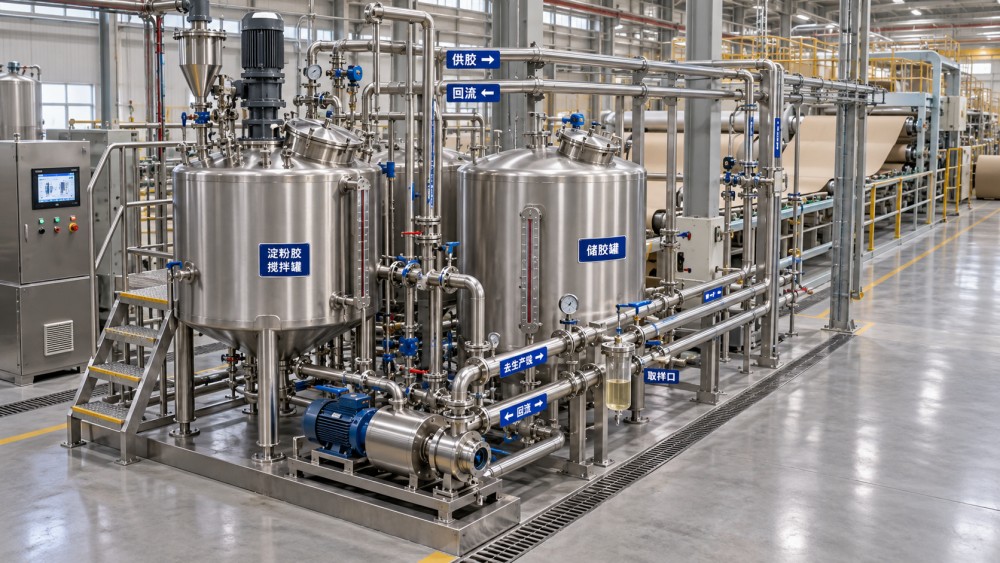
A process-flow drawing should identify preparation vessels, service tanks, transfer pumps, supply and return lines, sampling points, drains, and instruments. Show which circuits share adhesive and where recipes remain separate. This exposes scope gaps that a general arrangement drawing alone often misses.
Pump selection needs a stated duty, including adhesive characteristics, flow, pressure, pipe length, elevation, and anticipated operating conditions. Oversized circulation can add unnecessary energy and shear; insufficient delivery can starve a glue station during high demand. Ask how the design manages low tank levels, blocked lines, loss of return flow, and pump maintenance.
Existing return adhesive deserves explicit treatment. Its temperature, contamination, and processing history differ from those of a fresh batch. The proposal should explain where returns enter, how they affect inventory and recipe separation, and whether the agreed formulation permits their reuse. An undefined return connection can undermine otherwise precise batch preparation.
Confirm installation requirements before commercial comparison. These include floor loading, access for vessel erection, maintenance clearance, starch unloading arrangements, electrical supply, water pressure, and heating utilities where required. Drainage and wash-water handling need a defined destination. A quotation excluding these interfaces can appear inexpensive while leaving substantial site work unresolved.
Specify automation through operating scenarios
“Fully automatic” says little about how a system behaves during interruptions. Request a control demonstration covering normal production and realistic abnormal events. Useful scenarios include an interrupted starch feed, loss of water supply, a failed weighing signal, a transfer fault, and recovery after power loss.
The important question is whether the system knows what has already entered the vessel and prevents an uncertain batch from being released. Recovery procedures should preserve batch identity and ingredient history. Unrestricted manual overrides weaken this protection, so access permissions and override records belong in the specification.
Recipe management should include controlled editing, version history, and a clear distinction between target and actual quantities. Agree which data must be available to the plant network, the communication interface, and who supplies the connection work. Access to batch records should remain practical without requiring a service visit or a proprietary report purchase.
Also establish ownership of software backups, restoration procedures, control-system documentation, and remote-access arrangements. A replacement controller or failed computer should have a documented recovery path. These details affect downtime long after commissioning has finished.
Compare installed cost and the cost of maintaining production
Normalize quotations against an identical scope before comparing prices. Separate the preparation package from storage, chemical handling, starch conveying, distribution, site piping, electrical installation, commissioning, and training. Clearly identify freight, lifting, travel, and any civil work. Otherwise, the apparent price difference may simply represent different supply boundaries.
Evaluate lifecycle cost using the plant’s own production assumptions. Relevant items include electricity, heating, water, cleaning, calibration, wear parts, maintenance labor, and adhesive discarded during interruptions or recipe changes. Require suppliers to state the basis of consumption estimates, including batch size and cycle conditions. Unsupported percentage savings do not provide a reliable investment calculation.
Automation creates value where it controls a meaningful source of variation or removes a recurring operating burden. An elaborate system brings little benefit if essential sensors are difficult to calibrate or replacement components have long lead times. Compare routine service tasks, access time, spare-part availability, and the consequences of individual component failures.
Assess support through concrete deliverables: a recommended spare-parts list, maintenance instructions, escalation contacts, remote diagnostic capability, and a defined site-service arrangement. Relevant references are installations with similar adhesive chemistry, capacity, and integration complexity. Their usefulness comes from comparable operating conditions rather than production scale alone.
Make acceptance criteria part of the purchase contract
Agree the verification plan before placing the order. Factory testing can establish sequencing, interlocks, weighing functions, documentation, and mechanical operation within the test facility’s limits. It cannot fully prove performance with the installed pipework, site utilities, and corrugator demand. Reserve those items for site acceptance.
Site trials should cover the agreed batch-size range, consecutive preparation cycles, peak replenishment demand, and representative adhesive holding time. Define sampling locations and measurement methods in advance. Record raw-material conditions and utility conditions so that deviations can be investigated without relying on conflicting recollections.
Bonding performance belongs in the trial, but its evaluation needs controlled corrugator conditions. Adhesive application, paper combinations, heat input, speed, and relevant machine settings must be documented. A board-bond result alone cannot isolate kitchen performance, while a satisfactory tank sample cannot establish successful delivery and application.
The contract should state how deviations will be corrected, who supplies retest materials, and when acceptance is complete. Link final payment to agreed deliverables such as performance records, as-built drawings, calibration documentation, software backups, and completed training. This gives the purchase a measurable endpoint and keeps unresolved integration work visible before handover.
Related News
 KPS to Acquire 70% of MM Packaging at €2.4 Billion Enterprise ValueKPS will acquire 70% of MM Packaging at a €2.4 billion enterprise value. Explore what the deal means for the packaging business and its customers.Corrugated Thermodynamics Architect
 How to Size Bridge Conveyors for a Corrugator LineSize Bridge Conveyors for your corrugator line with practical guidance on web accumulation, sheet throughput, layout, and controls. Avoid costly bottlenecks.Corrugated Thermodynamics Architect
 Nine Dragons Paper Raises Chongqing Corrugated Paper Price by 50 Yuan per TonneNine Dragons Paper raises Chongqing corrugated paper prices by 50 yuan per tonne. See when the increase takes effect and what it means for packaging costs.Corrugated Thermodynamics Architect
 How Automatic Warp Control Systems Improve Corrugated Board FlatnessDiscover how automatic warp control systems improve corrugated board flatness, reduce production waste and support more reliable converting.Corrugated Thermodynamics Architect
 How to Evaluate a Sheet Stackers Factory for Your Production LineEvaluate a sheet stackers factory with confidence. Compare capacity, line integration, acceptance tests and service to choose the right supplier for your production line.Corrugated Thermodynamics Architect
 What to Ask a Starch Mixer Manufacturer Before OrderingChoosing a starch mixer manufacturer? Ask these essential questions about capacity, pricing, automation and support before you order.Corrugated Thermodynamics Architect