How Carton Making Machines Improve Output in High-Mix Plants
In a high-mix carton plant, the day rarely follows a clean, predictable production plan. A short run of retail-ready trays may be followed by heavy-duty shipping cases, then by printed e-commerce mailers with a different flute profile, board grade, die, glue pattern, and delivery deadline. For project leaders, the pressure is not simply to add machine speed. It is to protect output when the work changes constantly.
That is where Carton Making Machines become a strategic investment rather than a single piece of converting equipment. The right configuration can reduce the time between jobs, keep registration and creasing under control, lower material loss during setup, and make production performance less dependent on individual operator experience. The wrong configuration may have an impressive maximum speed on paper but create queues, manual handoffs, and quality interruptions across the actual workflow.
For engineering managers and project owners evaluating capacity expansion or factory modernization, the useful question is not “Which machine is fastest?” It is: Which production system will deliver the most sellable cartons across the mix of orders we actually run?
Why high-mix plants lose output in places that are easy to overlook
Nominal machine speed is only one part of production capacity. In carton converting, much of the lost time sits between orders or around small quality corrections: loading the next job, changing printing plates or die-cutting tools, resetting feeder positions, tuning folding guides, adjusting glue application, checking barcode readability, and removing imperfect sheets before they move further downstream.
These losses compound. A die-cutter may wait for sheets because the printer is still making color adjustments. A folder gluer may be ready but held back by bundles arriving in the wrong orientation. Operators may slow a line because board warp, flute crush, or inconsistent scoring makes a fast run risky. When the plant handles many SKUs, these small interruptions can consume more productive time than a manager expects from the original capacity model.
High-mix production also creates a different quality risk profile. Long-run operations can justify a longer setup because the setup cost is spread across thousands of units. A short run cannot. If the first several hundred blanks require repeated correction, the job margin can disappear before stable production begins. Carton Making Machines designed for repeatability, accessible adjustment, and digital job recall directly address this reality.
Output should be measured as good cartons per scheduled shift
Project teams often begin evaluation with sheets per hour, blanks per minute, or maximum belt speed. These figures matter, but they do not describe the whole operating result. A more realistic output measure includes:
- productive runtime after planned and unplanned stops;
- average changeover duration by job family;
- first-pass yield after printing, die-cutting, and gluing;
- waste generated during setup and restart;
- time needed for inspection, bundling, and pallet transfer; and
- the number of operators required to keep the line stable.
A machine with a moderately lower top speed may produce more saleable cartons over a shift if its feeder settings, register positions, pressure values, folding guides, and glue parameters can be recalled reliably. This is especially relevant for plants serving e-commerce, seasonal promotions, food and beverage distribution, or industrial customers whose order patterns change week by week.
In practical terms, the best carton production line is not the one that looks fastest during a supplier demonstration. It is the one that returns to stable output quickly after the next order arrives.
Where Carton Making Machines create tangible gains
1. Faster changeovers without sacrificing setup discipline
Changeover is often treated as a labor issue, but it is equally a machine design issue. Tooling access, automatic side-register adjustment, motorized feeder settings, quick-lock systems, servo-driven positioning, and recipe storage can reduce the number of manual interventions required between jobs. Their value is not merely speed; it is consistency. A repeat job should not depend on an operator remembering the exact setting used three weeks earlier.
For flatbed or rotary die-cutting, fast tooling changes must be matched with dependable positioning and pressure control. On folder gluers, rapid adjustment is valuable only if folding carriers, pre-fold sections, and glue guns remain repeatable at production speed. A project specification should therefore distinguish between “fast to change” and “fast to return to approved quality.” They are not the same thing.
2. Better control of variation in board and blank quality
High-mix factories frequently process different corrugated grades, paper weights, moisture conditions, coatings, and blank dimensions. These material changes affect feeding, print transfer, die-cut depth, creasing behavior, folding accuracy, and adhesive performance. A machine built around a narrow material window may force operators into repeated manual correction.
Useful capabilities include vacuum or belt feeding systems appropriate to the board range, stable sheet separation, adjustable transport pressure, registration monitoring, adaptable creasing settings, and controlled glue application. Where digital controls are available, job recipes should record not only dimensions but also process settings linked to each substrate type.
This matters upstream as well. If the corrugator produces board with uneven moisture, poor bond quality, inconsistent cut length, or unstable score lines, even sophisticated converting equipment will struggle. Capacity planning should connect corrugator stability, blank preparation, printing, die-cutting, folding, gluing, inspection, and delivery as one production chain.
3. Less waiting between connected processes
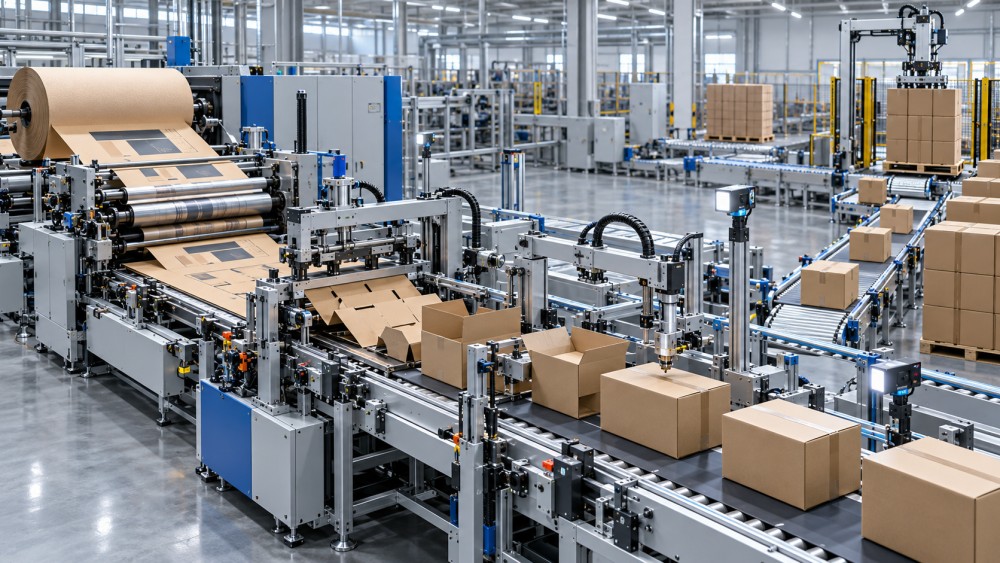
A standalone machine can be productive while the factory remains inefficient. Consider a post-print corrugated operation: the flexographic press may complete a job quickly, but if blanks require manual staging before die-cutting, then manual sorting before gluing, the work-in-process inventory grows and lead time stretches. Each pile of semi-finished material also becomes an opportunity for mixing, damage, or job identification errors.
Carton Making Machines improve output most effectively when their interfaces are planned early. Conveyor direction, buffer capacity, stack height, bundle orientation, pallet access, barcode scanning, and downstream accumulation all deserve attention during layout design. In some plants, a modest automatic transfer system brings more usable capacity than upgrading the primary converting machine alone.
Automation does not need to mean a fully lights-out factory. A practical design may automate repetitive handling and data capture while retaining skilled operators for complex setups, exception handling, and quality decisions. The objective is to remove the tasks that interrupt flow without creating an inflexible system that cannot accommodate unusual orders.
4. Earlier detection of defects and job mix-ups
When defects are discovered at final packing, the factory has already invested labor, machine time, adhesive, and material in a product that may need rework or disposal. Inline vision inspection, print registration checks, code verification, and job-tracking systems move detection closer to the source of the problem.
For a plant producing branded packaging, this can be as important as mechanical throughput. A missing date code, unreadable barcode, color deviation, incomplete glue seam, or incorrect blank version can stop shipment even when the cartons look acceptable at a distance. Inspection systems should be selected based on the real defect modes of the plant, not because inspection has become a fashionable automation feature.
The configuration choices that matter most during selection
There is no universal “best” carton making line. A project leader should begin with the plant’s order profile: median run length, number of daily changeovers, size range, board types, print requirements, special finishes, peak-season demand, and percentage of repeat work. From there, the machine specification can be built around actual constraints.
Ask suppliers to demonstrate the equipment using representative materials and realistic job transitions where possible. A clean demonstration on one standard board grade says little about performance with warped sheets, light board, heavily printed blanks, or a difficult folding pattern. Request a clear breakdown of the setup sequence: what is automated, what remains manual, which settings can be stored, and how the machine verifies that the next job is correctly configured.
Do not let automation create a new bottleneck
Automation is valuable when it simplifies the work around the core process. It becomes problematic when a plant adds complex equipment without sufficient engineering support, maintenance planning, data discipline, or operator training. An automated palletizer, for example, cannot resolve inconsistent bundle formation upstream. A vision system cannot compensate for poor lighting design, dirty optics, or unclear reject handling. A production management platform will not improve scheduling if job data and material status are unreliable.
Before approving a carton automation project, map the exception paths as carefully as the normal flow. What happens when a blank is misfed? How are rejects separated and counted? Can an operator safely access the machine during a jam? Where does a short batch go if the palletizing pattern is not viable? How are partial pallets labeled and tracked? The answers shape real uptime.
Maintenance deserves the same level of attention. High-mix production puts repeated adjustment cycles on mechanical components and increases the importance of calibration. A sound investment plan includes critical spare parts, preventive maintenance intervals, training for first-line troubleshooting, and clear responsibility for electrical, pneumatic, software, and mechanical issues.
Build the business case around flow, not only purchase price
Capital cost remains important, but it should be evaluated against the operational value of greater flexibility. A lower-priced machine with long setup times, high dependence on skilled manual adjustment, and limited integration may cost more over its working life than a better-configured line. Conversely, over-specifying automation for a stable, long-run product mix can burden a plant with unnecessary complexity.
A balanced business case looks at labor redeployment, setup waste, quality-related rework, downtime exposure, throughput at typical job sizes, maintenance consumption, energy use, and potential delivery improvements. It should also consider future mix changes. As brand owners increase SKU variety and e-commerce packaging evolves, the ability to absorb more frequent order changes may become a source of commercial resilience.
For project managers, the most useful outcome is a system that makes performance visible. When production data links job setup, machine status, reject reasons, material use, and shift results, improvement discussions become more factual. The team can identify whether the next investment should target feeding, die-cutting, gluing, inspection, material handling, or planning rather than relying on assumptions.
A practical decision standard for high-mix carton operations
Carton Making Machines improve output when they are selected as part of a coordinated production system. Their contribution comes from shorter, repeatable changeovers; controlled handling of varied materials; fewer defects reaching the end of the line; and smoother movement from blank to finished carton.
The strongest selection decisions are usually made by teams that test their assumptions against real order data. They examine the difficult jobs, not just the easy ones. They calculate sellable output rather than theoretical speed. And they treat integration, maintainability, and operator usability as capacity factors, not secondary details.
For a high-mix plant, this approach creates something more valuable than a faster machine: a carton operation that can respond to changing demand with less waste, less uncertainty, and a more dependable path to shipment.
Related News
 KPS to Acquire 70% of MM Packaging at €2.4 Billion Enterprise ValueKPS will acquire 70% of MM Packaging at a €2.4 billion enterprise value. Explore what the deal means for the packaging business and its customers.Corrugated Thermodynamics Architect
 How to Size Bridge Conveyors for a Corrugator LineSize Bridge Conveyors for your corrugator line with practical guidance on web accumulation, sheet throughput, layout, and controls. Avoid costly bottlenecks.Corrugated Thermodynamics Architect
 Nine Dragons Paper Raises Chongqing Corrugated Paper Price by 50 Yuan per TonneNine Dragons Paper raises Chongqing corrugated paper prices by 50 yuan per tonne. See when the increase takes effect and what it means for packaging costs.Corrugated Thermodynamics Architect
 How Automatic Warp Control Systems Improve Corrugated Board FlatnessDiscover how automatic warp control systems improve corrugated board flatness, reduce production waste and support more reliable converting.Corrugated Thermodynamics Architect
 How to Evaluate a Sheet Stackers Factory for Your Production LineEvaluate a sheet stackers factory with confidence. Compare capacity, line integration, acceptance tests and service to choose the right supplier for your production line.Corrugated Thermodynamics Architect
 What to Ask a Starch Mixer Manufacturer Before OrderingChoosing a starch mixer manufacturer? Ask these essential questions about capacity, pricing, automation and support before you order.Corrugated Thermodynamics Architect