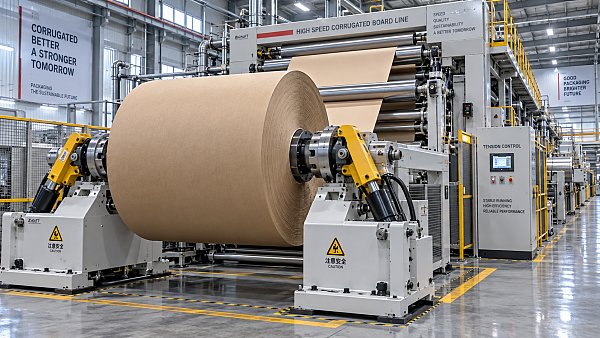
Heavy Duty Unwind Stands That Stabilize High-Speed Corrugators
A high-speed corrugator cannot run more steadily than the paper roll feeding its single facer or preheater section. When an unwind stand lacks stiffness, braking control, centering accuracy, or reliable reel-change behavior, the effect appears downstream as unstable web tension, flute damage, poor bonding, excess trim waste, and avoidable stops. A heavy-duty unwind stand is therefore not simply a roll-holding device. It is the first control point for paper stability on the corrugator.
The practical question is not whether a stand can carry a large roll. Many systems can support the nominal roll weight under static conditions. The more important question is whether it can keep the web stable while roll diameter falls, line speed changes, paper moisture varies, splices pass through the line, and the machine accelerates or decelerates. Stable high-speed production depends on performance under those changing conditions.
Why unwind instability becomes a board-quality problem
Paper enters a corrugator under tension, but it must not be pulled as though it were a rigid material. Linerboard and medium respond to tension changes through stretch, edge movement, curl, wrinkles, and occasional web breaks. A sudden increase in unwinding resistance can pull the web too hard. Insufficient resistance allows slack to form. Either condition disrupts the balance between the reel stand, braking system, preheater wrap, web guide, and the sections that follow.
On a medium web feeding the single facer, unstable tension can affect flute formation before the adhesive is even applied. On linerboard, poor control can create wrinkles or lateral wandering that later appears as uneven sheet geometry, registration difficulty in converting, or board with inconsistent visual quality. These effects are often attributed to paper quality, steam settings, or adhesive performance because those are visible production variables. Yet the source may be a reel stand that does not respond smoothly to changing reel inertia and web demand.
Large rolls make the issue more demanding. A full reel has high rotational inertia. It resists acceleration and deceleration, and its braking requirement changes continuously as its diameter decreases. The unwinding system must manage this transition without producing tension spikes. If its mechanical structure flexes, chuck engagement is inconsistent, or brake response is delayed, the machine may run acceptably at moderate speed but become difficult to stabilize when production speed rises.
“Heavy duty” should describe more than load capacity
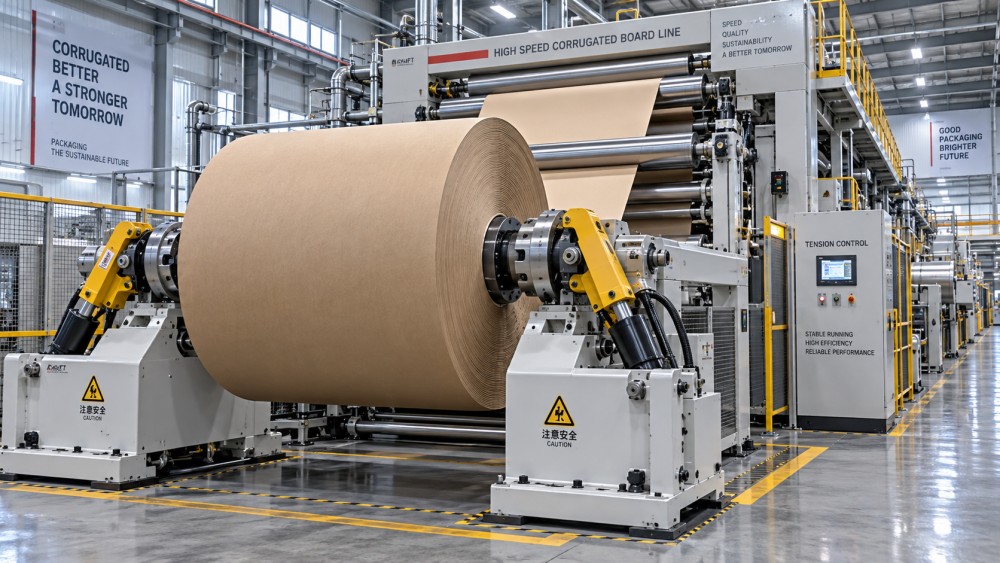
The term heavy duty unwind stands is often used loosely. In corrugator applications, a useful definition includes structural capacity, dynamic stability, braking behavior, reel-handling accuracy, and safe control of the roll during loading and running. A stand rated for a certain roll mass is not automatically suitable for the widest reels, highest operating speeds, or most demanding paper grades.
Static capacity answers a basic question: can the arms, shafts, chucks, bearings, and lifting mechanism carry the reel? Dynamic capability answers the production question: can the assembly control a rotating reel without vibration, chatter, roll drift, or tension variation? A machine can meet the first condition and fail the second.
Several mechanical details matter:
- Frame rigidity: Side arms and structural members must resist deflection when the roll is elevated and rotating. Excessive movement can alter web alignment and worsen vibration.
- Chuck or core-grip security: The reel must remain centered and securely engaged throughout the run. Worn expansion elements, damaged cores, or poor gripping surfaces can permit gradual lateral movement or sudden loss of holding force.
- Bearing condition: Bearing wear can create rough rotation, noise, heat, and uneven braking response. These symptoms are easy to miss during short checks but become important at sustained speed.
- Brake controllability: A brake must apply torque progressively and repeatably, not merely stop the reel. Pneumatic, hydraulic, or electrically controlled systems can all perform well when correctly maintained and matched to the application.
- Roll-centering repeatability: The reel should be placed at the intended datum position before threading. Repeated manual correction after the web enters the line is a sign that loading or centering control needs attention.
These points also explain why a larger stand is not always a better stand. Oversizing without proper control integration can leave the line with unnecessary mass, slow movements, or a braking system tuned for a different reel range. The useful target is a stand matched to the maximum reel dimensions and mass, but also to the normal working reel range and the line’s acceleration profile.
Tension control is a system, not a brake setting
A common production error is to treat unwind tension as a fixed brake-pressure setting. Brake pressure may be one part of the setup, but it cannot remain correct throughout the reel because the reel diameter and moment of inertia change continuously. The torque needed to maintain stable web tension at the beginning of a run is different from the torque needed near the core.
In a well-managed arrangement, the braking system receives a signal related to actual web demand. Depending on line design, that feedback can come from a dancer roll, load cell, festoon arrangement, drive control, or another tension-sensing method. The stand then adjusts braking torque as conditions change. The goal is not zero movement in the tension system; controlled movement may be necessary. The goal is to prevent tension from moving outside the range that the paper grade and process can tolerate.
Problems arise when the sensing device is mechanically restricted, contaminated with paper dust, incorrectly zeroed, or allowed to reach the end of its travel. A dancer roll that stays at one extreme is not providing useful control. It is reporting that the system lacks available correction. Before changing brake pressure repeatedly, check whether the dancer moves freely, whether its reference position is correct, and whether the brake actuator follows control commands without lag.
Brake response should also be checked during speed changes, not only at steady production speed. A reel may appear stable when the corrugator runs continuously at one speed but produce slack during deceleration or excessive tension during acceleration. These events can lead to web breaks, especially with lighter grades, moisture-sensitive paper, damaged reel edges, or rolls that are close to their core diameter.
Symptoms that point back to the unwind stand
Not every paper break originates at the unwind. Paper defects, poorly prepared splices, preheater conditions, misaligned rolls, and downstream nips can all contribute. Still, certain patterns justify a close inspection of the reel stand before changing process settings elsewhere.
The timing of the fault is important. If instability occurs only when one particular paper grade is used, paper properties and tension settings deserve attention. If the same issue appears across different grades but only on one unwind position, the stand itself becomes a stronger suspect. If the condition begins after reel changes, focus on loading accuracy, core condition, splice geometry, and the transition between the running reel and the incoming reel.
Reel changes are where stable running is often lost
A corrugator can maintain good tension for most of a reel and still lose productivity during reel changes. The outgoing reel becomes lighter, the web path changes as the splice approaches, and the incoming reel must be positioned accurately before it is brought into production. Heavy-duty stands reduce risk only when the full changeover sequence is disciplined.
The incoming roll should be checked before loading. Core damage, crushed reel edges, telescoping layers, loose outer wraps, and moisture-related deformation can all create problems that no braking system can fully correct. The paper should be loaded with its axis parallel to the intended web path, not merely placed where it appears visually centered. A roll that starts a few millimeters out of position can consume the available correction range of downstream web guides.
Splice preparation deserves the same attention as reel support. A splice that is too thick, poorly aligned, or inadequately secured can create a shock as it passes through tension-control and heating sections. That shock may be mistaken for a reel-stand fault. Conversely, a stand that allows slack immediately before the splice reaches the process can make a properly prepared splice fail. The reel change should be assessed as one connected event rather than as separate mechanical and paper-handling tasks.
Where automatic splicing is installed, the stand must maintain predictable reel position and unwinding behavior up to the transfer point. Where manual intervention is used, clear isolation procedures, controlled roll movement, and proper guarding are essential. A suspended or rotating reel contains significant stored energy. Attempts to correct alignment, clean a moving chuck, or handle loose paper near rotating components create avoidable hazards.
Mechanical checks that prevent repeated tension adjustments
When a line begins to show tension instability, the immediate response is often to adjust the brake. That may temporarily reduce a symptom, but it can also hide a mechanical problem. A structured check is more effective than repeated setting changes.
Start with the reel itself. Confirm roll width, core condition, edge damage, winding hardness, and whether the reel is sitting squarely in the chucks. Then inspect the stand while it is safely stopped and isolated: look for oil or dust contamination around brake components, wear on chuck surfaces, unequal arm movement, loose fasteners, hydraulic or pneumatic leaks, and abnormal bearing play. Check whether both arms reach their intended position and whether lifting movement is synchronized.
During controlled running, observe the web path rather than watching only the tension display. A stable number on a screen does not guarantee stable paper behavior if the sensor is poorly located or incorrectly calibrated. Watch for oscillation at the dancer, flutter between guide rolls, periodic lateral movement, and changes when speed is adjusted. Compare the two sides of a duplex or multi-reel arrangement where possible. A difference between positions can reveal a localized equipment issue.
Brake surfaces and control valves require clean, repeatable operation. Dust accumulation, inconsistent air supply, sticking valves, or poorly maintained friction components can cause torque to rise and fall in steps rather than smoothly. The result may be audible chatter, visible web pulsation, or unexplained breaks during otherwise normal production.
Alignment cannot be delegated entirely to web guides
Web guides correct small lateral deviations; they do not replace accurate reel loading and sound stand geometry. If a guide is forced to work near one end of its stroke for much of the run, the unwind position should be checked. Running with little correction reserve leaves the process vulnerable when the reel shifts, the paper expands under changing moisture conditions, or a splice enters the line.
Alignment should be verified from the reel centerline through the first guide and into the relevant preheater or entry section. The exact reference method depends on the machine layout, but the principle is consistent: each component should support a stable, repeatable web path. Misalignment causes edge loading and uneven wrap over heated rolls, which can contribute to curl or localized stress.
It is also important not to confuse a telescoped reel with a stand alignment problem. A reel with displaced layers can cause edge movement even when the stand is correctly set. The correct response is to identify whether the web is wandering because the reel axis is wrong, the paper is winding off unevenly, or the guide system is failing to respond. Treating all three conditions with more guide correction can worsen the situation.
Safe roll support is part of production stability
Safety features on heavy-duty unwind stands are sometimes viewed separately from productivity. In practice, they are closely connected. Secure chucks, controlled lifting, interlocks, emergency stops, guarding, and clear load limits reduce the chance of an uncontrolled reel movement that can stop the line for far longer than a routine adjustment.
Load limits must include the actual reel dimensions and center-of-gravity conditions, not only paper mass. An unusually wide reel, damaged core, or off-center roll can impose different stresses on arms and gripping equipment. Forklift placement and loading approach also matter. Impact damage to stand arms, chucks, sensors, or side frames may not cause an immediate failure, but it can introduce alignment errors that later appear as recurring production instability.
Reliable corrugator performance begins before paper reaches the single facer. When the unwind stand holds the reel securely, maintains a controlled web path, and adjusts torque smoothly as the reel changes, downstream settings become easier to stabilize. When it does not, teams can spend hours compensating at preheaters, brakes, guides, and process sections for a problem that started at the roll. The most effective approach is to treat the unwind stand as an active production system: inspect its mechanics, verify its feedback response, control reel changes carefully, and investigate repeatable symptoms at their source.
Related News
 What Determines Compression Section Price in Corrugator ProjectsCompression section price depends on width, speed, pressure control, heating, automation, and integration. Learn how to compare quotes and maximize corrugator ROI.Corrugated Thermodynamics Architect
 How a Servo Driven Folder Gluer Machine Improves Carton AccuracyDiscover how a servo driven folder gluer machine improves carton accuracy through synchronized motion, repeatable folding, precise glue placement, and faster changeovers.Corrugated Thermodynamics Architect
 How Carton Making Machines Improve Output in High-Mix PlantsCarton Making Machines help high-mix plants increase sellable output with faster changeovers, lower waste, reliable quality control, and smoother workflow integration.Corrugated Thermodynamics Architect
 Corrugator Control Systems That Improve Board Quality and UptimeCorrugator Control Systems improve board quality, reduce waste, and increase uptime with coordinated heat, moisture, tension, glue, and speed control.Corrugated Thermodynamics Architect
 How High Speed Feeder Systems Support Faster Corrugator OutputHigh speed feeder systems help corrugator plants improve stable throughput, reduce feeding delays, protect board quality, and maximize converting efficiency.Corrugated Thermodynamics Architect
 Heavy Duty Unwind Stands That Stabilize High-Speed CorrugatorsHeavy duty unwind stands stabilize high-speed corrugators with precise tension control, secure reel handling, and smoother roll changes. Discover how to reduce breaks, waste, and downtime.Corrugated Thermodynamics Architect