Corrugator Control Systems That Improve Board Quality and Uptime
A corrugator can appear mechanically sound while board quality drifts through a shift: flute height varies, warp increases after the double facer, bond strength becomes inconsistent, or operators repeatedly reduce speed to prevent breaks. In these situations, the problem is often not one isolated machine setting. It is the way temperature, moisture, web tension, glue application, and line speed are being coordinated—or failing to be coordinated—across the process.
Corrugator Control Systems improve board quality and uptime when they turn separate process signals into timely, stable operating actions. The most effective systems do more than display temperatures or allow remote speed adjustment. They maintain defined process windows, synchronize section behavior during grade and order changes, detect developing instability, and give operators enough context to correct the cause rather than repeatedly treating the symptom.
When board defects are really control coordination problems
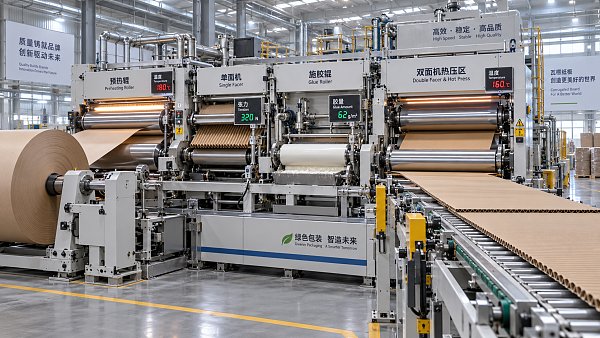
Corrugated board is formed through a sequence of thermal, mechanical, and adhesive-dependent events. A paper web enters with a particular moisture level, basis weight, and surface condition. It is preheated, conditioned, formed into flutes, bonded to liners, dried under pressure, then slit, scored, and cut. Each stage changes the condition of the material for the next stage.
That sequence explains why a defect observed at delivery may begin much earlier. A dry liner can pull through the machine differently from a more balanced sheet. Excessive heat before the single facer may affect paper behavior and adhesive response. A small tension mismatch can distort flute formation or create tracking issues. If speed increases without corresponding changes to steam, wrap, glue, and pressure settings, the double facer may not deliver enough bonding or drying time.
Manual operation can manage a stable, familiar order reasonably well. Difficulty rises when paper grades change, order lengths shrink, ambient conditions move, or the line must recover quickly after a stop. Under those conditions, disconnected controls force operators to make several adjustments based on incomplete information. Integrated control logic helps keep the process aligned.
- Symptoms at the dry end: warp, weak bonds, uneven caliper, cracked liner, score variation, or unstable sheet dimensions.
- Symptoms during running: web breaks, wandering paper, frequent speed reductions, glue-related buildup, and repeated manual intervention.
- Symptoms after a changeover: extended stabilization time, elevated trim or reject volume, and quality variation between the first and later stacks.
These symptoms do not prove that the control system is at fault. They do show why control architecture should be assessed as part of the root-cause path, rather than treated as a separate automation feature.
The process variables that must work together
Good control begins with reliable measurement, but measurement alone does not improve production. The system must connect each relevant signal to an understandable operating response. On a corrugator, that usually means controlling interactions rather than pursuing a single setpoint in isolation.
Heat, steam, and moisture balance
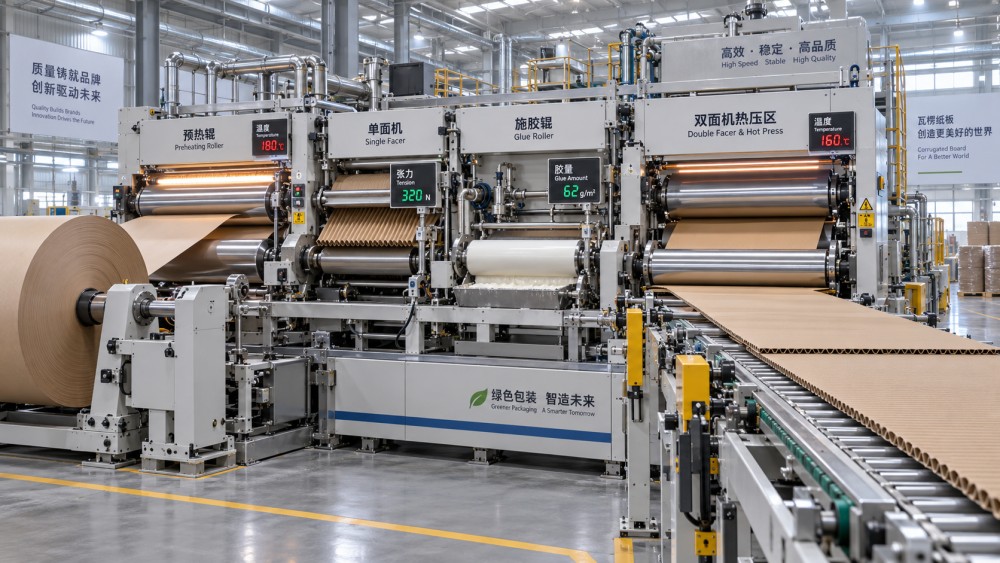
Preheaters, preconditioners, steam showers, and hot plates influence the temperature and moisture condition of liners and medium. Their purpose is not simply to make paper hot. They prepare the web for forming, adhesive application, and bonding while avoiding excessive moisture loss or localized thermal stress.
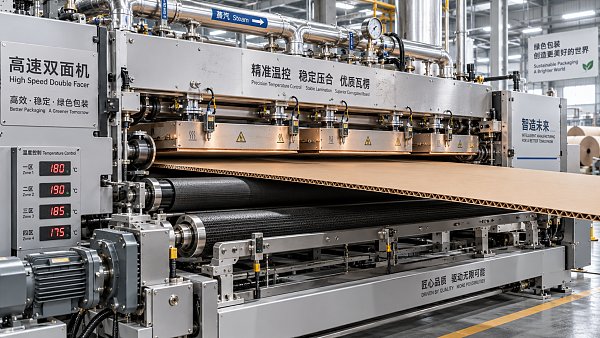
A control strategy should account for paper grade, running speed, wrap angle where applicable, and the thermal demand of the order. A liner that leaves a preheat section in a different condition from the target may later contribute to washboarding, poor adhesion, or warp. At the double facer, hot-plate zone control and pressure management must support adequate gelation and drying without producing an over-dried board.
Technical reviews should ask whether temperature feedback is measured at useful process locations, whether steam control responds smoothly, and whether the logic changes appropriately as speed changes. A system with many displayed values but no coordinated response may still leave the operator to manage thermal balance manually.
Tension and web handling
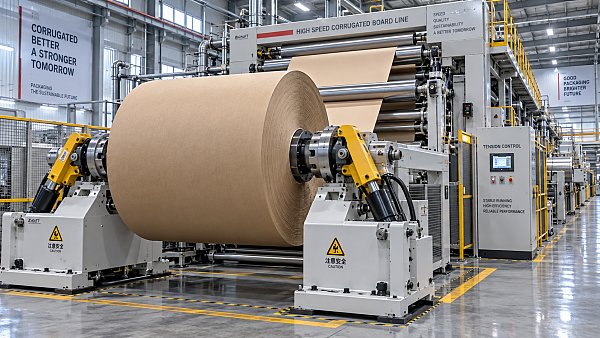
Tension control affects paper stability from reel stand through splicing, preheating, single facing, and downstream conveying. Too little control can allow slack, wrinkles, misalignment, or unstable flute formation. Excessive tension can increase break risk, stretch paper, and contribute to dimensional variation.
Because different papers behave differently, effective tension control needs more than one fixed setting. It should permit grade-specific recipes and compensate for changing reel diameter, acceleration, deceleration, and line-speed transitions. The value is especially clear during starts, splices, and order changes, when tension disturbances can travel downstream before an operator sees their full effect.
Glue application and bond development
Adhesive quality depends on formulation, viscosity, temperature, solids control, application amount, and the condition of the paper surfaces. At the machine, the glue system must apply an appropriate film consistently to the flute tips while avoiding excessive application, dry glue lines, or contamination.
Control of glue roll speed, metering conditions, gap settings, and circulation should be viewed alongside corrugator speed and paper condition. Increasing speed while leaving adhesive delivery unchanged may reduce bond reliability. Increasing glue to compensate for a thermal or moisture problem can create another issue, including longer drying demand or board warp.
A useful system does not assume that every weak bond requires more glue. It provides the operating history needed to distinguish between adhesive delivery, insufficient heat, poor contact, unsuitable paper conditioning, and other causes.
Speed synchronization across the line
Line speed is often treated as the headline productivity figure, yet stable speed coordination is more important than a high displayed maximum. The single facer, bridge, double facer, slitter-scorer, cut-off, stacker, conveyors, and waste handling equipment must maintain controlled relationships. A bottleneck or speed mismatch can create bridge instability, marking, sheet handling faults, or avoidable stops.
Control systems should manage ramp profiles rather than relying on abrupt changes. They should also coordinate speed reduction when a downstream condition requires it, while preserving safe web handling upstream. The aim is not to eliminate operator control but to prevent one local adjustment from destabilizing the complete line.
What separates a useful control architecture from a basic interface
When comparing systems, it is easy to focus on screen layout, remote access, or the number of available tags. These features matter, but their production value depends on the underlying architecture. A more useful evaluation examines how the system handles recipes, feedback, alarms, data quality, and recovery from abnormal events.
Recipe control deserves particular attention. A recipe should not be a static list copied from an earlier job without review. It should hold the settings that genuinely influence a repeatable process: paper combination, flute type, target speed range, preheater position or wrap, steam demand, adhesive-related settings, and downstream converting parameters. The best approach also allows controlled adjustment when actual paper behavior differs from the expected condition.
That distinction matters because paper variability is real. A control system cannot make every reel identical. It can, however, make deviations visible, preserve a record of what changed, and help the operating team respond without losing the reference condition for the job.
A practical way to investigate unstable quality
When a line develops recurring board defects, replacing settings one by one may create more confusion. A structured review should begin with the defect pattern. Is warp constant or tied to certain paper combinations? Does weak bonding appear after speed increases? Is the problem strongest immediately after an order change, after a splice, or only during certain ambient conditions?
- Define the defect precisely. Record the board structure, flute direction, paper combination, machine speed, order stage, and whether the condition affects all sheets or only a portion of the run.
- Check signal credibility before changing control logic. A temperature sensor with poor placement, a drifting pressure signal, or an unreliable moisture-related input can cause false corrective actions. Confirm sensor condition, calibration practices, and communication stability.
- Review trends around the first appearance of the defect. Look for speed changes, splice events, steam adjustments, glue-system variations, hot-plate zone changes, or tension alarms. The timing relationship is often more useful than a single current value.
- Separate automatic action from operator intervention. Determine whether the system made a correction, whether an operator overrode it, and whether the process improved or deteriorated afterward. This reveals whether the issue is tuning, process knowledge, or insufficient control authority.
- Test one controlled response at a time. Changes should be made within the equipment’s operating limits and documented against the observed result. Simultaneously changing steam, glue, pressure, and speed makes later diagnosis difficult.
This process also identifies cases where automation is being asked to compensate for a mechanical condition. Worn rolls, poor hot-plate contact, damaged belts, inconsistent steam supply, glue-roll wear, or web-guiding faults may sit outside the capability of software control. The system should expose the abnormal pattern, not hide it through repeated corrective movement.
Changeovers are where uptime gains are often lost
Shorter orders place more pressure on the control system because each job transition creates a temporary mismatch between incoming material, machine settings, and downstream requirements. A line may be mechanically capable of rapid changeover while still producing excessive off-spec board if its control sequence is fragmented.
Order-change control should coordinate the timing of paper transitions, speed profiles, heat and steam adjustments, adhesive conditions, slitting and scoring positions, cut length, and stack handling. The exact sequence differs by equipment design, but the principle remains the same: upstream process conditions must be ready before the new material reaches the sensitive bonding and converting zones.
Evaluate whether the system provides a clear order-state view. Operators should be able to see whether the line is preparing, transitioning, stabilizing, or producing to target conditions. This is more useful than a generic “automatic” status because it makes the source of delay visible. It also helps distinguish a normal stabilization period from an exception requiring intervention.
Using production data without creating a reporting burden
Data collection becomes valuable when it answers operational questions. For corrugator management, those questions may include: Which defects are associated with which paper combinations? How often are operators overriding automatic settings? Which alarms precede a web break? Does one section cause most speed restrictions? Are certain order changes consistently slow?
A historian should preserve enough context to answer those questions: timestamps, order identity, paper information, selected recipe, actual process values, alarm events, manual adjustments, and line status. Data without order context can show that a temperature changed, but not whether the change occurred during startup, stable production, a splice, or a quality incident.
Alarm management also deserves scrutiny. A crowded alarm list can train operators to acknowledge messages without investigation. Better alarm design differentiates between advisory conditions, process deviations, equipment faults, and conditions that require a controlled stop. Trend access at the alarm point helps an operator see whether the value moved gradually, jumped suddenly, or followed a related speed or pressure change.
Questions to ask before specifying an upgrade
An upgrade should be based on the production problem, not only on the age of the existing controls. A line that has reliable basic automation but poor data visibility may need different work from a line with obsolete drives, limited recipe capability, and frequent communication faults.
- Which quality defects consume the most investigation time or waste?
- Which process values are currently measured, and which important conditions are inferred or checked manually?
- Can operators compare actual values with recipe targets during a job and after a changeover?
- Are control loops tuned for present paper grades and normal speed ranges, or are they based on outdated operating assumptions?
- Can maintenance teams identify recurring faults by section, device, and event sequence?
- Will the proposed architecture remain serviceable, with documented inputs, outputs, network structure, backups, and controlled access rights?
Cybersecurity and access control should be included where remote diagnostics, networked production systems, or shared plant data are involved. The practical concern is not adding complexity for its own sake; it is ensuring that authorized changes are traceable and that a network interruption does not create uncontrolled machine behavior.
A well-designed corrugator control system does not remove the need for process knowledge. It gives that knowledge a repeatable operating framework: measured conditions are visible, recipes provide a disciplined starting point, deviations are easier to trace, and corrective actions are less likely to create new instability elsewhere on the line. For board plants seeking stronger quality consistency and more dependable uptime, that coordination is often the most important capability to evaluate.
Related News
 What Determines Compression Section Price in Corrugator ProjectsCompression section price depends on width, speed, pressure control, heating, automation, and integration. Learn how to compare quotes and maximize corrugator ROI.Corrugated Thermodynamics Architect
 How a Servo Driven Folder Gluer Machine Improves Carton AccuracyDiscover how a servo driven folder gluer machine improves carton accuracy through synchronized motion, repeatable folding, precise glue placement, and faster changeovers.Corrugated Thermodynamics Architect
 How Carton Making Machines Improve Output in High-Mix PlantsCarton Making Machines help high-mix plants increase sellable output with faster changeovers, lower waste, reliable quality control, and smoother workflow integration.Corrugated Thermodynamics Architect
 Corrugator Control Systems That Improve Board Quality and UptimeCorrugator Control Systems improve board quality, reduce waste, and increase uptime with coordinated heat, moisture, tension, glue, and speed control.Corrugated Thermodynamics Architect
 How High Speed Feeder Systems Support Faster Corrugator OutputHigh speed feeder systems help corrugator plants improve stable throughput, reduce feeding delays, protect board quality, and maximize converting efficiency.Corrugated Thermodynamics Architect
 Heavy Duty Unwind Stands That Stabilize High-Speed CorrugatorsHeavy duty unwind stands stabilize high-speed corrugators with precise tension control, secure reel handling, and smoother roll changes. Discover how to reduce breaks, waste, and downtime.Corrugated Thermodynamics Architect