What to Check Before Choosing a Laser Coder Manufacturer
A laser coder is rarely a stand-alone purchase. Its value depends on whether it produces readable, durable codes on the actual substrate, at the required line speed, with acceptable safety controls and without becoming a source of stoppages. A low initial quotation can become expensive if the supplier cannot validate the application, integrate with existing controls, or restore production quickly after a fault.
Before selecting a laser coder manufacturer, the central question is not “Which machine has the highest stated power?” It is whether the manufacturer can take responsibility for the full coding result: code quality, production-line communication, enclosure and extraction requirements, service access, and the cost of keeping the system productive over its operating life.
Start with the coding task, not the brochure specification
Laser coding is applied to a broad range of packaging materials, but the required mark can differ substantially. A date code on an outer corrugated case has different technical demands from a small Data Matrix code on a coated folding carton, a variable code on a flexible film, or serialization data on a pharmaceutical package. The substrate, surface treatment, required contrast, code size, and production speed should be defined before comparing manufacturers.
Material variation is particularly important in printing and packaging operations. Uncoated paperboard, varnished cartons, coated labels, metallized films, plastics, and painted surfaces do not absorb laser energy in the same way. A mark that appears sharp on a sample may become weak or inconsistent when coating thickness, pigment content, moisture, print coverage, or board colour changes. The manufacturer should therefore be able to explain not only that its laser can mark a material, but how it will maintain acceptable results across the material range used in production.
Request application trials using representative production samples rather than generic test cards. These samples should include the lightest and darkest artwork areas, the most demanding coatings, normal production variation, and any recycled or lower-grade substrate that may enter the supply chain. Where codes must be scanned, assessment should include verification with the intended scanner or vision system, not visual appearance alone.
The required output also needs precise definition. A readable human-readable date may be adequate for one line. Another line may require batch data, QR codes, GS1 DataMatrix symbols, serial numbers, logos, or variable text driven by a manufacturing execution system. The more data-intensive the job, the more important controller capability, data handling, layout management, and error prevention become.
Match laser source and wavelength to the real application
“Laser coder” describes a category rather than one uniform technology. A manufacturer should be evaluated on its ability to recommend the correct source for the marking mechanism required, rather than steering every application toward the same platform.
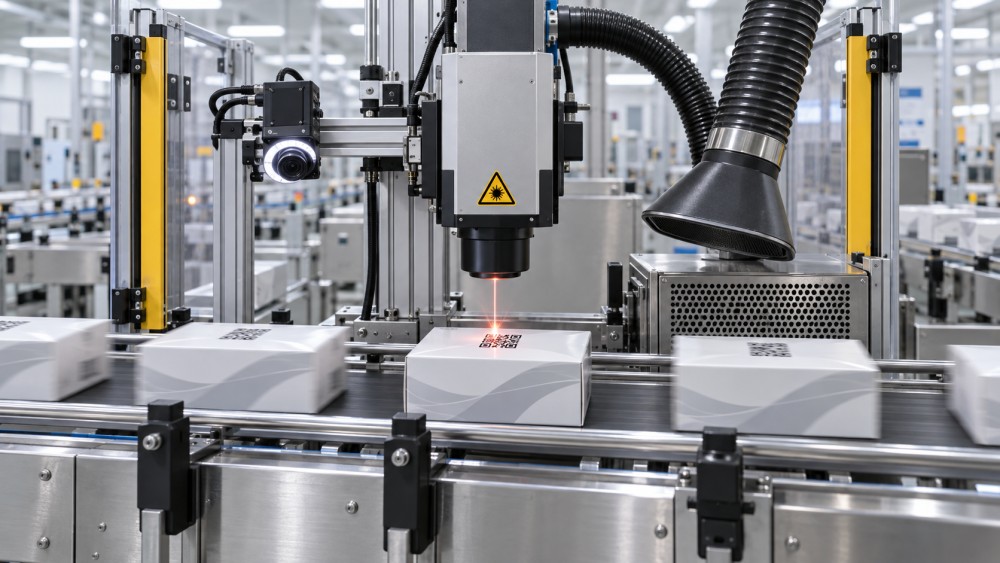
CO2 lasers are widely used for many paper, cardboard, wood, glass, and selected film applications. Their marks may result from surface removal, colour change, or controlled ablation. Fiber lasers are commonly considered for metals and many plastics, especially where fine, high-contrast marks are needed. UV laser systems can be relevant when a low-heat “cold marking” effect is needed to reduce substrate damage on sensitive materials. These broad categories do not eliminate the need for testing: additives, inks, coatings, laminations, and pigments can change the result significantly.
Power rating alone does not establish suitability. Higher power can provide more available energy or faster marking under certain conditions, but it may also increase the risk of burning, distortion, excessive ablation, odour, or damage to protective coatings. Beam quality, pulse characteristics, marking head optics, focal distance, line speed, and software settings all affect the finished code.
A capable laser coder manufacturer should state the operating window for the proposed configuration: expected substrate range, line-speed range, marking field, focal tolerance, code complexity, and any conditions that would require a slower line or a different lens. Broad claims such as “suitable for all packaging materials” should be treated as a warning sign unless supported by controlled application evidence.
Assess code quality in production conditions
The useful standard is not whether a code can be made in a demonstration. It is whether every required code remains legible and, where relevant, machine-readable after production handling, packing, transport, and storage.
For printed cartons and corrugated cases, contrast can be affected by artwork placement. A laser mark placed over dark ink, metallic decoration, heavy varnish, or a textured surface may have poor scanner performance even when the same code works well on a blank panel. The coding position should be reviewed with packaging design and print-production teams early enough to avoid creating an unscannable code zone.
For variable codes, buyers should ask how the system prevents common failures: wrong date, missing code, duplicated serial number, incorrect product file, truncated data, or code placement outside the designated area. These are not merely printer issues. They involve job selection, operator permissions, message approval, input signals, reject logic, and verification.
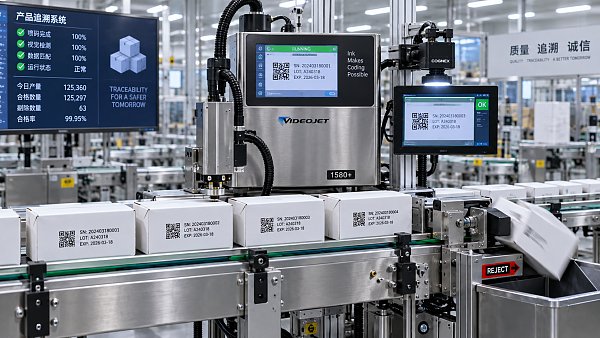
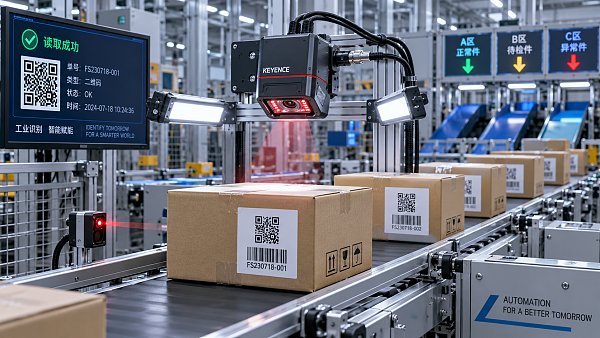
Where traceability is commercially or legally important, the proposal should distinguish between marking and verification. A laser coder creates the mark; it does not automatically prove that every code is correct. Inline vision inspection may be needed to confirm presence, position, readability, and content. The manufacturer does not need to supply every component directly, but it should be clear about interface responsibility and what happens when a failed code is detected.
Integration capability is often more valuable than a standalone machine feature
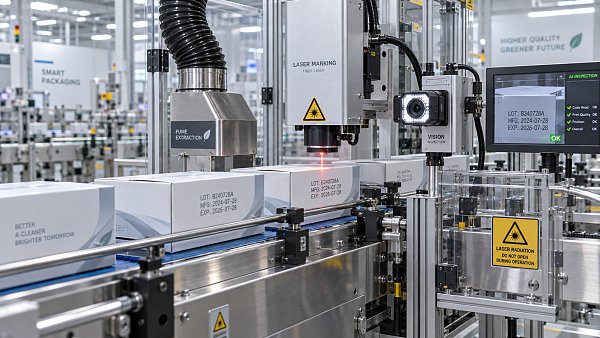
Laser coders must operate within a moving production system. In carton converting, commercial print finishing, labeling, or end-of-line case packing, successful operation depends on synchronization with conveyors, product sensors, encoders, line controls, and sometimes inspection and reject devices.
Line speed should be discussed as a production condition, not as a headline maximum. The effective speed depends on the code content, available marking time, product pitch, surface position, scan field, and whether the product is stationary or moving. A system that marks a short date code at a stated high speed may not maintain that performance with a dense 2D symbol, several text lines, or a large coding area.
Clarify how the coder receives product and job information. Common needs include discrete I/O, encoder input, Ethernet-based industrial communication, database connectivity, and interfaces to PLC, ERP, MES, or line-management systems. The relevant issue is not whether a protocol appears on a specification sheet; it is whether the supplier can document the interface, provide support during commissioning, and define ownership when data transfer fails.
Frequent job changes deserve special attention. In short-run packaging work, downtime can be caused less by laser hardware than by selecting the wrong message, manually editing fields, or changing focal positions. A well-designed system should support controlled job selection, recipe management, user access levels, and a practical changeover process. If the coding operation requires repeated manual alignment, its apparent automation benefit may disappear.
Examine the manufacturer’s approach to safety, extraction, and installation
A laser is not simply another printhead. The installation must manage laser radiation, fumes, particles, and operator access. The exact requirements depend on the laser class, enclosure design, substrate, local workplace rules, and production layout. Buyers should require a clear statement of the proposed safety concept rather than assuming that the base unit quotation covers the complete compliant installation.
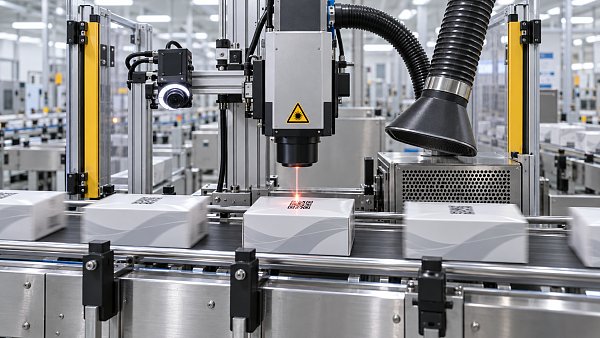
An enclosed laser station may include interlocked guarding, safety windows where applicable, emergency-stop integration, warning devices, and controlled access. On an open conveyor, the solution may require a protective enclosure or an engineered guarding arrangement. The supplier should identify the residual risks, required customer-side work, acceptance checks, and operator training obligations.
Fume extraction is equally important. Laser interaction with paper coatings, inks, plastics, adhesives, and laminates can create particulate matter and vapours. A generic extractor is not automatically suitable for every application. Capacity, filtration stages, duct routing, replacement intervals, fire considerations, and monitoring requirements should be defined against the material being coded. Poor extraction can affect operator conditions, contaminate optics, reduce mark consistency, and shorten maintenance intervals.
For cross-border equipment purchases, documentation matters as much as hardware. Confirm which conformity documentation, electrical documentation, risk information, manuals, and declarations the manufacturer will provide for the destination market. The buyer remains responsible for ensuring that the final installed system meets applicable local requirements, especially when the coder is integrated into a larger line by multiple parties. Contract language should not leave this boundary ambiguous.
Compare uptime support, not only warranty duration
Laser systems have fewer routine consumables than ink-based coding technologies, but they are not maintenance-free. Optics can require cleaning, extraction filters require replacement, cooling arrangements need attention, and electrical or control components can fail. The cost of an unavailable coder is usually dominated by line disruption, emergency labour, delayed shipments, rework, or the need to apply codes manually.
Service evaluation should cover response channels, diagnostic capability, local or regional field support, spare-parts stock, escalation procedures, and the supplier’s ability to support software and control issues. A long warranty is less useful if the process for obtaining technical help is slow or spare parts must be shipped internationally without a defined lead time.
Ask which failures can be diagnosed remotely, which components are field-replaceable, and whether the installed team can perform basic recovery tasks safely. Also ask about support for older systems. A manufacturer that discontinues controllers, software versions, or critical parts without a practical migration route can create an avoidable lifecycle risk.
References can be useful, but they should be relevant. A supplier may have many installations in beverage bottling yet limited experience with coated folding cartons or corrugated packaging. Reference checks should focus on comparable substrate, code type, line speed, integration complexity, and service geography.
Build the cost comparison around the installed lifecycle
A quotation comparison based on equipment price alone masks the actual financial decision. The installed cost may include laser source and marking head, mounting frame, safety enclosure, extraction unit, conveyors or product handling changes, sensors and encoders, PLC integration, validation trials, commissioning, training, documentation, and site acceptance. These items are often supplied by different parties, making a low equipment price look artificially attractive.
Operating cost should include electricity, extraction filters, preventive maintenance, replacement optics where applicable, service contracts, spare parts, software licences or support fees, and expected production interruptions. It is also worth comparing the cost of rejected or reworked packaging caused by coding errors. For high-value or regulated products, a missed or incorrect code can have consequences far beyond the direct cost of one carton or case.
A useful commercial comparison converts these items into a common ownership period and records assumptions openly. There is no need to rely on speculative savings claims. The decision becomes clearer when each supplier is measured against the same production hours, product mix, installation scope, maintenance plan, and service coverage.
Use acceptance criteria that can be enforced
Technical promises should be converted into measurable acceptance criteria before the purchase order is issued. The criteria may cover the approved substrates, specified code formats, scan performance where required, line speed, code position tolerance, data changeover function, communication signals, safety functions, extraction performance, and documentation delivery.
Factory acceptance testing can reduce risk before shipment, particularly when the application is complex or the equipment is being exported. Site acceptance testing should confirm that the system performs after installation on the actual line, with the customer’s products and controls. The contract should define what constitutes a pass, the correction process if requirements are missed, and the point at which final payment is released.
It is also prudent to document exclusions. If a supplier has tested only one board grade, one ink system, or one code layout, that limitation should be visible. Unstated assumptions often become disputes after installation, when the system is asked to handle materials or operating conditions never included in the original evaluation.
A manufacturer should reduce operational uncertainty
The strongest laser coder manufacturer is not necessarily the one offering the most impressive individual specification. It is the one that can define the application accurately, prove the mark on representative materials, integrate reliably with the line, support safe installation, and provide transparent lifecycle obligations.
For a packaging or print operation, coding is part of quality control and traceability, not a cosmetic add-on. A disciplined supplier review therefore treats code quality, system interfaces, safety engineering, service coverage, and installed cost as one decision. That approach makes it easier to identify a supplier whose proposal will remain workable after the quotation has been converted into a running production line.
Related News
 What Determines Laser Coder Price in Industrial Packaging LinesLaser coder price depends on power, speed, materials, integration, and verification. Discover how to compare total costs and select the right packaging solution.Machine Vision & Coding Fellow
 How to Choose a Serial Number Printing Machine for TraceabilityChoose a serial number printing machine with confidence. Explore traceability, code quality, data control, inspection, and integration factors for reliable packaging serialization.Machine Vision & Coding Fellow
 How to Choose a Barcode Reader for a Packaging LineChoose the right barcode reader for packaging line applications with expert guidance on code quality, speed, optics, lighting, validation, and reject control.Machine Vision & Coding Fellow
 What to Check Before Choosing a Laser Coder ManufacturerChoose a laser coder manufacturer with confidence. Learn how to assess application trials, code quality, integration, safety, service support, and lifecycle cost.Machine Vision & Coding Fellow
 How Variable Data Printing Machines Improve Traceability AccuracyDiscover how a variable data printing machine improves traceability accuracy through unique coding, inline verification, and reliable data reconciliation.Machine Vision & Coding Fellow
 How to Calculate Serial Number Printing System Cost and ROISerial number printing system cost: calculate total ownership, compare suppliers, and build a practical ROI model to reduce errors, downtime, and compliance risk.Machine Vision & Coding Fellow