What Determines Laser Coder Price in Industrial Packaging Lines
Laser coder price is rarely determined by the laser unit alone. In an industrial packaging line, the quoted cost changes with the code that must be marked, the material being marked, line speed, environmental protection, integration work, and the level of verification required. A low initial quotation can become an expensive choice when it creates missed codes, slows changeovers, or requires frequent intervention on a high-output line.
For packaging plants, the useful question is not simply “How much does a laser coder cost?” It is: what configuration is needed to produce readable, permanent, traceable codes at the required throughput, with acceptable operating risk? Procurement decisions become clearer when the price is separated into equipment scope, installation scope, and lifetime operating cost.
Why laser coder price varies so widely
Laser coders use concentrated light to alter the surface of a pack, carton, label, film, or other substrate. The resulting mark may be a color change, surface engraving, coating removal, or controlled ablation. That basic principle is simple; the production conditions are not.
A unit used to add a basic date code to a stable, unprinted carton requires a different specification from one that must create a high-contrast serialized code on coated folding cartons moving through a variable-speed cartoner. Both may be described as laser coding systems, but their practical requirements and price structure are substantially different.
The largest cost differences normally come from the following areas:
The marking application determines the right technology
“Laser” is not one uniform category. The appropriate source depends on how the packaging surface reacts. Fibre-based systems are commonly considered for many coated papers, cartons, labels, and certain plastics. CO2 systems are often used where organic materials, paper-based packaging, films, or coatings respond well to that wavelength. Other applications may need a different laser type where heat sensitivity, marking contrast, or material composition makes the usual choice unsuitable.
This is why a material sample is more valuable than a generic demonstration. A supplier should mark the actual substrate, including the intended coating, print layer, varnish, adhesive zone, and product orientation. An acceptable-looking sample made at low speed is not enough. The plant needs to see whether the code remains legible when the production line runs at its normal range and when ordinary variation in substrate finish occurs.
Corrugated and paperboard applications need particular care. A code may be clear on one board grade but weak on another because surface texture, liner color, moisture, recycled content, coating, and print coverage change how the material responds. In folding-carton work, the chosen coding area must also avoid damaging the visual finish or creating a mark that becomes inconsistent after folding.
For printed packaging, the question is not merely whether a laser can mark the surface. It must create a code that scanners and vision systems can read reliably. A low-cost configuration that produces marginal contrast can lead to rejected packs, manual inspection, and traceability failures that outweigh the saving at purchase.
Speed claims need to be translated into line conditions
Speed is often discussed in broad terms, yet a laser coder does not operate in isolation. The usable marking time depends on the available coding window, pack spacing, product stability, direction of travel, code position, and data load. A short alphanumeric code on a regularly spaced carton is very different from a dense 2D code with variable data on intermittent-motion equipment.
Ask suppliers to state the proposed solution against a defined production condition: code content, character height, code area, substrate, line speed, and product pitch. This avoids a common comparison error: one quotation is based on a simple test pattern while another includes the actual production code.
Plants with frequent SKU changes should also examine setup time. The cost of a laser coding system rises when it needs multiple mechanical positions, manual focal adjustment, or separate recipes that operators struggle to manage. The more product formats and code layouts a line handles, the more value there is in stable mounting, recipe control, clear job selection, and interfaces that reduce manual data entry.
Integration items often explain the gap between a base quote and project cost
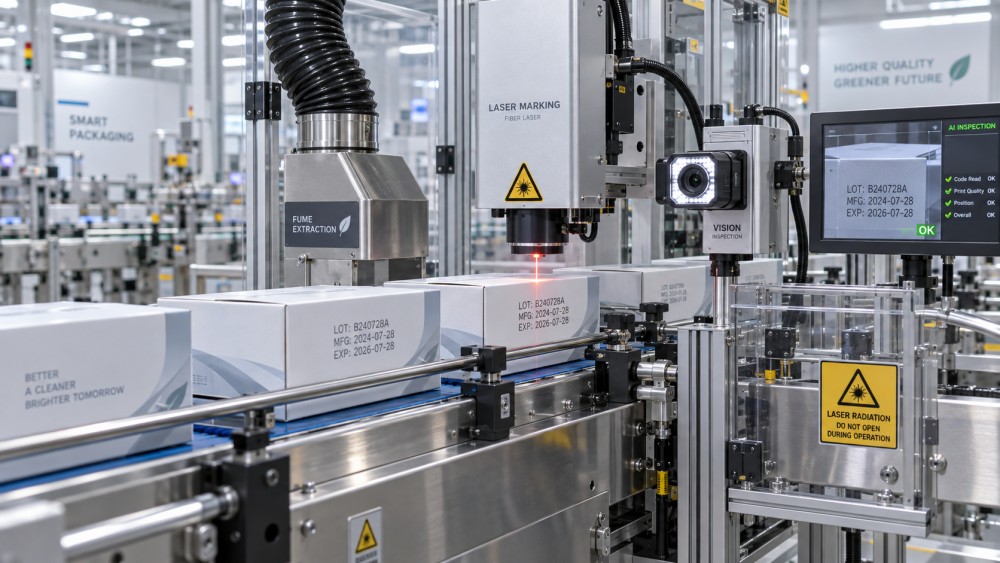
A base laser coder price may cover the laser head and controller, but a production-ready installation can require much more. On a packaging line, the coder may need brackets, a guard or enclosure, interlocks, extraction, a product sensor, an encoder, a signal tower, a remote interface, and communication with a printer, PLC, vision system, or production-management platform.
Fume extraction deserves special attention. Laser marking can generate particles or vapors from paper coatings, inks, films, or other packaging layers. Extraction is not a cosmetic accessory: it protects the marking lens, helps preserve code consistency, and supports a cleaner work area. The right extraction arrangement depends on the material and layout, so it should be specified as part of the application rather than added as an afterthought.
The coding point may also be constrained by the rest of the line. On a folder gluer or cartoner, there may be limited access after the product is formed. On a corrugated converting line, vibration, dust, board movement, and changing sheet dimensions can affect mounting and mark placement. On an end-of-line case packer, coding before or after sealing may change both accessibility and traceability logic.
A complete quote should identify every interface, physical modification, safety component, and commissioning task. When responsibilities are unclear, integration delays are common and the apparent savings of a lower equipment quote disappear quickly.
Compare total cost of ownership, not just purchase cost
Laser coding is often evaluated because it can reduce dependence on consumable ink or ribbon. That can be a valid advantage, but it should not be reduced to “no consumables.” Systems still need electricity, extraction filters, cleaning, periodic inspection, trained operators, and technical support. The cost of downtime also matters, especially where one coder can stop an otherwise productive packaging line.
Procurement teams should compare the full operating picture:
- Expected maintenance activities and who is qualified to perform them.
- Lens-cleaning access and protection from dust or product debris.
- Availability of local service, remote diagnostics, and critical spare parts.
- Software licensing, recipe management, and data-connectivity costs.
- Impact of marking failure on product release, rework, and customer claims.
- Energy and extraction requirements for the proposed operating hours.
There is no universal rule that laser is the lowest-cost method for every packaging operation. It is often a strong fit where permanent coding, high uptime, changing code data, and reduced consumable handling justify the investment. It can be less suitable where the substrate cannot produce adequate contrast, the line runs too many incompatible materials, or the production need is limited to occasional low-volume marking that a simpler process can handle economically.
Do not buy a coding unit without defining the verification requirement
Marking and verifying are separate functions. A laser coder may create a visually acceptable code, but that does not prove the code is correct, complete, in the correct position, or readable by the intended scanner. This distinction becomes important for batch identification, barcode data, serialized codes, and products where a missing or incorrect mark creates a traceability issue.
Where code integrity matters, define whether the line needs presence detection, optical character verification, barcode verification, automatic reject, or production data reconciliation. These requirements add equipment and integration cost, but treating them separately from the original coding project can create a fragmented system with unclear ownership.
The best level of inspection depends on the consequence of an error. A shipping case carrying a basic internal routing mark does not need the same control strategy as a regulated carton or a brand pack where a scan failure disrupts distribution. The decision should follow risk, not a default specification.
A practical way to request comparable quotations
Before inviting suppliers to quote, create a short application brief shared with production, engineering, quality, and IT where data connectivity is involved. It should include samples and a clear description of what is being marked. This makes laser coder price comparisons far more meaningful.
- List every substrate and finish the system must code, including seasonal or customer-specific variants.
- Provide the exact code formats: date, lot, time, text, serial number, barcode, or 2D code.
- State normal and maximum line conditions, including speed, pitch, direction, available coding window, and format changes.
- Describe the installation environment: dust, heat, washdown exposure, access limitations, and available utilities.
- Define required interfaces to the packaging machine, PLC, factory network, inspection equipment, or data source.
- Request a line-item breakdown for hardware, mounting, safety, extraction, integration, commissioning, training, warranty, and support.
- Require marks to be validated on representative production materials, not only on supplier-provided samples.
This process is especially useful in carton converting and commercial print environments, where code quality can be affected by print coverage, varnish, board variation, and the location of the final coding step. Platforms such as Global Commercial Print & Corrugated Packaging Intelligence (CPCS) place coding systems in the wider context of printing, converting, inspection, and factory automation. That perspective helps project teams avoid evaluating the coder as an isolated machine when its output must work with the rest of the production process.
Where the lowest quotation becomes a risk
The lowest quote may be appropriate when the application is simple, the material is stable, the line speed is moderate, and the coding consequence is low. It becomes risky when it omits application testing, assumes a generic mounting position, excludes extraction or safety hardware, or provides no clear path for service and data integration.
Another weak purchasing approach is specifying more laser power without defining the marking result. Higher power does not automatically mean a better code. On some substrates, excess energy can damage the surface, reduce contrast, create debris, or compromise the appearance of printed packaging. The desired outcome is a consistent code at the required speed, not the highest equipment rating on a datasheet.
A defensible purchase decision links the system configuration to a defined operating requirement, then compares each supplier on the same scope. When procurement teams make that comparison, price becomes easier to interpret: it reflects not only the laser source, but the level of reliability, integration, verification, and operating support the line actually needs.
Related News
 What Affects Barcode Scanner Prices for Production Lines?Barcode scanner price depends on speed, durability, integration, and maintenance. Learn how to compare production-line quotes and make a smarter investment.Machine Vision & Coding Fellow
 Why an Industrial Barcode Scanner Fails to Read CodesIndustrial barcode scanner not reading codes? Discover how to diagnose print, setup, lighting and communication issues and restore reliable production.Machine Vision & Coding Fellow
 How to Choose a High Speed Barcode Reader for Packaging LinesChoose a high speed barcode reader with confidence. Compare optics, line speed, controls, and acceptance tests to improve packaging-line reliability.Machine Vision & Coding Fellow
 How Do Barcode Scanners Verify Serial Numbers on Packaging Lines?Discover how Barcode Scanners validate serial numbers, detect duplicates, and trigger package rejection. Learn how to improve packaging line accuracy and traceability.Machine Vision & Coding Fellow
 How to Choose a High Speed Barcode Scanner for Moving CartonsChoose a high speed barcode scanner for moving cartons with confidence. Compare motion blur, optics, tracking, and real-world tests to reduce no-reads and costly rejects. Explore the guide.Machine Vision & Coding Fellow
 When Is a Higher Industrial Barcode Reader Price Worth Paying?Is a higher industrial barcode reader price worth it? Discover how to compare read reliability, integration costs, and downtime savings to make a smarter investment for your production line.Machine Vision & Coding Fellow