What Affects Barcode Scanner Prices for Production Lines?
The barcode scanner price on a production line reflects more than the cost of the device itself. Scanning speed, code readability, industrial durability, integration requirements, and ongoing maintenance can all affect the total investment. For financial approvers in packaging and printing, understanding these factors is essential to comparing supplier proposals and assessing long-term value. The most useful question is not simply what a scanner costs, but what it will cost to make each scan reliable and actionable.
Start with the scanning job, not the device
A handheld reader used to identify a pallet at a dispatch station has a different job from a fixed scanner checking every carton on a fast-moving folder gluer. Both may read the same barcode format, but the second application has less time to capture an image, may require a trigger and reject mechanism, and must communicate its result to the machine before the carton reaches the next process.
That distinction matters when comparing quotations. A low device price may be appropriate for an operator-assisted checkpoint. It may also be misleading if the intended application requires automated positioning, multiple viewing angles, production data capture, and a controlled response to unreadable codes.
Before requesting prices, define the decision the scan must support. Is the system confirming that a shipping label is present, matching a carton to a production order, recording a unique serial number, or preventing the wrong packaging from entering a batch? Each objective carries a different consequence if a read is missed or the wrong code is accepted.
What drives the cost of the reader?
Code type, size, and print quality
The reader must support the actual codes used on the line, including any planned transition from linear barcodes to two-dimensional symbols. Small codes, limited contrast, damaged labels, and variable print quality can make the job harder. An imaging reader with suitable optics and lighting may be needed where a simpler device cannot consistently capture the code.
Packaging adds complications that do not show up in a catalogue photograph. A barcode printed on brown corrugated board can have less visual contrast than the same symbol on a white label. Flexographic ink spread, uneven board surfaces, glossy coatings, folds, or poor label placement can affect readability. A more capable scanner may help, but it cannot be assumed to compensate for every upstream printing problem.
For a new installation, ask suppliers to test representative production samples, including difficult but acceptable variations. Testing only a clean, stationary sample can make several proposals look equivalent when they are not.
Line speed and the available viewing window
Production speed affects more than the advertised reading rate. The supplier needs to know how long the code remains in view, the distance to the reader, the range of carton positions, and whether vibration or motion blur is likely. Exposure, lighting, optics, triggering, and processing must work together under those conditions.
A faster or higher-resolution device can raise the purchase price, but the most expensive model is not automatically the safest choice. If cartons are well positioned and codes are large and consistent, a less complex setup may be sufficient. Conversely, a line with mixed pack sizes and unpredictable code positions may require additional cameras or a redesign of the conveying and guiding arrangement.
Mounting, environment, and access
Dust, paper fibres, vibration, cleaning routines, and accidental contact can affect equipment selection. Industrial housings and suitable protection may add cost, as can a bracket that keeps the reader aligned without obstructing maintenance or product flow. The required protection level should match the actual installation and cleaning conditions, rather than being selected solely from a product description.
Access is easy to underestimate. A scanner mounted where operators cannot clean its window or maintenance staff cannot replace a cable may save space initially but cost more in interruptions later. Ask who will be able to reach it, how alignment will be restored after replacement, and whether spare components must be stocked locally.
The quote may cover only part of the system
The scanner itself is one line in a larger project. Depending on the application, a complete installation can also require lighting, lenses, sensors, mounting hardware, protective enclosures, cables, network components, software, control-panel changes, and engineering time. A reject gate or stop mechanism may be needed if a failed read must prevent a carton from continuing downstream.
Integration is often where apparently comparable offers diverge. One supplier may quote a reader that sends decoded data to a programmable logic controller; another may include the logic that matches the code against the active job, records the result, and handles a mismatch. Neither scope is inherently wrong, but the missing work still has to be funded and assigned.
For a packaging plant connecting scanning to production management, clarify whether the proposal includes the interface to existing systems, data mapping, testing, and support after software updates. Also establish who owns the integration between the machine builder, scanner supplier, and plant IT team. A gap between responsibilities can delay commissioning even when every component has arrived.
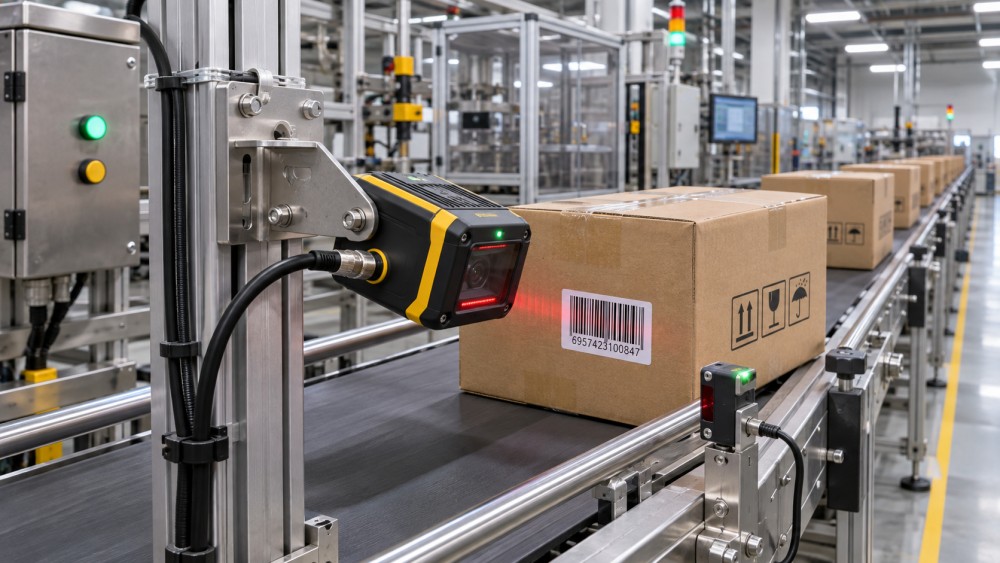
Consider the full path of one carton: detection, image capture, decoding, comparison with the expected value, recording, and the physical response if the result is wrong. A quotation should identify which parts of that path are included. It should also explain what happens if communication is lost or the scanner produces no result.
Reading a barcode is not the same as verifying it
A successful scan establishes that a particular reader decoded a symbol under particular conditions. It does not, by itself, demonstrate that the printed barcode meets a specified print-quality grade or will be readable throughout a customer’s supply chain.
If a customer requires formal barcode quality verification, confirm the applicable specification, grading method, equipment, and reporting requirements before approving the purchase. A verification system may involve different hardware and procedures from a production reader. Treating those functions as interchangeable can leave the plant paying for an additional solution after installation.
The reverse is also worth checking: if the operational need is simply to capture a readable logistics code at a controlled checkpoint, a full verification setup may be more than the process requires. The customer agreement and the plant’s quality plan should decide that question.
Compare total ownership cost, not just capital cost
A defensible comparison separates the initial project cost from recurring expenses and operating exposure. The initial figure should include equipment, installation, integration, commissioning, training, and any planned production interruption. Recurring items can include support agreements, software licences where applicable, replacement lighting or cables, spare readers, and periodic checks.
Then consider the cost of failure in the specific process. An unreadable pallet label may be resolved by an operator with a handheld scanner. An unreadable code on a high-speed carton line may cause an automatic reject, a line stop, or manual investigation. The financial impact depends on throughput, response procedures, and whether affected product can be identified without holding an entire batch.
For an investment review, use plant-specific assumptions rather than a generic return-on-investment claim. Estimate expected annual costs for maintenance, support, rejects, manual intervention, and downtime for each option. Add those to the installed cost over the intended evaluation period, and state which assumptions are uncertain. If the more expensive proposal relies on fewer stops or less rework to justify its premium, identify the evidence that would confirm or challenge that expectation.
Avoid counting the same benefit twice. For example, if reduced manual handling is already included in a labour estimate, do not also treat the same saved time as a separate productivity gain without explaining how it changes actual capacity or staffing costs.
Make competing proposals comparable
Issue suppliers the same application description and ask them to identify exclusions. The following points are particularly useful when one barcode scanner price is substantially lower than another:
- Which code types, sizes, materials, orientations, and line conditions are covered by the offer?
- How many readers, lights, triggers, and mounting assemblies are included, and who supplies the reject or stop function?
- Does the software only decode the symbol, or also compare it with the correct job data and retain a usable record?
- Are installation, electrical work, machine controls, network connection, testing, and operator training included?
- What are the warranty terms, repair arrangements, spare-parts availability, licence conditions, and support response commitments?
- Which assumptions could lead to a change order after a site survey or production trial?
A proposal can be commercially attractive and still leave a plant with substantial internal work. That may be acceptable if the engineering team has capacity and the responsibilities are explicit. It becomes a problem when an excluded controls modification or unpriced data interface is discovered only after the purchase order is issued.
Set acceptance criteria before approving the order
A demonstration should reflect the operating range the plant expects to buy, not merely prove that the reader works on one sample. Agree on representative products, code locations, line speeds, print variations, and changeover conditions. Include tests for missing, unreadable, and incorrect codes, along with the required machine response and the handling of scan records.
Define how results will be measured, who witnesses the test, what constitutes acceptance, and who pays for corrective work if the agreed conditions are not met. Where performance depends on the quality or position of the printed code, specify those responsibilities too. Otherwise, a disagreement about whether the problem lies with the printer, scanner, or conveyor can be difficult to resolve.
The purchasing decision is usually clearest when the options are compared at the same scope: a functioning checkpoint, not just a reader in a box. Approve the solution that meets the documented production and traceability requirement at an acceptable whole-life cost, while leaving enough budget and accountability for integration, testing, and support.
Related News
 What Affects Barcode Scanner Prices for Production Lines?Barcode scanner price depends on speed, durability, integration, and maintenance. Learn how to compare production-line quotes and make a smarter investment.Machine Vision & Coding Fellow
 Why an Industrial Barcode Scanner Fails to Read CodesIndustrial barcode scanner not reading codes? Discover how to diagnose print, setup, lighting and communication issues and restore reliable production.Machine Vision & Coding Fellow
 How to Choose a High Speed Barcode Reader for Packaging LinesChoose a high speed barcode reader with confidence. Compare optics, line speed, controls, and acceptance tests to improve packaging-line reliability.Machine Vision & Coding Fellow
 How Do Barcode Scanners Verify Serial Numbers on Packaging Lines?Discover how Barcode Scanners validate serial numbers, detect duplicates, and trigger package rejection. Learn how to improve packaging line accuracy and traceability.Machine Vision & Coding Fellow
 How to Choose a High Speed Barcode Scanner for Moving CartonsChoose a high speed barcode scanner for moving cartons with confidence. Compare motion blur, optics, tracking, and real-world tests to reduce no-reads and costly rejects. Explore the guide.Machine Vision & Coding Fellow
 When Is a Higher Industrial Barcode Reader Price Worth Paying?Is a higher industrial barcode reader price worth it? Discover how to compare read reliability, integration costs, and downtime savings to make a smarter investment for your production line.Machine Vision & Coding Fellow