How to Choose an IP67 Vision Sensor for Wet Production Lines
An IP67 vision sensor can survive temporary water exposure, but that rating alone says very little about whether it will keep reading printed marks, codes, edges, or registration targets on a wet packaging line. Selection should start from the inspection task and the actual washdown environment. A sensor that performs well near a dry conveyor may become unstable beside a folder gluer wash section, a coding station with mist, or a corrugated line area where steam, starch residue, and paper dust combine on the lens cover.
On wet production lines, the first mistake is treating all moisture as the same condition. Fine spray, direct nozzle impact, condensate from temperature changes, foam cleaning agents, and sticky process residue each stress the housing and optics differently. If the line runs water-based inks, adhesives, or cleaning chemicals, the front window material, cable jacket, connector sealing, and mounting hardware matter as much as the camera specification. A sensor may keep water out of the electronics while still losing inspection reliability because the lens cover hazes, droplets remain on the surface, or built-in lighting reflects unpredictably from a damp substrate.
Start with the failure mode, not the catalog category
Before comparing models, define what must be detected and what happens when detection drifts. Wet-line inspection usually falls into a few practical groups: presence or absence of a carton feature, code reading, print mark detection, edge or position verification, surface defect screening, and orientation checks. These tasks place very different demands on image resolution, lighting geometry, processing speed, and tolerance to environmental noise.
A simple cap-presence or flap-position application may work with a compact sensor that offers basic job storage and discrete outputs. Barcode verification on glossy pharmaceutical cartons or date-code reading on damp corrugated shippers usually needs stronger image processing, more stable lighting, and tighter control over working distance. If the line changes SKU size frequently, setup speed and recipe recall may outweigh a small gain in raw resolution. If a reject gate must fire within a short conveyor pitch, trigger latency and output timing become more important than extra inspection tools that will never be used.
It is useful to write the defect in production language: missing print, doubled print, skewed label, unreadable code, incomplete glue line, crushed edge, misplaced hand-hole, and similar conditions. That wording keeps evaluation close to the process. General phrases such as “high accuracy inspection” often hide the real acceptance window and lead to overspecified hardware.
IP67 is only one layer of environmental suitability
IP67 confirms resistance to dust ingress and temporary immersion under defined test conditions. Wet production lines create a broader exposure pattern. Repeated hot-water cleaning, alkaline detergent, acidic foam, ink wash, and fast temperature swings can attack seals over time. In packaging plants, connectors often fail before housings do. A sensor body with good ingress protection can still become the weak point if the M12 connector is poorly oriented, over-tightened, or constantly stressed by cable movement.
Look closely at the enclosure material. Stainless steel hardware is usually preferable around aggressive washdown zones, while painted or lightly coated brackets may corrode and loosen alignment. Polycarbonate windows can be acceptable in some areas, but if abrasive cleaning cloths or chemical splash are common, a harder front surface may remain clearer for longer. Ask whether the supplier defines resistance to the actual cleaners used on site rather than only providing a generic ingress statement.
Another practical detail is pressure equalization. When a sensor is mounted near warm process equipment and then exposed to cold rinse water, internal pressure changes may pull moisture toward seals or create fogging at the viewing surface. If the line sees frequent sanitation cycles, thermal shock behavior deserves attention during trials.
Optics and lighting decide whether the image remains usable
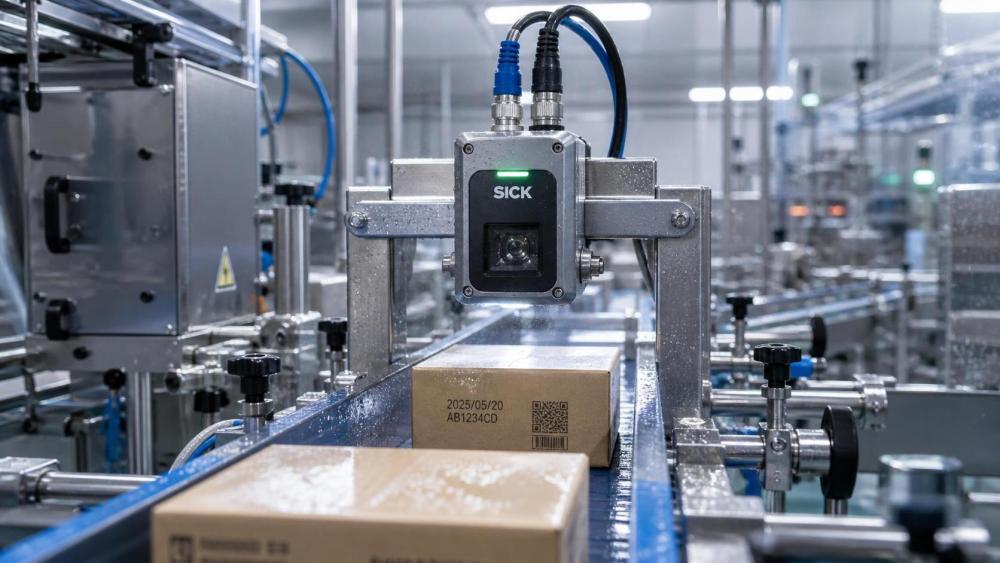
Wet surfaces create glare, bright spots, and unstable contrast. For that reason, lighting design often determines success earlier than image algorithm selection. Built-in white LEDs are convenient, but convenience is not the same as robustness. A reflective varnished carton, a damp flexible pack, and a dark printed case each respond differently to direct light. If the target includes embossed codes, low-angle lighting may separate the feature better than front lighting. If shiny droplets keep saturating the image, polarized lighting or a different viewing angle may be needed.
Integrated lighting can reduce wiring and simplify installation, especially where space is tight between machine frames. External lighting gives more control and is often easier to replace independently of the sensor. On lines with strong ambient light variation, such as areas near open guarding or skylights, shielding and controlled illumination become more important than nominal brightness. A powerful light source that heats the lens area may also increase condensation risk during washdown recovery.
Working distance should be chosen around the real machine geometry, not around the vendor’s best-case image example. If the sensor must look past guide rails, fluttering carton flaps, spray guards, or moving belts, the usable field of view can shrink quickly. A longer working distance may protect the sensor from splash but may also reduce detail or require stronger illumination. Short distances can improve contrast but make cleaning residue accumulation worse.
Detection performance must be evaluated under line variation
Bench demonstrations rarely reproduce the line state that causes false rejects. Evaluate the sensor with real samples that include acceptable variation: paper tone shift, print density change, warped blanks, slightly skewed labels, and normal product motion. Wet-line inspection should also be tested immediately after cleaning, during temperature stabilization, and after several hours of production when residue has begun to build.
If the sensor reads codes, test damaged quiet zones, ink spread, low contrast, and curved or uneven surfaces. If it detects marks on corrugated board, include different flute show-through conditions and board colors. For registration or edge checks on printed cartons, inspect at realistic speed with vibration present. A sensor that only works when the sample is manually held flat under ideal lighting is not really qualified.
Pay attention to tolerance handling. Excessively tight thresholds may look impressive in a demo because they detect every subtle deviation, but on a live line they can create unnecessary stops or reject accumulation. Excessively loose thresholds hide process drift until a customer complaint or downstream jam exposes it. The right choice depends on where the inspection sits in the process and whether failed items can be reworked, diverted, or must trigger an upstream correction.
Mechanical mounting often decides long-term stability
Wet lines rarely stay mechanically quiet. Pumps cycle, guards open and close, conveyors transmit vibration, and sanitation crews may contact brackets during cleaning. If the sensor cannot hold alignment, the initial image quality does not matter. Choose a mounting arrangement that prevents gradual rotation and allows repeatable repositioning after maintenance. Fine adjustment is useful during commissioning, but once the station is validated, the mount should resist casual movement.
Cable routing deserves the same level of attention. Downward connector orientation generally sheds water better than horizontal runs that collect droplets at the coupling. Leave a proper drip loop where possible. Avoid routing signal cables tightly alongside motor power or solenoid wiring if the sensor output drives reject devices or communicates with a PLC over industrial Ethernet. Intermittent communication faults are often misdiagnosed as vision problems.
Physical accessibility matters too. A lens cover that cannot be wiped without removing a safety panel will be cleaned less often. If line crews must remove the entire sensor to clear residue, the system will lose position over time. Good selection includes the realities of maintenance access, not only machine envelope drawings.
Integration should match the control architecture already in place
An inspection node on a wet line does not work in isolation. It must trigger at the right moment, send a stable result, and align with reject timing, line speed changes, and product tracking. Some applications only need a pass/fail signal and a jam alarm. Others require image logging, job-based parameter switching, code string transfer, or communication with traceability software. Choose the interface level that the line can actually use.
On packaging equipment, common integration questions include trigger source quality, encoder availability, reject confirmation feedback, and whether the line controller can handle delayed decisions when several products are between inspection and rejection. If multiple order formats run on one machine, recipe changeover should be tied to the machine job file or HMI selection rather than relying on manual adjustment at the sensor body. Otherwise, the best inspection hardware can still fail because the wrong recipe remains active after a changeover.
Image storage can be useful during fault analysis, but local memory limits and network bandwidth should be considered. Continuous saving of full-resolution images may not be practical on every line. In many cases, storing only failed images or a short event window is enough to distinguish print variation from moisture contamination, vibration, or trigger mismatch.
Cleaning and maintenance requirements should be part of the comparison
Some sensors appear similar until routine sanitation begins. Ask how the front window should be cleaned, which chemicals are acceptable, whether replacement protective covers are available, and whether lighting intensity can be monitored as it ages. A model that requires careful manual cleaning with restricted chemicals may be a poor fit beside washdown conveyors, even if the image quality is strong on day one.
Maintenance intervals should include more than electronic diagnostics. Lens fouling, bracket loosening, gasket wear, and connector seal condition belong in the inspection plan. If the line uses compressed air to keep the viewing surface clear, confirm air quality and oil carryover, because contaminated purge air can create a film instead of preventing one. Air purge can help in splash zones, but it adds tubing, fittings, and another failure point that needs space and upkeep.
Spare strategy also affects selection. If the sensor requires a unique software environment, proprietary connector pinout, or a specialized alignment tool, replacement after a failure may take longer than expected. Standardized power, communication, and mounting practices reduce recovery time during an unplanned stop.
Common selection errors on wet packaging lines
- Choosing by ingress rating and resolution while ignoring glare behavior on damp printed surfaces.
- Approving a trial using hand-presented samples instead of conveyor-speed product flow with vibration and splash present.
- Mounting too close to the process to improve image size, then losing uptime because residue accumulates on the optics every shift.
- Using integrated lighting without checking whether reflections change after cleaning chemicals leave a thin surface film.
- Assuming any network-capable sensor will fit the existing PLC logic, reject timing, and recipe management structure.
- Leaving no access path for cleaning and revalidation, which turns minor fouling into repeated alignment loss.
How to compare candidates in a useful way
A practical comparison matrix should stay close to production conditions: inspection task, target size, line speed, trigger method, washdown exposure, chemical contact, working distance, mounting envelope, communication type, image retention needs, and maintenance access. Add observations from real trials rather than relying only on datasheet values. Notes such as “contrast dropped after rinse,” “window remained clear with mist present,” or “recipe switch required manual confirmation” are more valuable than a long list of unused software tools.
Where corrugated and commercial print lines intersect with coding, traceability, or finishing inspection, it can be useful to assess whether one sensor family can share configuration logic or spare parts across several stations. That only makes sense if the tasks are genuinely similar. A single standard can simplify support, but forcing one device into every application usually creates compromises at the most difficult stations.
The best choice is often the sensor that maintains stable judgment through cleaning cycles, product variation, and routine maintenance without requiring constant parameter correction. On wet production lines, image quality, enclosure durability, and integration discipline have to hold together. If one of those three falls short, the protection rating on the label will not rescue the inspection point.
Related News
 What Determines Laser Coder Price in Industrial Packaging LinesLaser coder price depends on power, speed, materials, integration, and verification. Discover how to compare total costs and select the right packaging solution.Machine Vision & Coding Fellow
 How to Choose a Serial Number Printing Machine for TraceabilityChoose a serial number printing machine with confidence. Explore traceability, code quality, data control, inspection, and integration factors for reliable packaging serialization.Machine Vision & Coding Fellow
 How to Choose a Barcode Reader for a Packaging LineChoose the right barcode reader for packaging line applications with expert guidance on code quality, speed, optics, lighting, validation, and reject control.Machine Vision & Coding Fellow
 What to Check Before Choosing a Laser Coder ManufacturerChoose a laser coder manufacturer with confidence. Learn how to assess application trials, code quality, integration, safety, service support, and lifecycle cost.Machine Vision & Coding Fellow
 How Variable Data Printing Machines Improve Traceability AccuracyDiscover how a variable data printing machine improves traceability accuracy through unique coding, inline verification, and reliable data reconciliation.Machine Vision & Coding Fellow
 How to Calculate Serial Number Printing System Cost and ROISerial number printing system cost: calculate total ownership, compare suppliers, and build a practical ROI model to reduce errors, downtime, and compliance risk.Machine Vision & Coding Fellow