How to Choose a Serial Number Printing Machine for Traceability
A serial number printing machine should be selected as part of a traceability system, not as an isolated marking device. A fast printer that produces inconsistent, unreadable, duplicated, or poorly recorded codes can create more operational risk than a slower solution with controlled data handling and reliable verification.
The first decision is therefore not which printing technology to buy. It is to define what each serial number must do after it is printed. A code used only for internal batch tracking has different requirements from one that supports product authentication, shipment tracking, recalls, regulated packaging, or downstream scanning by retailers and logistics partners. Once that purpose is clear, the right combination of printer, software, inspection, and line integration becomes much easier to assess.
Start With the Traceability Workflow, Not Print Speed
A serial number is useful only when it remains unique, legible, linked to the right production record, and available to the people or systems that need it. Before comparing machines, map the path of one code from creation to final use:
- Where is the unique number generated?
- What information is associated with it, such as product format, production time, lot, order, operator, or destination?
- Will the code be printed as human-readable text, a barcode, a 2D symbol, or a combination?
- Who scans or reads it after packing: an internal warehouse, a distributor, a retailer, a consumer-facing verification platform, or a regulatory process?
- What happens when a print is unreadable, a carton is rejected, or a production job is stopped and restarted?
This exercise often exposes requirements that are not visible in a supplier brochure. For example, printing a serial number on a folding carton may be simple, but the process becomes more demanding when the carton is later folded, glued, bundled, palletized, scanned, and reconciled with production data. A code placed too close to a crease, glue seam, varnished area, or die-cut edge may look acceptable on a flat sheet but become difficult to scan after conversion.
For corrugated shipping cases, the challenge may be less about fine resolution and more about code contrast, dust tolerance, variable board surfaces, print placement, and whether the marking process keeps pace with conveyor movement. A suitable system must fit the actual production condition, not only the sample material used during a demonstration.
Choose the Printing Technology Around the Material and Code Duty
Different technologies can print serial numbers effectively, but their suitability changes with substrate, line speed, required resolution, available installation space, and the permanence expected from the mark. The goal is not to find a universally superior technology. It is to identify the one that creates a readable code consistently under normal operating conditions.
Substrate testing should include more than one representative sample. Packaging materials often vary by supplier, coating, moisture level, surface texture, recycled-fiber content, ink coverage, varnish, and storage condition. A code that scans well on a clean uncoated board may fail after rub, handling, condensation, abrasion, or a change in print background.
For printed cartons, the selected location matters as much as the marking method. Dark graphics, metallic decoration, heavy varnish, and variable ink density can reduce contrast. If a code must be read by common scanners, give the machine a controlled print window rather than asking it to print over unpredictable artwork. This may require coordination between packaging design, prepress, printing, and converting teams.
Code Quality Must Be Measured, Not Assumed
A serial number may appear sharp to the eye and still fail downstream scanning. Human-readable characters can be incomplete, blurred, distorted, or too small for practical manual verification. Barcodes and 2D codes may contain enough contrast to look plausible while suffering from poor cell definition, quiet-zone interference, print gain, damage, or placement errors.
The selection process should define an acceptance rule for each code format. That rule should cover readability, print position, data accuracy, and the ability of the intended scanning device to capture the code in realistic conditions. It is also important to define which failures require automatic rejection and which can be handled through controlled manual review.
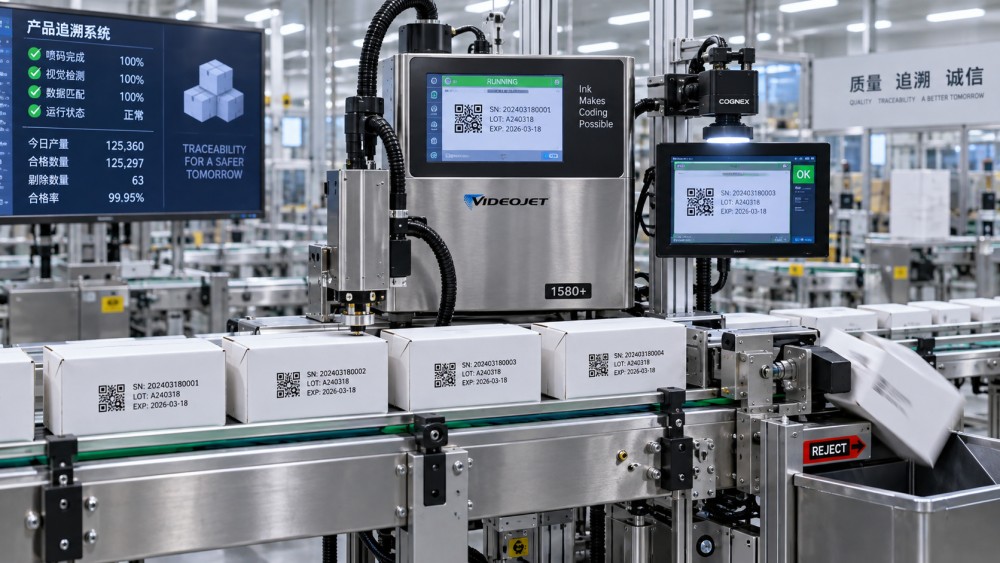
Do not treat a camera as proof that the traceability process is complete. A vision system can confirm whether a code exists, whether it is positioned correctly, whether it can be decoded, and whether the decoded value matches the expected data. Those are different inspection functions. A basic presence check may miss a duplicate serial number. A decoding check may detect a wrong value but not necessarily confirm that the code belongs to the correct order unless it is connected to the production data source.
For serialized packaging, the strongest arrangement is usually closed-loop: the printer receives controlled data, the vision system reads the printed result, failed items are handled in a documented way, and accepted codes are recorded against the relevant production event. The exact architecture can be simple or highly automated, but the connection between printing, verification, rejection, and reporting should be explicit.
Data Control Is Often the Deciding Factor
Many traceability failures begin before ink reaches the substrate. A serial number printing machine may perform mechanically well yet still create serious problems if operators load the wrong file, restart a job without sequence control, import duplicate numbers, or cannot reconcile rejected packs with the serialization database.
Ask suppliers to explain the full data path in operational terms. The answer should show how a new job is created, how serial numbers are allocated, how the printer receives them, how completed and rejected items are recorded, and how unused numbers are handled at the end of a run. The workflow should also explain what happens during a power interruption, network loss, printer fault, product jam, or shift handover.
Data connectivity needs to match the factory environment. Some applications can operate with a local controller and controlled job files. Others need communication with enterprise resource planning, manufacturing execution, warehouse, order-management, or brand-owner serialization systems. Integration is valuable only when responsibilities are clear. A connection that transfers data but does not reliably report exceptions can make investigations harder rather than easier.
Access control deserves the same attention as connectivity. Operators need a practical way to load approved jobs and respond to alarms, but they should not be able to casually alter sequence rules, templates, or serialized data. Audit records are especially useful when the plant must explain why a code was rejected, reprinted, skipped, or assigned to a specific batch.
Assess the Machine in Its Real Position on the Line
The installation point changes the machine requirements. A printer mounted before a folder gluer faces different risks from one installed after final packing. Before conversion, there may be better access to a flat print surface, but subsequent die-cutting, folding, and gluing can affect the code. After conversion, the code may better represent the finished pack, but product orientation, conveyor control, and available marking area may be more difficult.
In corrugated operations, coding can be placed on a case conveyor, near a print-and-apply station, or as part of an integrated printing process. Each option should be examined against case size variation, flap geometry, warped board, dust, vibration, gap control, and transport stability. The machine must hold a consistent distance and position relative to the target surface. A technically capable printhead cannot compensate for unstable product presentation.
For folding cartons and commercial print work, job changeover can be a larger concern than continuous speed. Frequent short runs require fast, mistake-resistant template selection, dependable registration, and a clear method for removing old-job data. The best machine for long, uniform orders may create unnecessary setup burden in a high-mix environment.
During evaluation, use actual production speeds and normal product spacing. Request a trial that includes start-up, acceleration, stop-and-restart conditions, job changeover, and representative substrates. A stable sample taken at a slow demonstration speed is not enough to judge performance in production.
Specify Inspection and Rejection Together
Inspection is only useful when the line can respond correctly to the result. If the camera identifies a failed code, the system needs a defined action: stop the line, trigger a reject device, flag the item for controlled removal, or place the production batch into review. The right response depends on throughput, product value, packaging format, and the risk created by a missing or incorrect serial number.
Rejected items require particular discipline. A rejected code may have been printed but unreadable; it may have been printed correctly but linked to an incomplete record; or it may not have printed at all. The process must prevent rejected packaging from returning to production without an authorized decision. This is where physical segregation, reconciliation records, and clear operator prompts become more valuable than a long list of software features.
Also examine false rejects. An overly sensitive inspection setup can interrupt output and create avoidable waste. An overly permissive setup allows poor codes through. The suitable balance comes from testing code quality against the actual scan environment and setting inspection criteria that support the traceability purpose.
Compare Total Operating Burden, Not Purchase Price Alone
The lower-priced machine is not necessarily the lower-cost choice. A traceability printer affects consumables, cleaning, spare parts, printhead or laser maintenance, operator intervention, planned downtime, technical support, line integration, and waste from rejected packaging. These costs are influenced by the number of jobs, substrates, shifts, environmental conditions, and expected service response.
Ask practical maintenance questions. How is the printhead cleaned? Can consumables be changed without losing the job state? Which parts are expected to wear? How does the machine alert operators before print quality deteriorates? Can maintenance personnel access diagnostic information without stopping the entire line? A system that requires specialist intervention for routine recovery may be unsuitable for a busy packaging plant, even when its printed result is excellent.
It is also useful to assess supplier support in terms of integration responsibility. Serialization problems can involve mechanics, printing, camera configuration, network communication, data management, and reject handling. The project scope should identify who owns each interface and who resolves faults that cross those boundaries.
A Practical Evaluation Sequence
A disciplined selection process reduces the risk of buying a machine that works in isolation but fails in the full workflow.
- Define the traceability objective and the information each serial number must carry or reference.
- Document substrates, packaging formats, code locations, production speeds, product orientation, and environmental conditions.
- Choose the required code formats and set acceptance criteria based on actual scanning and handling conditions.
- Map the data lifecycle, including generation, job approval, printing, verification, rejection, reconciliation, and reporting.
- Evaluate printing technologies on representative materials rather than generic samples.
- Review vision inspection and reject handling as one functional system.
- Test normal production events, including changeovers, stops, restarts, faults, and operator intervention.
- Compare operating burden, integration scope, and support arrangements alongside capital cost.
Packaging operations increasingly treat coding, inspection, automation, and production data as connected decisions. Resources such as CPCS can help project teams compare these equipment boundaries across commercial printing, corrugated packaging, converting, vision inspection, and factory automation. The useful question is not whether a printer can produce a serial number. It is whether the complete system can prove, at normal production conditions, that the right code reached the right pack and can still be used when traceability matters.
Related News
 What Affects Barcode Scanner Prices for Production Lines?Barcode scanner price depends on speed, durability, integration, and maintenance. Learn how to compare production-line quotes and make a smarter investment.Machine Vision & Coding Fellow
 Why an Industrial Barcode Scanner Fails to Read CodesIndustrial barcode scanner not reading codes? Discover how to diagnose print, setup, lighting and communication issues and restore reliable production.Machine Vision & Coding Fellow
 How to Choose a High Speed Barcode Reader for Packaging LinesChoose a high speed barcode reader with confidence. Compare optics, line speed, controls, and acceptance tests to improve packaging-line reliability.Machine Vision & Coding Fellow
 How Do Barcode Scanners Verify Serial Numbers on Packaging Lines?Discover how Barcode Scanners validate serial numbers, detect duplicates, and trigger package rejection. Learn how to improve packaging line accuracy and traceability.Machine Vision & Coding Fellow
 How to Choose a High Speed Barcode Scanner for Moving CartonsChoose a high speed barcode scanner for moving cartons with confidence. Compare motion blur, optics, tracking, and real-world tests to reduce no-reads and costly rejects. Explore the guide.Machine Vision & Coding Fellow
 When Is a Higher Industrial Barcode Reader Price Worth Paying?Is a higher industrial barcode reader price worth it? Discover how to compare read reliability, integration costs, and downtime savings to make a smarter investment for your production line.Machine Vision & Coding Fellow