When Are Thermal Inkjet Printers the Right Choice for Product Coding?
The short answer: use TIJ when code quality and flexibility matter more than unlimited throw distance
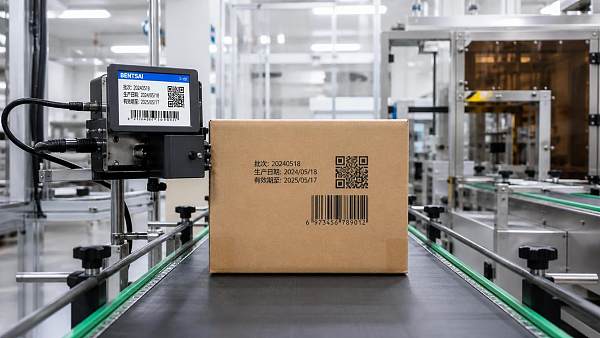
Thermal inkjet printers are a strong choice for product coding when a line needs crisp, high-resolution variable data on a relatively controlled print surface. They are especially useful for printing expiry dates, lot numbers, serial numbers, QR codes, and barcodes on cartons, folding boxes, labels, paper bags, and many coated packaging materials.
For a packaging producer or brand owner, the appeal is straightforward: a thermal inkjet system can produce sharp marks without the maintenance profile associated with some other coding methods. But that advantage only holds when the product path, substrate, speed, ink selection, and data workflow are aligned. A well-specified TIJ installation can simplify short runs and frequent code changes. A poorly matched one can lead to smudging, unreadable barcodes, missed prints, and recurring cartridge cost.
Where thermal inkjet coding fits best
TIJ is most convincing where the code itself is part of the package quality requirement. Cartons used in pharmaceutical, food, cosmetics, consumer goods, and e-commerce fulfilment often carry information that must remain legible through distribution, handling, and scanning. On these applications, a small, clear two-dimensional code may be more valuable than a large but less defined mark.
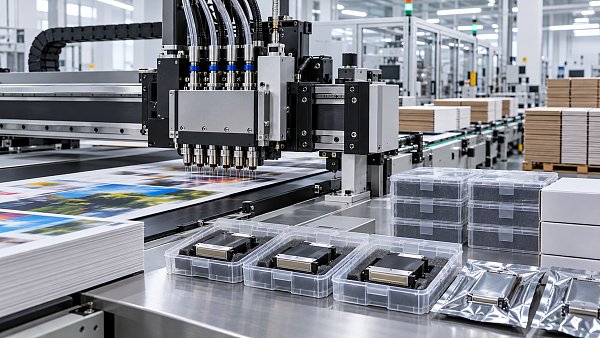
The technology works by ejecting tiny droplets of ink through a disposable print cartridge. This supports fine character formation and relatively high print resolution, making it suitable for dense text, small characters, logos, and machine-readable codes. It also makes TIJ attractive for lines that switch frequently between SKUs, languages, date formats, or destination-market information.
Typical good-fit applications include:
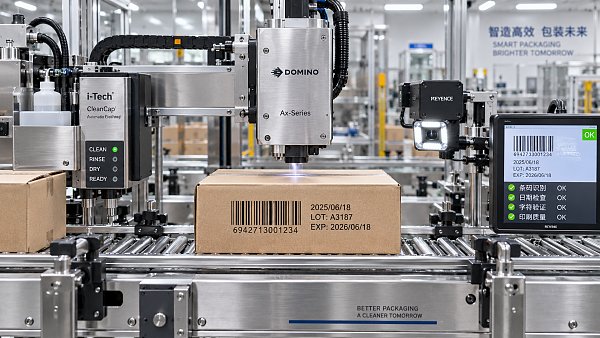
- Printing batch, date, and traceability data on flat folding cartons after packing or during cartoning.
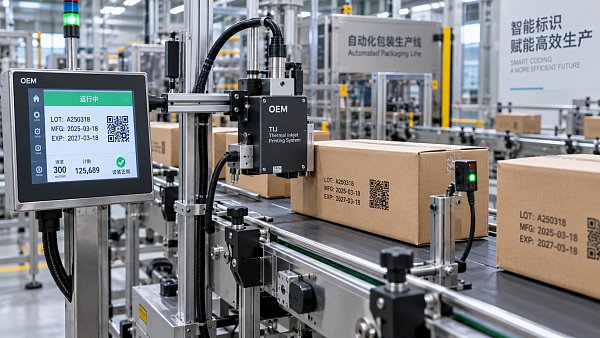
- Adding variable QR codes or serialization data where code contrast and edge definition affect scan performance.
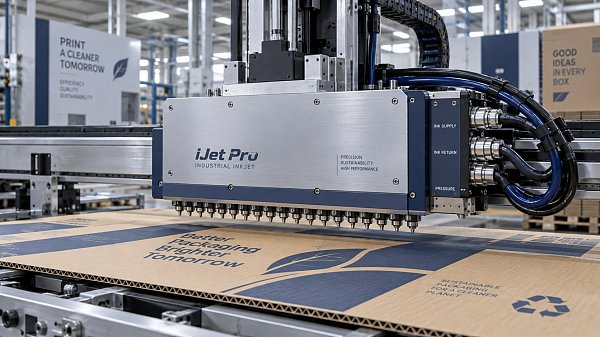
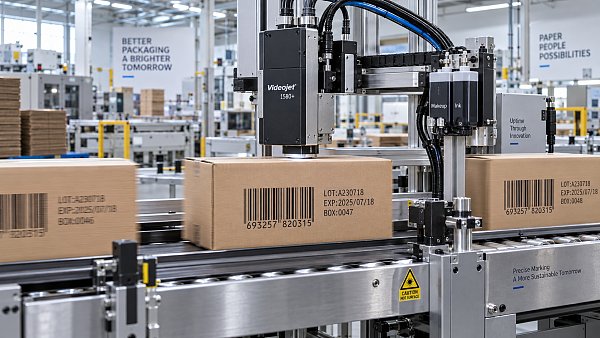
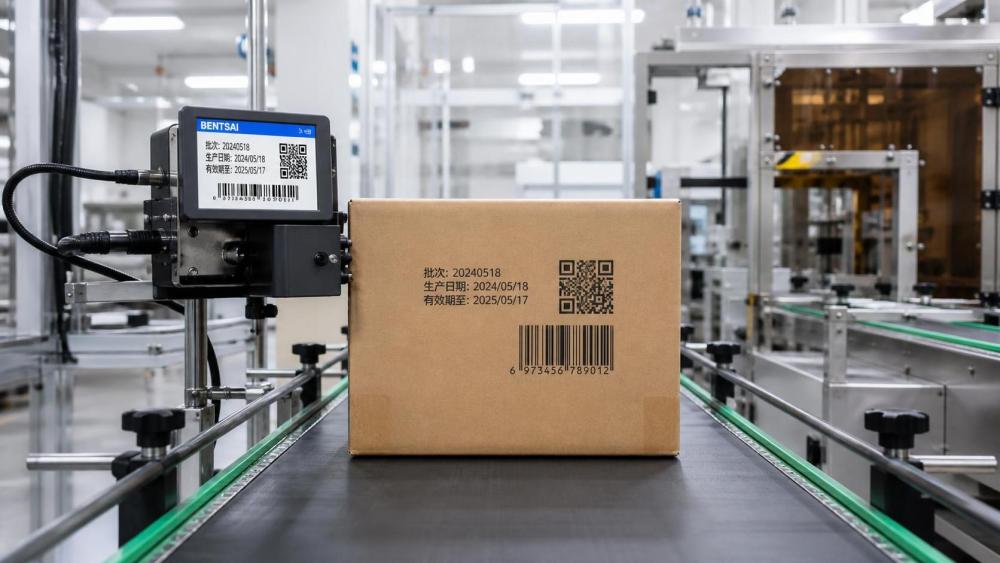
- Coding corrugated cases after case packing, provided the printhead can be held close to the board surface.
- Applying variable information to paper labels, coated labels, pouches, and selected plastic packaging using compatible inks.
- Short-run packaging work where pre-printed packaging is impractical or where variable content changes from job to job.
In these conditions, the printer is doing more than replacing a date stamper. It becomes part of a production-data process: receiving job information, printing the correct code, and supporting verification before products leave the line.
Print distance is often the first practical limit
Thermal inkjet printers perform best when the printhead is positioned close to the substrate. This is one of the most important facts to establish before comparing models, print resolution, or quoted line speeds. A stable, short gap helps droplets land accurately and keeps text and barcode edges clean.
That requirement is easy to meet on flat, consistently conveyed cartons. It becomes harder on warped corrugated cases, uneven kraft surfaces, recessed pack areas, curved containers, or products that move laterally on the conveyor. If the gap changes substantially while the product passes the printhead, code quality can deteriorate even when the printer itself is operating correctly.
For corrugated packaging, surface variation deserves particular attention. The outer liner may be absorbent, dusty, or slightly uneven. Board warp, case flap geometry, and conveyor vibration can alter the effective print distance. TIJ can still be suitable, but the mounting arrangement, product guide design, and print location need to be evaluated as part of the application. Treating the printer as an isolated add-on often creates avoidable problems.
High resolution does not automatically mean durable coding
A common assumption is that a sharp code will also be durable. These are separate questions. Print quality depends on resolution, head-to-product spacing, motion control, and data formatting. Durability depends heavily on ink chemistry and the packaging surface.
On absorbent uncoated board, many inks dry quickly because they penetrate the surface. That may suit shipping cases and paper-based packs, although excessive absorption can soften fine barcode features. On glossy cartons, varnished board, films, or non-porous plastics, the ink must adhere to the surface and dry fast enough to resist smearing at downstream handling points.
Before selecting a system, a buyer should define what the printed code must survive. For example, a code may only need to remain readable through internal warehouse movement, or it may need to resist abrasion, moisture, cold storage, condensation, oil, or repeated contact in distribution. The answer affects the choice of ink, curing or drying time, print position, and whether TIJ is appropriate at all.
It is also important to distinguish between a visually acceptable code and a reliably scannable one. Small QR codes and high-density linear barcodes may look complete to an operator while failing scan-grade requirements because of poor contrast, ink spread, missing elements, or inconsistent placement. When the code supports traceability or automated logistics, inline vision inspection should be considered early, rather than added only after a quality issue occurs.
Frequent changes are where TIJ can create operational value
Thermal inkjet systems are often well suited to packaging operations with many SKUs, short production runs, seasonal formats, export labels, or customer-specific coding rules. Variable data can be updated electronically, and a cartridge-based printhead reduces some of the cleaning and servicing work associated with systems that rely on more complex ink circulation.
That does not make changeovers automatic. The line still needs controlled product selection, correct message assignment, and clear approval of date and batch data. In a carton plant or contract packing operation, the greater risk may be printing a technically perfect code on the wrong product than failing to print a code at all.
A useful workflow links the printer message to the production order, restricts unauthorized edits, and confirms the printed result with a camera where the consequence of error is high. This is particularly relevant when a factory handles similar-looking cartons, multiple customer accounts, or product families with different date formats and traceability rules.
When another coding method may be a better fit
TIJ is not the default answer for every production environment. The technology is less attractive where the code must be printed at a large distance from the product, the surface position varies widely, or the line environment exposes the print zone to heavy dust, vibration, or contamination without adequate protection.
It may also be a weaker economic choice when coding is limited to large, simple characters on very high-volume, low-variation production. In those cases, cartridge consumption, replacement frequency, and total ink cost should be assessed against the expected output and required mark quality. A low equipment price can obscure a higher operating cost if print coverage is large or messages use dense graphics and codes.
Questions to answer before specifying a printer
The most productive first step is to define the coding job rather than starting with a printer model. Packaging teams should document the substrate, available print area, required message content, product speed, code size, expected line stops, and downstream handling conditions. These details reveal whether the application favors TIJ or requires a different approach.
- What surface will be printed: porous board, coated carton, label stock, film, plastic, or a mixed material?
- Can the printhead remain at a stable, close distance throughout the print window?
- Does the code require only human readability, or must it meet scanner and traceability requirements?
- How often will operators change messages, products, or ink types?
- What happens if a code is missing, wrong, smeared, or unreadable after packing?
- Will dust, board fibres, vibration, moisture, or temperature affect print performance?
- What is the full cost of cartridges at the required print coverage and production volume?
These questions also help separate a coding issue from a line-design issue. If cartons are unstable, cases arrive with inconsistent spacing, or product tracking is unreliable, replacing the printer alone will rarely solve the underlying problem.
A practical decision rule
Thermal inkjet printers are the right choice for product coding when the operation needs clear variable information on a controlled surface, values quick message changes, and can manage ink compatibility and printhead positioning. They are particularly effective for carton coding and traceability tasks where barcode readability, presentation, and data accuracy carry commercial weight.
The decision becomes less favorable as the product surface becomes more irregular, the required throw distance increases, or the operating environment makes adhesion and consistent placement difficult. For most packaging operations, the right evaluation is not “Can a TIJ printer mark this pack?” It is whether it can deliver the required code quality, uptime, verification, and operating cost at the conditions the line will actually run.
Related News
 Why Inkjet Printhead Prices Vary with Design and Ink CompatibilityCompare inkjet printhead price factors, from nozzle design to ink compatibility. Discover how to assess performance, reduce replacement risks, and choose better value for your printing system.Machine Vision & Coding Fellow
 How Inkjet Printheads Affect Code Quality and Maintenance CostsInkjet Printheads directly influence code clarity, barcode reliability, downtime, and maintenance costs. Learn practical steps to prevent defects and extend printhead life.Machine Vision & Coding Fellow
 How to Evaluate an OEM TIJ Printer Manufacturer for Production LinesChoose an OEM TIJ printer manufacturer with confidence: evaluate print quality, ink compatibility, integration, uptime, and total cost for reliable production-line coding.Machine Vision & Coding Fellow
 What Determines Inkjet Printhead Price in Industrial Coding SystemsInkjet printhead price depends on technology, ink compatibility, resolution, maintenance, and uptime. Learn how to compare total ownership cost and choose the right coding solution.Machine Vision & Coding Fellow
 How to Choose an Inkjet Printhead Supplier for Reliable ProductionChoose an inkjet printhead supplier with confidence. Learn how to verify compatibility, quality control, technical support, traceability, and total production cost.Machine Vision & Coding Fellow
 When Are Thermal Inkjet Printers the Right Choice for Product Coding?Thermal Inkjet Printers deliver crisp, flexible product coding for cartons, QR codes, barcodes, and variable data. Discover when TIJ is the right fit for your line.Machine Vision & Coding Fellow