What Affects the Price of a Carton Coding Machine?
What Affects the Price of a Carton Coding Machine?
The carton coding machine price can vary considerably depending on the printing technology, production speed, code quality, and level of automation required. For procurement teams, the lowest initial quote may not deliver the best long-term value: ink consumption, maintenance, integration, and supplier support can all affect the total cost of ownership. This guide examines the main factors behind pricing and helps buyers compare equipment against their production and traceability requirements.
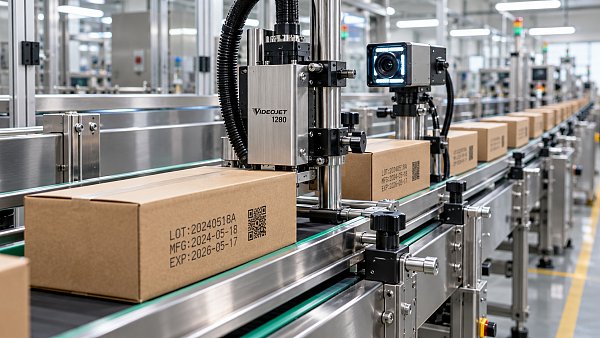
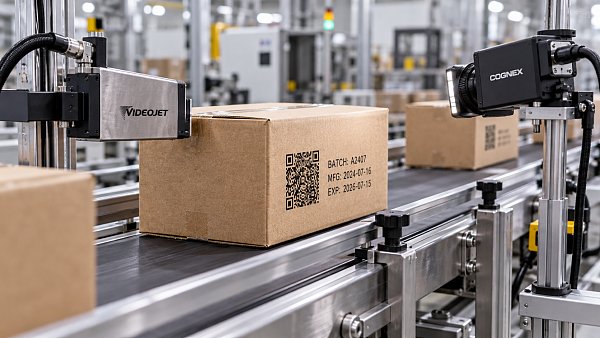
A useful starting point is to define what is being purchased. A basic printhead and controller are not equivalent to a complete coding station with a conveyor, product handling, camera inspection, reject mechanism, and production-data connection. Both may appear in a supplier’s quotation as a carton coding machine, but their installed costs and capabilities can be very different.
What does the quoted price include?
Before comparing figures, ask each supplier to separate the printer from the equipment and services needed to make it work on the line. A quote may cover the controller, printhead, mounting bracket, and basic software while excluding a product sensor, encoder, conveyor modifications, installation, or operator training.
Also check whether the price includes the number of printheads needed for the required print height and carton sides. A system designed to print one short batch code on one side of a box should not be compared directly with a system printing large barcodes and variable text on multiple faces.
There is no single reliable market price for every application without a defined specification. Currency, supplier location, print technology, service coverage, and delivery terms all affect the quotation. When indicative prices are requested, the assumptions behind them matter as much as the number itself.
Printing technology changes both purchase and operating costs
Carton coding commonly uses inkjet or laser marking, but these are not interchangeable. The right choice depends on the surface, required mark, line layout, and available support. A lower-priced technology can become expensive if it needs frequent intervention or cannot print a readable code on the actual carton.
Thermal inkjet
Thermal inkjet systems use cartridges and are often considered for text, dates, barcodes, and other variable information. They can be attractive where clean operation and straightforward cartridge replacement are priorities. Depending on the equipment, larger print areas may require multiple printheads, increasing hardware and mounting costs.
Cartridge cost deserves close attention. The relevant figure is not simply the price per cartridge, but the number of acceptable codes produced from it under actual operating conditions. Print coverage, resolution, maintenance, and idle time can all influence consumption.
Continuous inkjet
Continuous inkjet can suit fast-moving lines and applications requiring small characters on a variety of materials. Its purchase and running costs depend on the printer design, ink and solvent use, service schedule, and operating hours. Procurement should examine the full maintenance arrangement rather than assume that consumable costs alone represent the expense of ownership.
High-resolution case coding
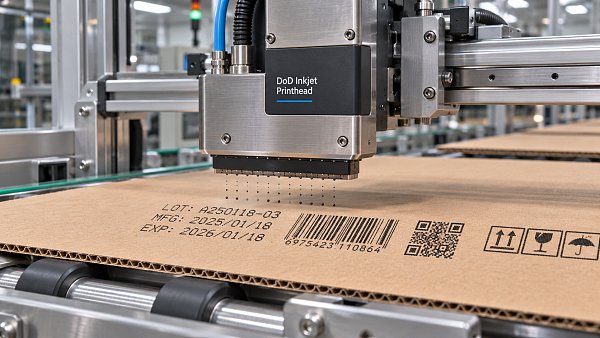
For corrugated shipping cases, large-character or high-resolution inkjet systems can print variable information directly onto the box. These systems may be considered where the operation wants to reduce reliance on preprinted labels. The comparison should include ink, printhead maintenance, code quality on the board grade, and the cost of any labels that would otherwise be used.
Direct printing is not automatically a substitute for a label. Dark, uneven, recycled, or coated surfaces may limit contrast or consistency. The customer’s barcode and presentation requirements determine whether the printed result is acceptable.
Laser marking
Laser systems mark a suitable surface without printing ink, but the equipment, enclosure, extraction, safety measures, and integration can add to the project cost. Not every carton or coating responds appropriately to a given laser. A sample test is essential, as is confirmation of the applicable safety and workplace requirements for the installation.
Ink-free marking should not be confused with maintenance-free operation. Lenses, filters, extraction equipment, and other components still need attention, and their service requirements should be included in the comparison.
Speed specifications need context
A printer’s advertised maximum speed is useful for screening, but it is not enough to confirm suitability. Speed may change with print height, resolution, number of lines, character size, and the amount of variable data. Ask suppliers to confirm the achievable line speed for the exact code and carton movement being specified.
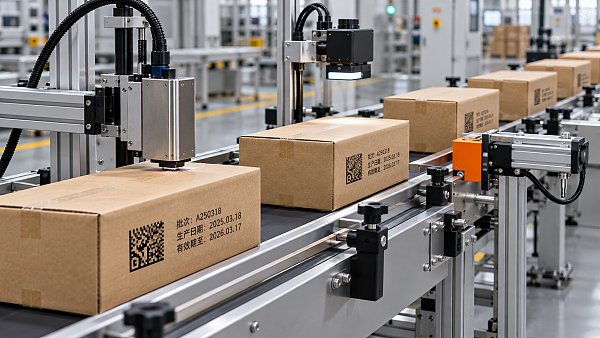
Product handling is equally important. If cartons move at uneven spacing, skew on the conveyor, or vary in distance from the printhead, the system may need guides, sensors, an encoder, or other controls. Those additions affect price, but they also protect the investment in the printer itself.
In a carton converting plant, the installation point can change the specification substantially. Printing onto flat blanks after a folder gluer is a different handling problem from coding assembled shipping cases at the end of a packing line. Access for cleaning, clearance around guards, and available mounting space should be checked before a quote is finalized.
Code quality and inspection add requirements
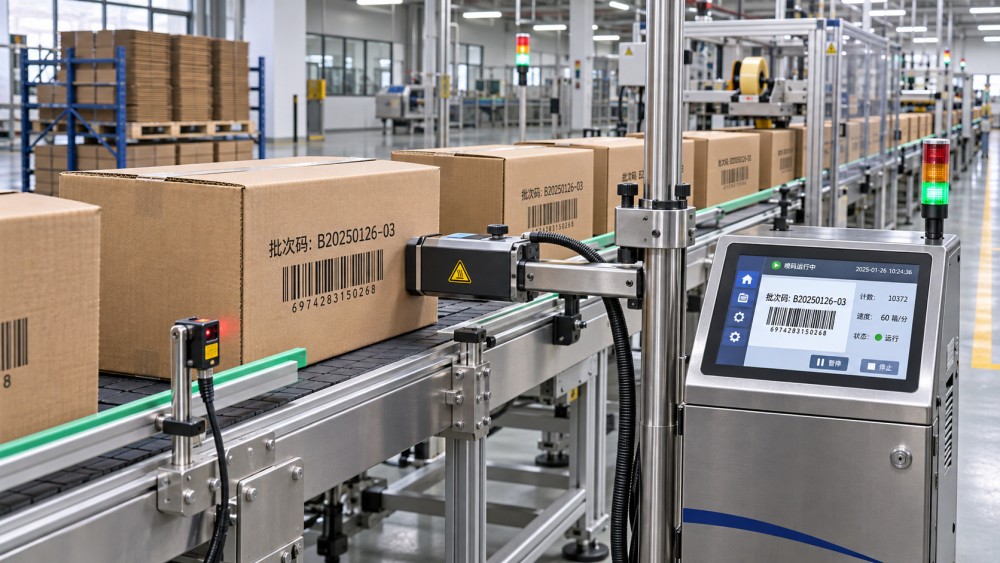
A readable date code and a machine-verifiable barcode are different purchasing specifications. Barcode performance depends on the printed symbol, substrate, contrast, positioning, and the conditions under which it will be scanned. If a customer or application specifies a verification method or minimum grade, provide that requirement to bidders rather than relying on a general promise of “barcode quality.”
Request samples on the actual board or folding-carton stock, including representative coatings and colors. Test the code after normal handling or expected storage conditions where those factors matter. For variable-data jobs, samples should include the longest message and most demanding symbol, not only a short text string.
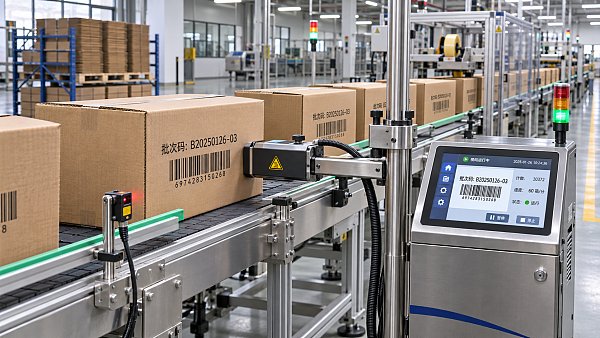
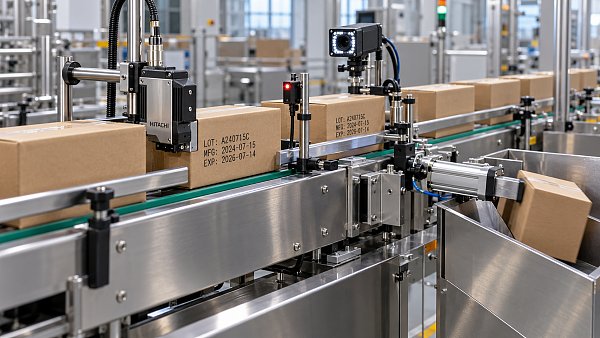
A camera system can check for a missing or incorrect code, but inspection scope varies. Reading a code is not necessarily the same as verifying its quality against a specified standard. If faulty cartons must be removed automatically, the project may also need a reject device, tracking logic, and a confirmation sensor. Ask how the system handles cartons already between the camera and reject point when the line stops.
Automation and data connections can reshape the project
Manual message selection may be adequate for a stable product range with clear operator checks. Frequent changeovers, multiple production lines, or individual carton identifiers can justify a more connected system, but software and integration costs should be made visible from the start.
Clarify where each code originates and who controls it. A date generated locally by the printer is relatively straightforward; a unique identifier supplied by a production or traceability system requires reliable data transfer, synchronization, and error handling. Ask what happens if the network is unavailable, a job changes unexpectedly, or a carton is rejected after a code has been assigned.
The quotation should identify interface development, software licences, recurring fees, cybersecurity responsibilities, and acceptance testing where applicable. It should also state which party is responsible for connecting the printer, line controls, inspection equipment, and plant systems. Gaps between suppliers are a common source of unbudgeted work.
Calculate ownership cost using the actual production pattern
A practical comparison combines the installed cost with expected expenses over the intended evaluation period. Use the same assumptions for each supplier: production volume, shift pattern, code size, planned uptime, and maintenance coverage. Include any expected changes in product mix rather than basing the calculation only on the easiest job.
- Capital and installation: printer, printheads, handling equipment, guards, integration, freight, commissioning, and training.
- Consumables: ink, cartridges, solvents, filters, cleaning materials, and labels where still required.
- Service and parts: preventive maintenance, replacement components, technical support, and any software or service subscriptions.
- Production impact: operator intervention, changeover time, test prints, rejected cartons, and downtime associated with cleaning or faults.
For ink-based equipment, ask for a documented consumption estimate using the proposed artwork and operating conditions. Then check how the supplier treats start-up, purging, cleaning, and unused cartridge capacity. An estimate based on continuous operation may not represent a plant that runs short batches and stops frequently.
Service availability also has a cost, even when it does not appear as a line item. Confirm where spare parts are held, how support is requested, what response commitment is written into the agreement, and whether the plant can perform routine maintenance itself. A low-priced imported unit may still be viable, but only if its support arrangements match the consequences of a stoppage.
Build a specification that produces comparable quotes
Send the same application brief to each shortlisted supplier. Include carton material and finish, dimensions, direction of travel, print location, code examples, required line speed, available space, and operating hours. State whether cartons are flat or assembled, how many sides need coding, and whether product dimensions change between jobs.
Define acceptance in practical terms: the code content, position tolerance, readability or verification requirement, test substrate, and production speed at which performance must be demonstrated. If inspection and rejection are included, specify the faults to be detected and how rejection will be confirmed. Agree whether testing occurs before dispatch, at the plant, or at both stages.
Finally, compare delivery scope and commercial terms alongside the price: installation responsibilities, lead time, warranty exclusions, consumable compatibility, and the availability of training and parts. CPCS approaches coding as part of the wider packaging production system; that perspective is useful when a seemingly small printer purchase affects conveying, inspection, changeovers, or traceability. The strongest quotation is the one that makes those interfaces and their costs explicit.
Related News
 How Do Drop on Demand Inkjet Printers Control Ink Droplets?Discover how Drop on Demand Inkjet Printers control droplets through precise firing, ink formulation, and substrate handling for sharper codes and graphics.Machine Vision & Coding Fellow
 What Affects the Price of a Carton Coding Machine?Carton coding machine price depends on printing technology, speed, automation, and running costs. Discover how to compare quotes and choose the best value for your production line.Machine Vision & Coding Fellow
 How to Choose a Variable Data Printing Machine for PackagingChoose the right variable data printing machine for packaging. Compare material compatibility, speed, data control, and inspection to reduce waste and make a confident investment.Machine Vision & Coding Fellow
 How Can an Online TIJ Printer System Prevent Missing Batch Codes?Discover how an online TIJ printer system helps prevent missing batch codes with reliable triggers, vision inspection, and verified rejection. Reduce rework and protect traceability.Machine Vision & Coding Fellow
 Industrial Inkjet Printer Market Forecast to Reach $9.2 Billion by 2035Industrial inkjet printer market forecast: $9.2 billion by 2035. Explore how packaging traceability, automation, and CIJ and TIJ technologies could shape equipment investment.Machine Vision & Coding Fellow
 How Does Variable Data Printing for Cartons Improve Traceability?Discover how variable data printing for cartons improves traceability with verified codes and linked records to help locate affected stock and support faster recall decisions.Machine Vision & Coding Fellow