How to Evaluate an OEM TIJ Printer Manufacturer for Production Lines
Start with the Production Constraint, Not the Printhead Specification
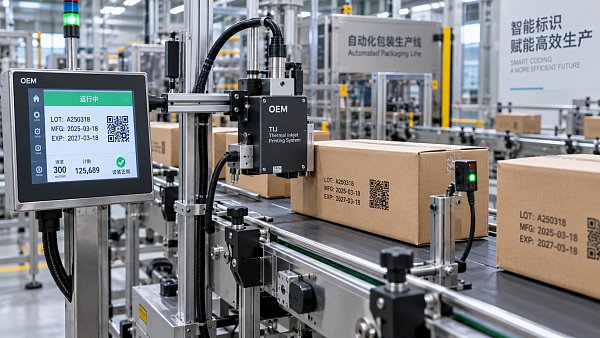
Selecting an OEM TIJ printer manufacturer is a production-line decision, not a desktop printing decision. A thermal inkjet system may produce sharp text and readable codes in a sample run, yet still become a source of rejects, stoppages, and traceability gaps after it is mounted on a fast packaging, converting, or corrugated line.
The first screening question is simple: can the supplier support the exact print condition at the line's real operating speed, material range, and maintenance rhythm? That condition includes more than line speed. It includes the distance between printhead and substrate, product presentation stability, available mounting space, ambient dust or moisture, expected code content, shift pattern, and the time available for cleaning or cartridge replacement.
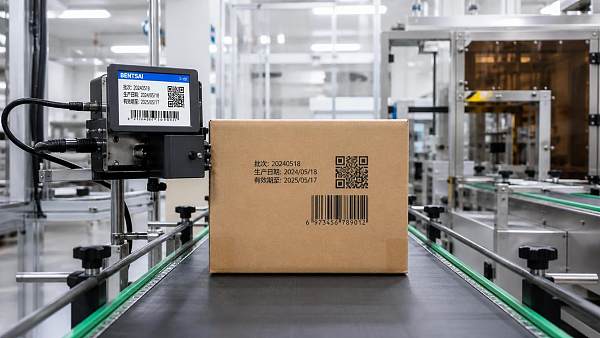
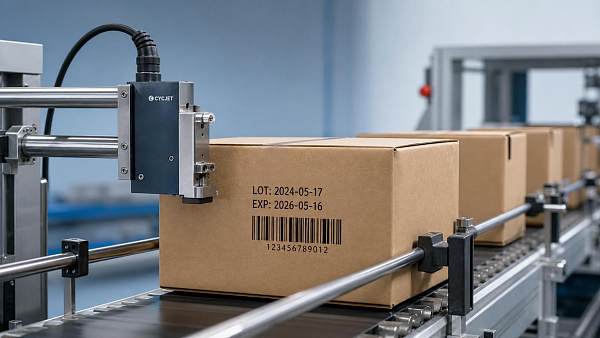
For a carton plant, for example, the relevant question may be whether the system can place a batch code consistently on coated board after folding and gluing, where board position can vary and glue-related contamination may be present. For a corrugated converter, the concern may be stable print quality on uneven kraft surfaces with changing flute profiles. On a high-volume consumer-goods line, the main issue may be whether serialized codes remain readable through frequent product changeovers and line acceleration.
A capable OEM TIJ printer manufacturer should begin with these production variables. Suppliers that lead only with dpi, maximum firing frequency, or nominal print speed may still have a useful product, but those figures do not establish line suitability on their own.
Evaluate the Complete Printing System
TIJ is often described as a compact, low-maintenance coding technology. That can be true when the application is well matched to the printhead, ink, controller, and mechanical installation. It becomes misleading when the evaluation treats the print engine as an isolated component.
Technical evaluators should assess the system in four connected layers: print performance, ink and substrate behavior, integration design, and operating support. A weakness in any one layer can undermine the others. A high-resolution printhead will not compensate for poor product guidance; a suitable ink will not solve a controller that cannot receive reliable variable data; an elegant bracket will not protect uptime if access for servicing was ignored.
Print quality must be judged at operating conditions
Request samples printed at the expected line speed, with the intended data format and on representative production materials. Static samples are useful only for an initial check. The more meaningful evaluation reproduces realistic distance, orientation, vibration, and throughput.
Assess character formation, edge definition, contrast, barcode or QR code readability where relevant, and consistency across repeated prints. Look beyond the first few prints. A system should maintain acceptable quality over a run length that reflects the plant's operating pattern, particularly where long shifts or limited operator intervention are expected.
Print height and resolution should also be evaluated in relation to the code's purpose. Large logistical markings, small alphanumeric lot codes, date codes, serialized identifiers, and machine-readable symbols place different demands on the system. A specification that appears generous for text may be inadequate for a dense code with small modules. Conversely, buying excessive resolution for simple outer-case identification can add cost and complexity without improving the result.
Print position tolerance deserves the same attention as print quality. If cartons, pouches, labels, or corrugated sheets move laterally or rotate before coding, determine whether the line can mechanically control that variation. A TIJ controller can trigger printing at the right moment, but it cannot correct a product that arrives inconsistently at the print zone unless the installation includes suitable sensing, guidance, or vision feedback.
Ink Compatibility Is Often the Deciding Factor
The most expensive TIJ integration failures are frequently blamed on the printer, when the underlying mismatch lies between the ink, substrate, downstream process, and environmental exposure. An OEM supplier should be able to explain this relationship clearly and test it against the intended application.
Packaging lines may print on uncoated paper, coated folding carton, varnished board, corrugated kraft, film, foil laminate, plastic closures, or labels. These surfaces differ in absorbency, surface energy, roughness, drying behavior, and tolerance for abrasion. Ink that delivers strong contrast on porous board may feather on another paper grade. Ink that adheres to a non-porous coating may require more controlled drying conditions or may be vulnerable to rubbing before the product reaches the next station.
The review should account for what happens after printing. Codes may pass through conveyors, stackers, bundling equipment, shrink wrapping, refrigeration, distribution handling, or contact with moisture and cleaning agents. If printed packaging is later varnished, laminated, or otherwise converted, the code also has to remain functional through that process sequence.
- Define every substrate that the line is expected to run, including coated and uncoated variants.
- Check adhesion, smear resistance, abrasion resistance, and code contrast after realistic handling.
- Confirm drying behavior at the available print-to-contact distance and conveyor speed.
- Review ink storage, cartridge shelf-life controls, and procedures for managing partially used consumables.
- Where food, pharmaceutical, cosmetic, or regulated packaging is involved, establish the applicable migration, material-contact, and documentation requirements before approving the ink.
It is prudent to distinguish between an ink that prints successfully and an ink that remains acceptable throughout the package's intended lifecycle. The supplier's role is not to make broad compatibility claims; it is to provide a defensible combination of ink selection, application limits, and validation support.
Integration Flexibility Matters More Than a Standard Mounting Kit
Production lines rarely provide ideal coding conditions. Space can be limited around a folder gluer, cartoner, case packer, or conveyor transfer. Existing PLC architecture may constrain communication methods. A line may require multiple print positions, printing on either side of a pack, or data that changes by order, batch, destination, or unit.
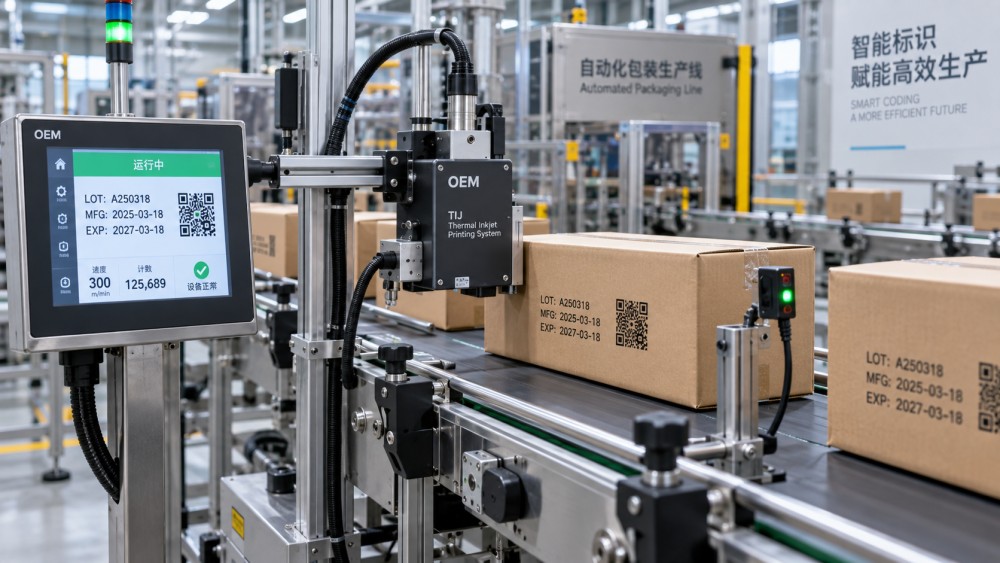
For this reason, evaluate the manufacturer's engineering capability alongside the printer hardware. The supplier should be able to describe how its controller, printheads, sensors, and software fit into the line architecture. This includes electrical interfaces, trigger management, encoder use, alarm outputs, remote status access, and data communication with the plant's production systems.
Variable-data control requires particular scrutiny. A coding system can be technically accurate while still printing the wrong batch, date, product code, or serial record if the interface between job management and printer control is poorly designed. Determine how print jobs are selected, who can alter message content, how changes are logged, and what prevents an operator from applying an outdated file after a job change.
For traceability applications, the system should have a clear answer to several operational questions:
- Can it receive and validate variable data from the approved production source?
- Can it manage sequential or serialized records without duplication caused by stops or restarts?
- What status signals are available when the printer faults, runs low on ink, loses communication, or detects an invalid job?
- How is printed-code verification handled: through the printer, a separate vision system, or both?
- Can failed or unreadable products be identified and rejected before they enter the next packaging stage?
TIJ equipment does not always need a complex software stack. For simple date coding, a local controller with controlled message access may be sufficient. But when coding is linked to quality records, market-specific labeling, aggregation, or recall readiness, the integration requirement changes substantially. A manufacturer that can support both basic and connected use cases is generally less likely to force an unsuitable architecture onto the line.
Test Uptime Claims Through Serviceability
Low-maintenance claims should be translated into specific tasks: cleaning, cartridge change, nozzle inspection, printhead replacement, message setup, fault recovery, and operator training. The important measure is not how little maintenance a system appears to need in a brochure. It is how quickly a trained production operator can restore stable output without creating a quality risk.
Printhead accessibility is a practical example. A printhead mounted deep inside guarding may be protected, but difficult to inspect or replace. A more accessible position may improve servicing but expose the head to dust, board debris, accidental impact, or changing product distance. The best installation is usually a compromise informed by the actual line layout, with protected access and repeatable adjustment points.
Ask the manufacturer to map foreseeable fault conditions and the recovery method for each one. This should cover dry nozzles after idle time, ink depletion, sensor contamination, missed triggers, controller communication loss, power interruption, and mechanical disturbance of the printhead position. The evaluator should understand whether these events create a controlled stop, a warning that operators can act on, or a risk of silent non-printing.
Spare-parts policy is another operational issue. TIJ systems may reduce the maintenance burden associated with some other coding technologies, but consumables and critical components still need predictable availability. Establish the lead time and local support model for cartridges, printheads, controllers, cables, sensors, mounting hardware, and any proprietary service tools. A line cannot benefit from a compact printer if a minor component failure creates a prolonged coding bypass or manual rework process.
Use Total Operating Cost, Not Purchase Price, to Compare Suppliers
A lower equipment quote can be commercially attractive while producing a higher cost per acceptable code. The cost comparison should include ink consumption, cartridge yield under real coverage, planned replacement items, integration engineering, commissioning time, operator training, validation work, and the production consequences of a coding failure.
Ink cost should be normalized against the actual message design. A large, bold code with variable content, repeated across several print locations, consumes a different amount of ink than a small date code. Coverage, font size, print height, resolution setting, purge behavior, and expected waste during maintenance all affect consumable demand. Request assumptions behind any estimated cost-per-print calculation and make sure they match the intended job.
It is also useful to separate the cost of normal operation from the cost of exceptions. A coding error can require sorting, reworking, scrapping, relabeling, or holding finished goods. In traceable packaging flows, it can also disrupt batch reconciliation. A supplier that provides a slightly more expensive system with stronger alarm handling, documented job control, and accessible service support may offer lower operational exposure over the life of the line.
Evaluation should not reduce every risk to a financial estimate, since the available data may not support a precise figure. It should, however, identify which failure modes can stop the line, which can create nonconforming packs, and which can escape to the customer without immediate detection.
Make the Supplier Demonstrate the Application
The final selection should be based on an application review that is specific enough to reveal integration and process limitations before installation. Provide the supplier with representative materials, code artwork, line speed range, product spacing, available print window, environmental conditions, and required production-system interfaces. Ask for a documented proposal that states the printhead arrangement, recommended ink, expected maintenance routines, required line modifications, and any operating constraints.
A useful factory acceptance approach focuses on agreed acceptance criteria rather than a general impression of print quality. The criteria may cover readable-code performance, print placement, data changeover, alarm response, restart behavior, substrate coverage, and inspection-system compatibility. Where the printer will be integrated into a new or upgraded packaging line, the mechanical, controls, and quality teams should review the proposal together. Each group sees a different failure mode.
The strongest OEM TIJ printer manufacturer is not necessarily the one with the broadest catalogue or the lowest initial quote. It is the one that can define the limits of its system, support a repeatable installation, and show how the coding process will remain controlled when the line is running at normal production pressure.
Related News
 How Inkjet Printheads Affect Code Quality and Maintenance CostsInkjet Printheads directly influence code clarity, barcode reliability, downtime, and maintenance costs. Learn practical steps to prevent defects and extend printhead life.Machine Vision & Coding Fellow
 How to Evaluate an OEM TIJ Printer Manufacturer for Production LinesChoose an OEM TIJ printer manufacturer with confidence: evaluate print quality, ink compatibility, integration, uptime, and total cost for reliable production-line coding.Machine Vision & Coding Fellow
 What Determines Inkjet Printhead Price in Industrial Coding SystemsInkjet printhead price depends on technology, ink compatibility, resolution, maintenance, and uptime. Learn how to compare total ownership cost and choose the right coding solution.Machine Vision & Coding Fellow
 How to Choose an Inkjet Printhead Supplier for Reliable ProductionChoose an inkjet printhead supplier with confidence. Learn how to verify compatibility, quality control, technical support, traceability, and total production cost.Machine Vision & Coding Fellow
 When Are Thermal Inkjet Printers the Right Choice for Product Coding?Thermal Inkjet Printers deliver crisp, flexible product coding for cartons, QR codes, barcodes, and variable data. Discover when TIJ is the right fit for your line.Machine Vision & Coding Fellow
 Common Carton Coding Problems and How to Fix Poor Print ReadabilityCarton Coding Machines often face poor print readability due to ink flow, alignment, or carton surface issues. Learn practical fixes to reduce rework, protect traceability, and keep lines running smoothly.Machine Vision & Coding Fellow