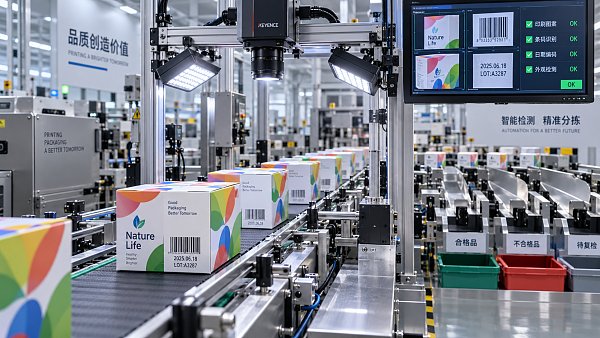
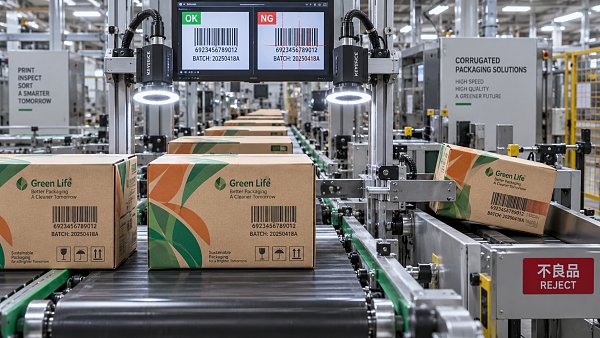
What Determines Glue Detection Systems Cost on Production Lines
Glue detection systems cost is determined less by the presence of a camera or sensor than by the production conditions the system must verify. A simple station that confirms whether adhesive exists in one fixed location has a very different scope from an inline inspection setup that tracks multiple glue lines, changing carton formats, high conveyor speeds, reject handling, and production records. The quoted equipment price therefore needs to be read alongside installation work, interface requirements, false-reject exposure, and the cost of keeping the system reliable after commissioning.
On folding carton, corrugated box, and specialty converting lines, adhesive defects can take several forms: a missing bead, a short glue pattern, a shifted application position, intermittent application caused by a blocked nozzle, excessive squeeze-out, or glue applied to the wrong panel after a job setup error. Detection technology must be selected against the defect that matters, the substrate surface, and the point in the process where a fault can still be isolated. These choices shape both capital cost and operating cost.
Detection method sets the starting cost range
The inspection principle is usually the first major cost driver. Systems based on simple presence sensors are suited to defined applications where a bead or adhesive patch passes a repeatable point. They are often less complex to install, but their usefulness falls when carton geometry, glue color, or application patterns vary substantially.
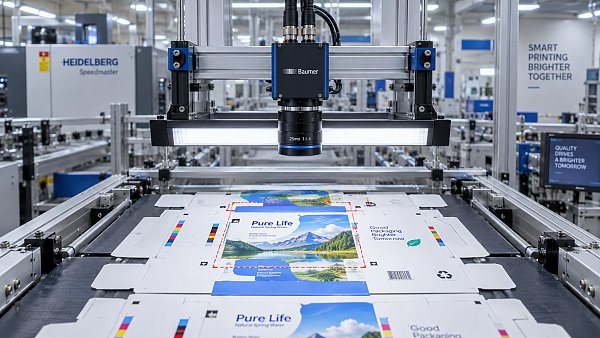
Machine vision inspection generally carries a higher initial cost because it requires cameras, lighting, image processing, mounting hardware, and configuration for each inspected feature. It can distinguish the position, continuity, width, and relative shape of an adhesive pattern when the visual contrast is adequate. Its value is strongest where a basic sensor would register “glue present” even though the bead is misplaced or incomplete.
Some adhesives are difficult to inspect in visible light. Clear cold glue on white board, glossy coating, varnished printed stock, and reflective metallized surfaces can weaken contrast. Ultraviolet-responsive additives, ultraviolet illumination, infrared methods, thermal sensing, or specialized optical arrangements may be considered where the application cannot otherwise be seen consistently. The adhesive formulation, lighting enclosure, safety measures, and validation work can all expand the scope beyond a standard camera package.
A detection method should not be priced in isolation. A highly capable inspection head offers little return if production variation makes its image unstable, while a low-cost presence sensor may create expensive escapes where a narrow, accurately placed glue line is essential to carton integrity.
Inspection coverage changes system architecture
System cost rises with the number of glue locations inspected, but sensor count alone is an incomplete measure. A straight-line side seam on a single-panel carton is a relatively contained task. A multi-point carton with crash-lock sections, four-corner construction, internal partitions, or several glue guns requires more viewing angles, more triggers, and more logic to associate each result with the correct blank.
The layout of the production line also matters. On a folder gluer, the accessible position before folding may offer a clear view of adhesive patterns, yet the sheet can be moving quickly and vibrating. Inspection after folding may verify the finished condition more directly, but a closed carton can hide the glue joint. Corrugated applications introduce additional challenges because flute profile, board warp, dust, and variable liner appearance affect the image and sensor signal.
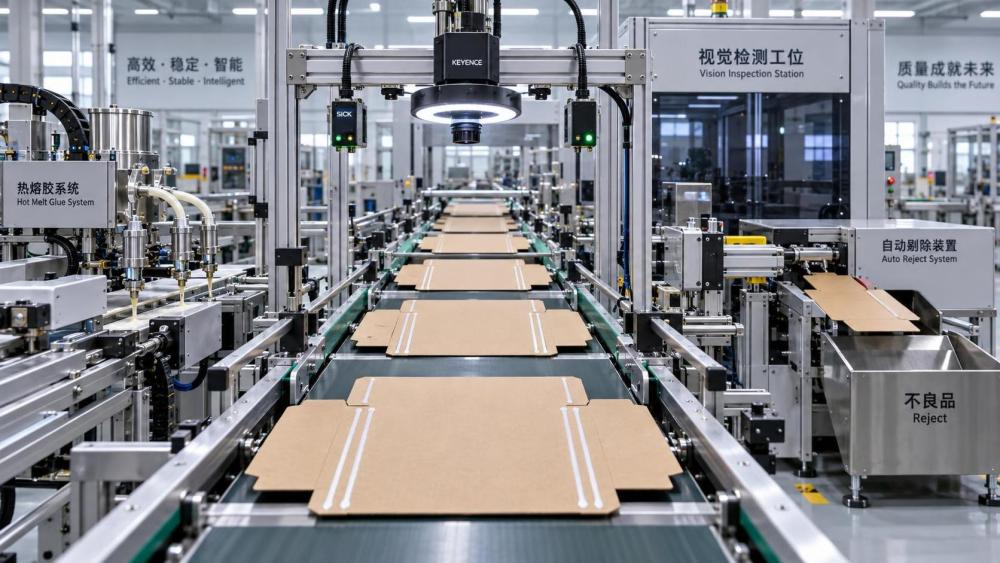
Inspection stations often need upstream and downstream components that are excluded from an early equipment estimate. These can include a shaft encoder for position tracking, a product sensor or registration signal, brackets designed for a particular machine frame, protective housings, cable routing, an industrial control enclosure, and a reject device. A camera may represent a modest portion of the installed system if electrical integration and mechanical modification are substantial.
Line speed and product variability are expensive requirements
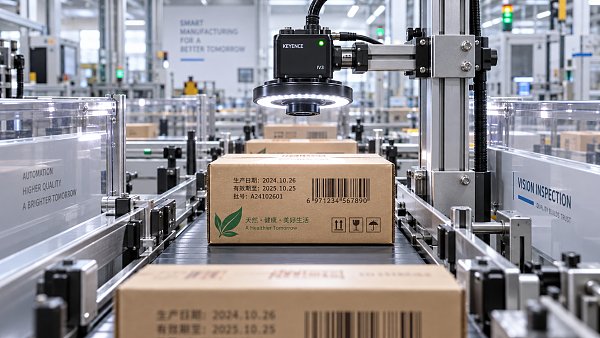
High speed does not merely require a faster camera. It reduces the available time to trigger, capture, process, communicate a result, and reject the relevant product without affecting adjacent cartons. The system must maintain positional accuracy despite speed changes, gaps between blanks, belt movement, and occasional skew. Faster applications can require higher-performance imaging hardware, controlled lighting with short exposure times, more precise encoder synchronization, and reject timing logic.
Product variability adds a separate layer of cost. A line dedicated to one carton size and one adhesive recipe can be configured with fixed regions of interest and stable thresholds. Short production runs, frequent format changes, and mixed job conditions require recipes, job selection controls, repeatable setup references, and validation routines. The cost is not only software licensing. Time is needed to define acceptable glue appearance for each job and to ensure that a new recipe does not mistake printed graphics, score lines, windows, or board texture for adhesive.
Wide size ranges may require movable camera mounts, several inspection zones, adjustable lighting, or a larger field of view. A large field of view can reduce hardware count, but it may lower effective image resolution at the defect location. The appropriate design depends on the smallest defect that must be identified, not simply on the maximum blank size.
Glue and substrate conditions affect both specification and upkeep
Adhesive systems are often discussed as though they are uniform, but inspection performance is closely tied to process chemistry. Water-based cold glue may change visual appearance as it absorbs into uncoated board. Hot-melt adhesive can be glossy, stringy, or irregular at the moment of application. Starch adhesive on corrugated board is a different inspection problem again, especially if monitoring is intended near the corrugator glue roll or at a bonding stage rather than on a finished carton.
Dark inks, heavy coverage printing, foil, aqueous coating, laminate, recycled liner variations, and dust contamination can all influence contrast. A system designed around a clean, unprinted sample may perform poorly after production moves to a more complex artwork or a different board supplier. This is why material samples should include the expected range of substrates, printing conditions, glue patterns, and normal production imperfections during the technical evaluation.
There is also a distinction between detecting adhesive and confirming bond quality. A vision system can verify that a glue pattern appears to be present and located correctly. It cannot automatically prove that adhesive temperature, open time, substrate moisture, compression, or fiber condition produced a durable bond. Where bond failure is the concern, glue detection should be evaluated alongside application controls and suitable offline or process-specific bond testing. Treating visual presence as proof of adhesion is a common source of misplaced confidence.
Integration scope often exceeds the inspection hardware
A complete cost assessment should define what happens after a defect is found. Alert-only systems are simpler than systems that stop the machine, activate a reject gate, mark a suspect batch, or transmit a fault to the line controller. Each response has different consequences for throughput and traceability.
A reject mechanism deserves particular scrutiny. The system must identify the defective item, calculate when it reaches the reject point, and confirm that the mechanism removes it without damaging good production. When cartons run in close succession or change position between inspection and delivery, dependable rejection can be harder and costlier than detection itself. In some layouts, controlled stop logic or batch segregation is more realistic than individual ejection.
Commissioning is where quoted capability becomes usable capability
The cost of commissioning depends on the number of formats, defect types, and operating states to be validated. A credible acceptance process should test normal good production as well as deliberately introduced conditions such as missing glue, shifted glue, partial application, and realistic non-defects. The purpose is to establish detection sensitivity without creating an alarm rate that disrupts production.
False rejects and missed defects have different cost consequences. Loose thresholds can pass a defective carton; overly sensitive settings can reject acceptable output because of print variation, dust, board edge irregularity, or lighting changes. Neither problem is solved merely by selecting more advanced hardware. Stable mounting, clean optics, controlled illumination, repeatable triggering, recipe discipline, and periodic review of saved defect images are part of the installed performance.
Commissioning estimates should state whether recipe creation is limited to a small group of agreed formats or includes the full initial production portfolio. It should also clarify who provides cartons, adhesive samples, machine access, electrical work, control permissions, and mechanical support. Unclear boundaries in these items often produce later change costs even where the inspection equipment itself was priced accurately.
Lifecycle cost is shaped by maintenance and production discipline
Glue detection systems introduce routine maintenance tasks: cleaning camera lenses or sensor faces, checking lighting condition, inspecting brackets for movement, confirming trigger alignment, and reviewing alarm behavior after material or artwork changes. Dusty converting environments and adhesive mist can shorten cleaning intervals. Protective housings reduce contamination, but they must not obstruct the optical path or make access impractical.
Spare parts strategy also affects long-term exposure. Common items include lighting modules, cables subject to flexing, sensors, power supplies, industrial computer components, and reject-device wear parts. The practical issue is not simply whether spares are available; it is whether a failure mode stops the line, disables inspection while production continues, or permits a controlled fallback procedure. That distinction should be documented before approval rather than decided during an unexpected failure.
Software support deserves similar attention. Recipe backups, configuration records, user access control, remote support arrangements, and compatibility with future plant network policies can matter years after installation. A low initial quote that excludes commissioning support, software updates, or structured handover may transfer cost into the operating period.
Comparing proposals without comparing unlike scopes
Two proposals can show a large price difference while addressing different problems. A useful comparison separates the cost of inspection hardware, machine-specific mechanics, controls integration, reject handling, installation, commissioning, training, documentation, and ongoing support. It should also identify exclusions such as site electrical work, compressed air, network drops, guarding changes, line downtime, or modifications to a glue applicator.
- Defect definition: Specify whether the requirement is glue presence, bead position, coverage, continuity, width, pattern sequence, or a combination of these conditions.
- Production envelope: Record maximum and normal line speed, carton spacing, smallest and largest formats, substrate range, adhesive type, and the number of active glue paths.
- Response to a failure: Distinguish alarm, stop, marking, individual rejection, and batch hold. These are different technical scopes with different costs.
- Acceptance basis: Agree on representative materials and fault samples before installation, including printed and coated work that could affect inspection contrast.
The lowest equipment price is often appropriate for a stable, single-purpose application with a well-defined defect and straightforward access to the glue area. A more extensive system becomes justified when missed glue has high downstream consequences, formats change frequently, individual fault isolation is necessary, or records are required to investigate quality events. The cost question is therefore best framed as the price of achieving a defined inspection outcome under actual line conditions, including the controls and upkeep needed to sustain it.
Related News
 How to Select an Area Scan Camera for Reliable Print InspectionChoose an area scan camera for print inspection with confidence. Learn how resolution, lighting, speed, and testing affect defect detection—and make a smarter investment.Machine Vision & Coding Fellow
 How to Build a Reliable Compact Vision Sensor Inspection SystemBuild a reliable compact vision sensor inspection system with proven guidance on lighting, triggering, defect detection, and production-ready quality control.Machine Vision & Coding Fellow
 How High Accuracy Spectrophotometers Improve Print Color Controlhigh accuracy spectrophotometers help print and packaging teams detect color drift early, reduce waste, improve approvals, and protect brand consistency across every production run.Machine Vision & Coding Fellow
 How Spectrophotometers for Color Matching Improve Print ConsistencySpectrophotometers for color matching help printers control Delta E, reduce waste, and deliver reliable brand color across every press run.Machine Vision & Coding Fellow
 How Print Inspection Systems Prevent Defects Before ShipmentPrint Inspection Systems help detect print, barcode, color, and coding defects in real time—improving traceability, reducing waste, and preventing costly shipment failures.Machine Vision & Coding Fellow
 Smart Cameras for Inspection That Catch Print Defects in Real TimeSmart camera for inspection solutions catch print defects in real time, verify codes, reduce false rejects, and strengthen packaging quality control.Machine Vision & Coding Fellow