Using Vision Sensors for Carton Detection to Prevent Packing Errors
A missed carton, a mixed carton, or a carton carrying the wrong printed code can pass through a packing line in seconds. The visible defect may seem minor at the machine, but its consequences can include rework, shipment holds, customer complaints, traceability failures, and avoidable exposure for operators who must intervene in a moving line.
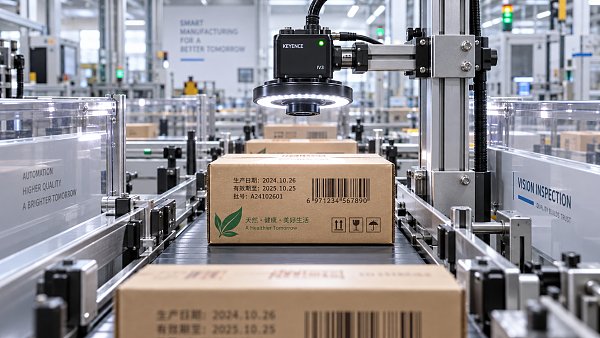
A vision sensor for carton detection is worth considering when photoelectric sensors or manual checks can confirm that something is present, but cannot reliably confirm that the correct carton is present, properly positioned, printed correctly, or ready for the next process. The most effective installations are built around a defined packing risk. They do not treat vision as a general-purpose quality camera added after the line has already been designed.
For quality and safety teams, the practical question is simple: which errors must be stopped before they become packed product, and can the inspection system make that decision consistently at production speed?
Carton presence is only the first inspection task
Many packaging lines already use basic sensors to detect whether a carton has arrived at a station. This is useful for preventing empty cycles, controlling feeders, and detecting obvious jams. However, a conventional presence sensor generally cannot distinguish between a correctly erected carton and one that is skewed, partially open, upside down, damaged, or from the wrong job.
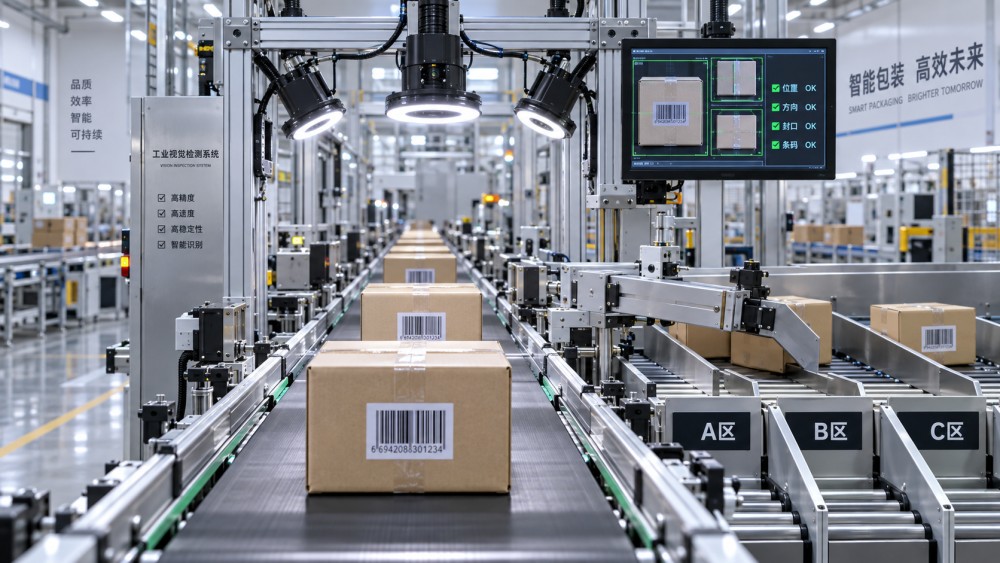
Vision-based carton detection extends the decision beyond “carton present” or “carton absent.” Depending on the camera setup and inspection logic, it can verify features such as:
- Whether a carton is present in the expected position at the expected time.
- Whether the carton orientation matches the packing or coding requirement.
- Whether flap position, opening condition, or carton geometry falls within an accepted range.
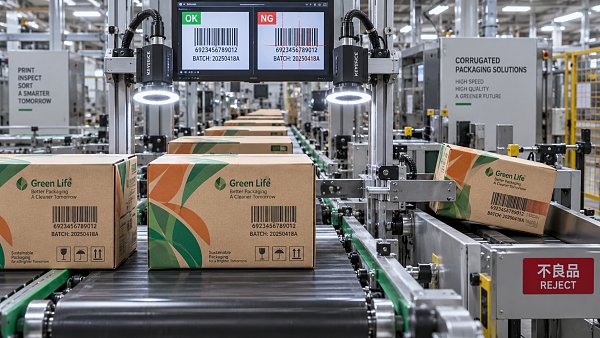
- Whether printed artwork, a logo, label, date code, lot code, or barcode is present and readable.
- Whether the carton belongs to the active order rather than a leftover or mixed SKU.
- Whether a finished carton has been rejected, diverted, or allowed to continue as intended.
The value comes from linking these checks to an action. A camera that identifies a defect but allows the defective carton to move downstream without a controlled response has limited operational value. The line must decide whether to stop, reject, divert, alarm, hold a batch, or require operator verification.
Start with the packing error, not the camera specification
Inspection projects often become difficult when the first discussion is about image resolution, artificial intelligence functions, or camera brand. Those details matter later. The initial design should begin with the failure mode that creates the business or safety risk.
For example, a carton erector may occasionally deliver a carton with an incompletely opened body. A downstream product loader may then misload product, crush the carton, or create a jam that requires manual clearing. In this situation, the inspection task is not primarily print verification. It is confirmation that the carton has reached the loading station in a usable, stable condition.
A cartoning line handling several similar products faces a different problem. A physically sound carton may still carry the wrong artwork or barcode. This can create a serious dispatch or regulatory issue, especially where pack identity, batch coding, or market-specific labeling must remain correct. Here, the system may need to compare a printed reference feature, read a code, or confirm a label position before final closure.
At the end of a line, the concern may be carton count or pack completeness. A vision sensor can confirm the expected pattern of cartons entering a case packer, palletizer, or conveyor transfer. This is useful where a gap in the flow can cause a robot to pick incorrectly or create an unstable load. The inspection point should be selected before the error becomes harder to correct.
Quality teams can usually define the application by answering four questions:
- What is the unacceptable carton condition or packing error?
- At what point can the error first be detected reliably?
- What line action can still prevent shipment, damage, or unsafe intervention?
- What evidence is needed after an alarm or rejection event?
Those answers determine whether a simple smart sensor is sufficient or whether the line needs a more capable vision system, controlled lighting, code-reading capability, image storage, and connection to production records.
Where vision inspection has the strongest effect
Carton detection is most useful at points where downstream automation assumes that every carton is correct. High-speed packaging equipment is designed around repeatable motion. One badly positioned carton can trigger a sequence of misfeeds, crushed packs, unplanned stops, and manual recovery work. The inspection point should therefore protect a critical handoff rather than duplicate a check that has no operational consequence.
Before product loading
Inspecting cartons after erection and before loading helps identify missing cartons, poor opening, incorrect orientation, or excessive skew. This reduces the chance that products are loaded into an unusable carton or released onto a conveyor without a carton at all. The image must be captured while the carton geometry is stable enough to judge. A carton still oscillating on a conveyor can produce inconsistent results even with a capable camera.
After printing, coding, or labeling
Where carton identity depends on a printed code, barcode, variable-data mark, or applied label, the camera should be positioned where the marked surface is visible and sufficiently controlled. A vision sensor can check presence and placement, while a code-reading application may confirm that the content is readable and matches the active production job.
This distinction matters. Detecting that a dark mark exists is different from proving that the correct lot number or product code has been printed. Quality teams should define the required level of verification rather than assume that any vision device reading a visible feature provides full traceability control.
Before case packing or palletizing
At end-of-line transfer points, vision can protect packing patterns and robotic handling. It can verify carton count within a lane, identify missing cartons before accumulation, or confirm that cartons are aligned for pick-and-place operations. This can reduce interruptions caused by failed robot picks or unstable downstream loads.
For safety managers, this also has an indirect benefit. Fewer recurring misfeeds and jams reduce the occasions when operators need to inspect, clear, or reset equipment. The safety benefit depends on the line’s guarding, lockout procedures, and recovery design; a camera does not remove those obligations. It can, however, reduce avoidable fault conditions that lead to intervention.
Lighting, contrast, and carton variability decide inspection reliability
A common mistake is to judge a vision solution from a clean demonstration using one carton style under fixed conditions. Packaging lines face more variation: corrugated board shade changes, recycled fiber content varies, print density shifts, glossy coatings reflect light, die-cut edges wear, and carton surfaces may carry dust or scuffing. A system that recognizes one ideal sample may generate nuisance rejects once normal production variation appears.
Lighting is often more important than adding camera resolution. The purpose of illumination is to make the feature being inspected distinct from the background and stable from one carton to the next. Front lighting may suit print or label checks. Backlighting can be effective for confirming carton outlines, flap position, holes, or die-cut geometry. Angled lighting may reveal raised, embossed, or poorly applied features, but it can also exaggerate harmless surface texture.
The chosen inspection feature should also be robust. A large, high-contrast registration mark is easier to validate than a small decorative graphic. A clearly defined code area is easier to inspect than variable content placed across a reflective, textured surface. If the production process cannot deliver a stable visual feature, the inspection system will inherit that instability.
False rejects can create a different kind of production problem
Inspection sensitivity should not be set solely to reject every visual difference. Overly tight tolerances can turn normal variation into repeated alarms. The result may be a line that operators learn to bypass, ignore, or run in a degraded mode. That undermines both quality control and safety discipline.
False rejects are especially damaging in short-run carton production, where artwork, board grade, dimensions, and print conditions change frequently. Every approved job needs an inspection recipe that defines accepted conditions, rejection criteria, and the product or order to which the recipe applies. Recipe control is a quality function, not just a convenience feature for maintenance staff.
Teams should separate defects into three groups:
- Critical defects: Conditions that must prevent downstream packing or shipment, such as a missing required code, incorrect product identity, or a carton absence that would cause mispacking.
- Actionable defects: Conditions that can be rejected automatically without stopping the line, such as a misplaced label where downstream product remains protected.
- Review conditions: Visual changes that may require an operator or quality decision but should not automatically create repeated line stops.
That classification makes the alarm strategy more credible. It also prevents one inspection station from being asked to solve every quality issue on the line. A vision sensor has to operate within a controlled decision window. If the acceptable condition itself is vague, the system will not create clarity.
Integration determines whether defects are contained
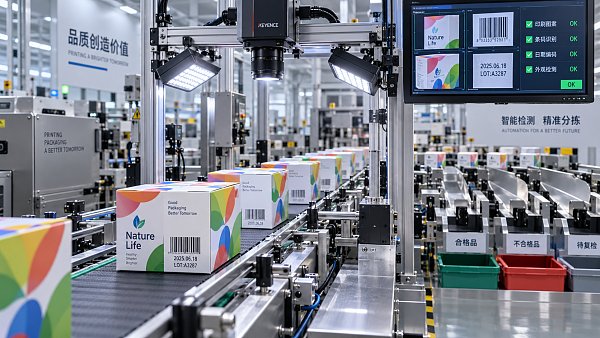
A carton inspection device should be treated as part of the packaging control system. The basic signal path is straightforward: detect the carton, acquire an image, assess the configured criteria, and send a pass, reject, or fault signal. In practice, timing and fault handling require careful design.
The system must know which carton is being inspected and which carton must be rejected. Conveyor speed changes, variable spacing, accumulation, and transfer points can all affect that relationship. On fast lines, a reject command may need to be delayed by a precise distance or synchronized through encoder-based tracking. Without reliable product tracking, a good carton can be rejected while the faulty carton continues.
Reject verification is equally important. If the line uses an air blast, pusher, diverter, or robotic removal device, it should confirm that the rejected carton actually left the accepted flow. Otherwise, the event record may show a rejection while the carton remains on the conveyor. Where rejected cartons can be reintroduced, a controlled quarantine process is needed to prevent accidental return to production.
Data handling should match the risk. A simple presence check may only require counts and alarm history. A code-verification station may need to record the inspected value, time, job identifier, and disposition. Storing every image indefinitely is not automatically useful; it can create unnecessary storage and retrieval work. Retain the information needed to investigate exceptions, demonstrate control, and improve recurring failure points.
Commissioning should test normal variation and credible failures
Successful commissioning is not a demonstration that the camera can find one good carton. It should prove that the station performs across the expected range of board, print, speed, positioning, and lighting conditions. Samples should include approved production variation as well as representative faults: absent cartons, rotated cartons, damaged flaps, missing labels, shifted codes, unreadable barcodes, and wrong-job carton samples where relevant.
Tests should also cover operational events. What happens when the lens becomes dusty? What happens after a job change? What signal is sent when image acquisition fails? Does the line stop safely, reject product, or continue with an alarm? The answer should reflect the severity of the inspection task. A system checking a non-critical orientation feature may allow controlled continuation. A system verifying a mandatory identity code may require a more conservative response.
Ownership must remain clear after installation. Production operators need a simple response to alarms. Quality personnel need authority over acceptance criteria and recipe approval. Maintenance teams need defined cleaning, alignment, backup, and replacement procedures. When these responsibilities are fragmented, inspection performance can drift without anyone recognizing that the original control has weakened.
Vision-based carton detection delivers the most value when it is placed at a decision point where an error can still be contained. Select the inspection task first, design the optical conditions around the carton and its variation, connect the result to a verified line response, and test the system against the faults that matter. That approach turns a camera from an added component into a practical control against packing errors.
Related News
 How to Build a Reliable Compact Vision Sensor Inspection SystemBuild a reliable compact vision sensor inspection system with proven guidance on lighting, triggering, defect detection, and production-ready quality control.Machine Vision & Coding Fellow
 How High Accuracy Spectrophotometers Improve Print Color Controlhigh accuracy spectrophotometers help print and packaging teams detect color drift early, reduce waste, improve approvals, and protect brand consistency across every production run.Machine Vision & Coding Fellow
 How Spectrophotometers for Color Matching Improve Print ConsistencySpectrophotometers for color matching help printers control Delta E, reduce waste, and deliver reliable brand color across every press run.Machine Vision & Coding Fellow
 How Print Inspection Systems Prevent Defects Before ShipmentPrint Inspection Systems help detect print, barcode, color, and coding defects in real time—improving traceability, reducing waste, and preventing costly shipment failures.Machine Vision & Coding Fellow
 Smart Cameras for Inspection That Catch Print Defects in Real TimeSmart camera for inspection solutions catch print defects in real time, verify codes, reduce false rejects, and strengthen packaging quality control.Machine Vision & Coding Fellow
 How Color Sensors Support Reliable Inline Print Quality InspectionColor Sensors enable reliable inline print quality inspection, helping packaging plants detect color drift early, reduce waste, protect brand consistency, and improve traceability.Machine Vision & Coding Fellow