How Print Inspection Systems Prevent Defects Before Shipment
How Print Inspection Systems Prevent Defects Before Shipment
A packaging defect discovered after shipment is rarely just a quality issue. A missing date code can interrupt a retailer’s receiving process. An unreadable barcode can delay warehouse handling. A color shift on a branded carton can trigger a customer rejection, while incorrect pharmaceutical text or an incomplete traceability mark may create a much more serious compliance concern. By the time a pallet has left the plant, the cost of identifying, sorting, returning, and replacing defective material can exceed the cost of the original print run.
That is why print inspection systems are increasingly treated as part of production control rather than a final visual check. In commercial printing, corrugated packaging, folding carton converting, and coded paper-based packaging, the objective is not simply to find defects. It is to detect a deviation early enough to stop its spread, isolate affected material, identify the likely process cause, and prevent non-conforming products from entering shipment.
For quality and safety teams, this changes the question from “Can the system see a defect?” to “Can it protect the release decision under actual production conditions?” The answer depends on inspection coverage, defect logic, camera placement, production speed, reject handling, data retention, and the discipline used to respond when the system raises an alarm.
Why Final Sampling Is Not Enough for Fast-Moving Print Production
Manual sampling remains useful, especially when evaluating tactile finish, substrate behavior, glue quality, or defects outside a camera’s field of view. But it has an obvious limitation: it examines only a portion of what was produced. On a flexographic press, offset press, digital press, or high-speed converting line, a print issue may emerge between samples and continue through a substantial quantity of sheets, blanks, labels, or corrugated cases.
Some defects are also difficult to judge consistently by eye. Minor registration drift may be accepted by one operator and rejected by another. A barcode can appear sharp but fail to scan reliably. Variable codes may be present but contain the wrong character sequence. A faint print area may become more visible only after folding, varnishing, or transport abrasion. Inspection must therefore be designed around the actual functional risk of the package, not only its appearance under a press-side light.
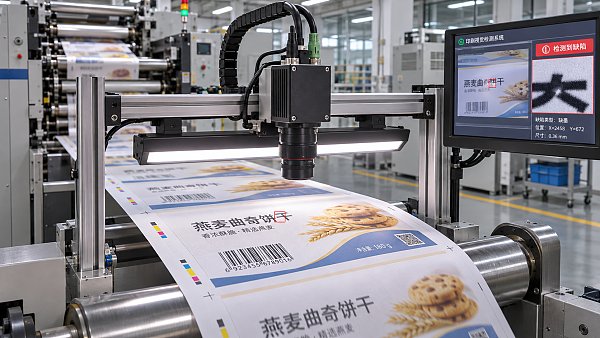
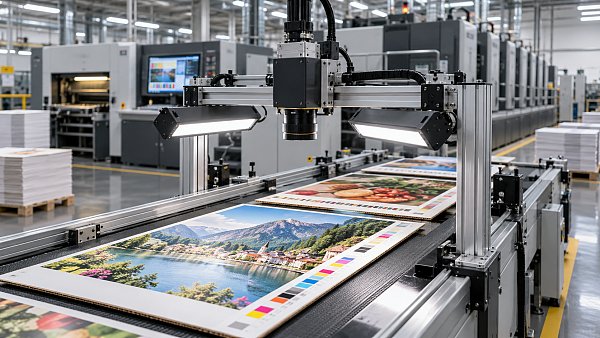
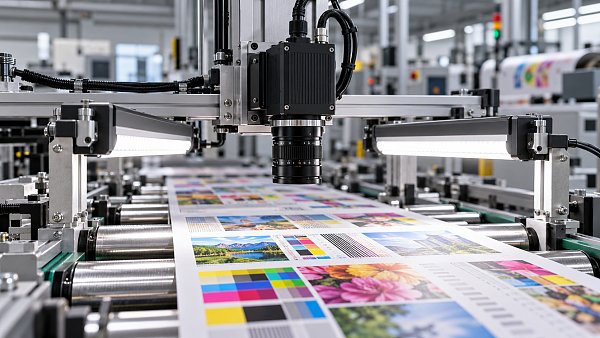
Inline inspection gives teams continuous visibility. It compares each printed item, or a defined inspection area on each item, against an approved reference and configured tolerance. Depending on the application, the system may assess print presence, color consistency, register position, text, logos, codes, barcode quality, or physical features such as die-cut alignment and glue placement. When connected properly to the press or converting line, it can flag a defect, trigger a reject mechanism, record an event, or prompt the operator to investigate before the issue reaches palletizing.
What an Inline Vision System Actually Does
Most print inspection systems combine illumination, industrial cameras, image-processing software, and a connection to the production line. The camera captures the printed surface as material moves through a controlled inspection zone. Software then evaluates the image against a master image, an approved artwork file, a code database, or rules established during job setup.
The inspection logic matters more than the hardware brochure suggests. A broad “difference from master” setting may catch obvious smears, missing print, and major color variation, but it can also create nuisance alarms when natural substrate texture, corrugated flute influence, varnish gloss, or acceptable ink variation is present. Conversely, tolerances that are too wide may allow a genuine customer-critical defect to pass. The most effective setup distinguishes between cosmetic variation, process warning conditions, and defects that require automatic rejection or line intervention.
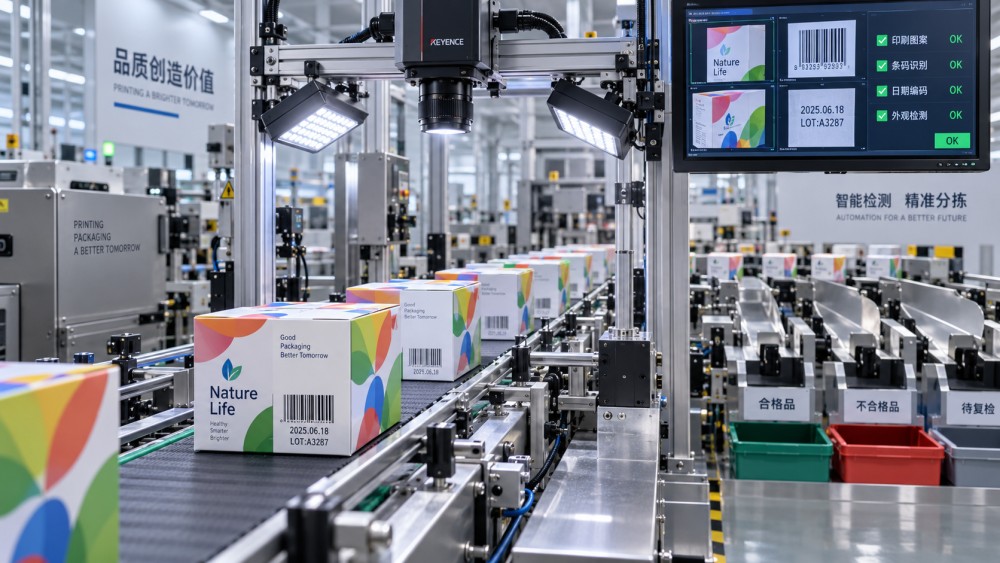
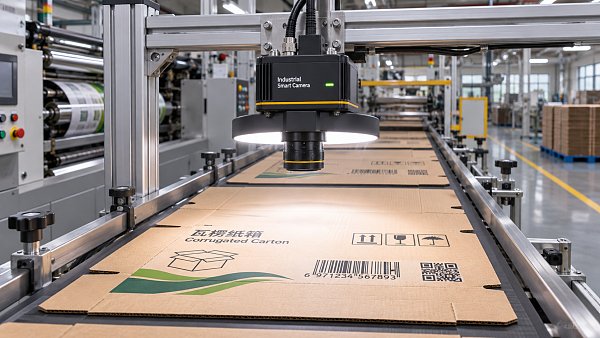
In corrugated post-printing, the inspection challenge often includes uneven board surfaces, print distortion associated with board movement, dust, and changing substrate characteristics. In folding cartons, small text, fine lines, metallic effects, foil, embossing, and tight registration requirements can demand more targeted inspection. For commercial print work, variable data and version control may be the central risk. The same inspection architecture is not equally suitable for every one of these tasks.
Defects that usually deserve automated control
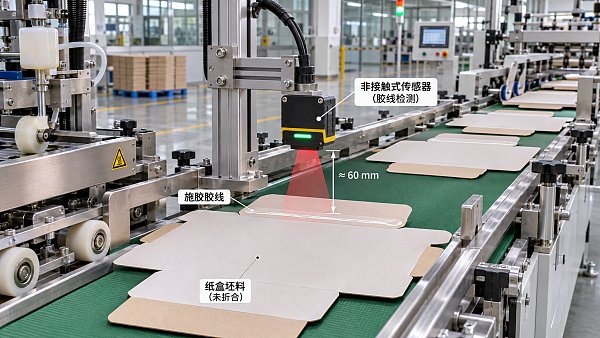
The appropriate defect library depends on the product and the release risk, but quality teams commonly focus on missing or incomplete print, hickeys, smears, color deviation, register error, damaged graphics, incorrect artwork version, absent or illegible codes, barcode defects, and variable-data mismatches. In converting operations, inspection may also be linked with checks for die-cut position, crease alignment, glue pattern, window placement, or folded-carton integrity.
Not every anomaly should be treated as a shipment-blocking event. A practical inspection plan classifies defects by consequence. A small mark in an unprinted flap may call for monitoring. A missing lot code, incorrect product identifier, or unreadable barcode normally requires much stricter action. This classification should be agreed by quality, production, engineering, and—where relevant—the brand owner before the job is released.
Prevention Depends on the Response Loop, Not Detection Alone
A camera that records defects without changing plant behavior is useful for investigation, but it does not fully prevent shipment failures. Prevention comes from a closed response loop: detect the condition, identify the affected production window, contain suspect material, correct the source, verify recovery, and retain evidence for final release.
Consider registration drift during a long run. If the system detects movement outside the approved tolerance, the operator may need to adjust web tension, plate position, impression settings, substrate handling, or press controls. The exact cause varies by process. On a flexographic line, ink, anilox condition, plate mounting, and web behavior may all contribute. On sheetfed work, feeder consistency, sheet positioning, blanket condition, and environmental factors can be relevant. The inspection system identifies the visible outcome; process knowledge is still needed to remove the cause.
The same principle applies to coding. If an inspection system finds missing, duplicated, or incorrect codes, the plant must know whether the error began at the printer, the data source, a changeover step, or an operator selection. Traceability is valuable here because it links a defect event to a specific job, time range, machine state, and often a production batch. Without that link, teams may be forced to quarantine far more material than necessary—or worse, release material with an uncertain history.
Where Inspection Should Sit in the Production Flow
There is no universal “best” camera location. The right position follows the defect risk and the point at which correction is still economical. Print inspection immediately after the print unit can provide rapid feedback and reduce the length of a defect run. Inspection after UV curing, coating, die-cutting, or folder gluing may be necessary when later processes can create, conceal, or amplify defects.
Many plants need more than one quality gate. A printed corrugated blank may be checked after printing for graphics and code accuracy, then checked again after converting if die-cut position or glue application is critical. A folding carton line may inspect printed sheets before die-cutting and use downstream verification to confirm that the finished carton retains correct orientation, coding, and structural features. The decision is a balance between risk coverage, integration complexity, line speed, available space, and the practicality of removing defective product.
Reject handling deserves the same attention as the cameras. If a system identifies a bad sheet but the reject mechanism cannot separate it reliably at line speed, the quality promise is incomplete. Plants should confirm how suspect products are marked, diverted, counted, secured, and reconciled. For some applications, an alarm and controlled stop may be safer than automatic rejection. That choice should reflect the product, the machinery, and the consequences of a false accept.
Choosing a System: Questions That Avoid Expensive Gaps
Inspection projects often fail at the definition stage, not the installation stage. Teams may purchase a system based on nominal line speed or camera resolution without documenting which defects must be found, where they occur, how frequently jobs change, and what happens after detection. A clearer evaluation starts with the production reality.
- Which defects create a customer, safety, traceability, or compliance risk?
- What is the smallest feature, code, or print variation that must be detected under normal operating conditions?
- Which substrates, ink systems, finishes, and artwork types must the system handle?
- Can inspection maintain required production speed without creating an unmanageable false-reject rate?
- How will approved masters, job versions, and variable data be controlled at changeover?
- What evidence must be stored for internal review, customer reporting, or lot release?
It is also important to test the system against representative samples rather than ideal artwork alone. Include typical substrate variation, difficult colors, fine text, expected print imperfections, and real production speeds where feasible. A demonstration that detects a deliberately large defect is not the same as proof that the system can separate acceptable variation from a meaningful production fault.
Color, Codes, and the Limits of a Single Pass/Fail Decision
Color inspection deserves careful interpretation. Some systems are designed primarily for image comparison and trend monitoring; others may support more detailed color measurement functions. The required approach depends on brand tolerances, print process, lighting conditions, substrate, ink behavior, and the customer’s approval method. A visual inspection platform should not automatically be assumed to replace a defined color-management process.
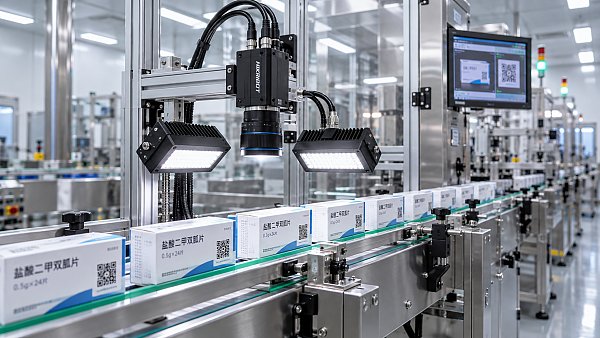
Barcode verification is similarly specific. Detecting that a barcode is present is different from confirming that it decodes correctly, contains the correct data, and meets the quality expectations relevant to the supply chain. For regulated, food, pharmaceutical, or retailer-controlled applications, teams should establish the exact barcode, text, lot-code, and recordkeeping requirements with the responsible customer or applicable standard owner. The inspection system must be configured around those requirements, not around a generic assumption of readability.
This is where quality managers often need to resist a simple green/red dashboard mindset. The inspection result is only trustworthy when the approved reference, tolerance settings, lighting, verification method, and operator response are controlled. Changes to artwork, substrate, ink, camera position, or product format may require the job recipe to be reviewed again.
Inspection Data Can Improve More Than Outgoing Quality
When defect records are organized by job, machine, material, time, and defect type, inspection data becomes a process-improvement tool. Repeated register alarms may point to a mechanical or tension-control issue. Recurring missing codes may expose a weak changeover procedure or unreliable connection to the coding source. A pattern of print voids can guide investigation into ink delivery, plate condition, contamination, doctor blade performance, or substrate dust.
The value is strongest when data is reviewed with production rather than treated as a quality department archive. Maintenance teams can use trends to prioritize checks. Production managers can identify jobs that require longer setup stabilization. Safety and compliance personnel can confirm whether defined control points were active and whether non-conforming material was contained. Over time, this creates a more defensible release process than relying on end-of-line visual judgment alone.
CPCS follows this broader view of packaging factory automation: vision inspection, coding and traceability, converting equipment, production management, and end-of-line handling should be assessed as connected parts of one operating system. A high-speed press or corrugated line only delivers its intended value when its output can be verified, controlled, and shipped with confidence.
A More Reliable Release Decision
Print inspection systems do not remove the need for trained operators, robust artwork control, preventive maintenance, or sensible sampling. They make those activities more effective by providing continuous evidence from the line. Their strongest contribution is not that they make every print job perfect; it is that they shorten the distance between defect creation and corrective action.
Before selecting or upgrading an inspection solution, define the shipment failures that matter most, map where they can arise, and decide how the plant will respond to each alarm. Then assess camera capability, software logic, line integration, reject control, traceability, maintenance needs, and operator workflow as one package. That is the practical route to preventing defects from becoming customer problems after the truck has left the gate.
Related News
 How Do Inline Glue Detection Systems Find Missing Glue?Discover how inline glue detection systems identify missing adhesive, prevent defective cartons from reaching customers, and support reliable quality control.Machine Vision & Coding Fellow
 How Does an Automatic Defect Detection System Inspect Print?Discover how an automatic defect detection system inspects print, identifies flaws, checks codes, and helps manufacturers improve quality control.Machine Vision & Coding Fellow
 How Can an AI Smart Camera Detect Defects in Printed Packaging?Discover how an AI smart camera detects printed packaging defects and what it takes to deliver reliable inspection at production speed.Machine Vision & Coding Fellow
 How to Choose a Pharmaceutical Carton Inspection SupplierChoose a pharmaceutical carton inspection supplier with confidence. Compare detection performance, integration, validation support, service, and lifecycle costs.Machine Vision & Coding Fellow
 How Color Inspection Systems Detect Print Color VariationsColor Inspection Systems detect print variations through imaging and measurement. Discover how references, tolerances, and setup improve quality control.Machine Vision & Coding Fellow
 How to Set Up an Inspection Camera for Print Quality ControlSet up an inspection camera for print quality control with practical tips on lighting, focus, triggers, and defect detection. Learn how to reduce false rejects and validate results at production speed.Machine Vision & Coding Fellow