How Carton Inspection Systems Reduce Packaging Defects at Speed
A packaging line can appear to be running well right up to the moment a customer rejects a pallet. The cartons may be structurally sound, but a faint print omission, an unreadable barcode, a misplaced date code, or an inconsistent glue seam can turn otherwise usable output into a costly quality event. For project managers responsible for corrugated or folding carton operations, the challenge is rarely finding defects after the fact. It is finding them early enough to prevent a small deviation from becoming a full-shift problem.
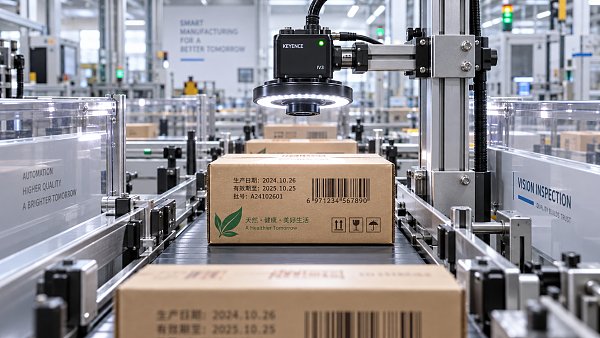
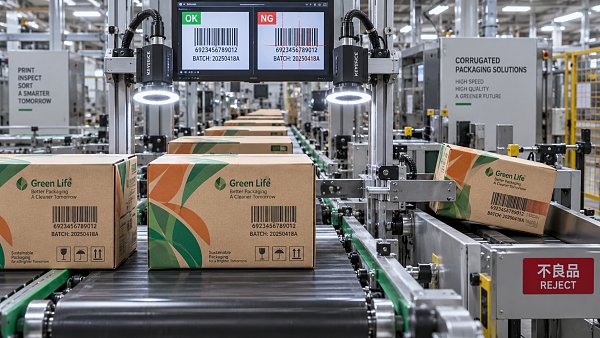
Carton Inspection Systems address that challenge by bringing quality control directly into the production flow. Using cameras, lighting, sensors, software logic, and reject or alert mechanisms, they check each carton or blank against defined quality criteria while the line continues to run. The objective is not simply to “see more defects.” It is to create a dependable link between production speed, quality assurance, traceability, and corrective action.
In high-volume packaging environments, that link matters. Shorter runs, more frequent SKU changes, retailer compliance requirements, and brand-specific artwork all increase the chance that an avoidable error reaches the finished-goods area. A well-planned inspection solution gives project teams a practical way to protect output without asking operators to slow down and inspect every sheet manually.
Why defects become more difficult to control at line speed
Packaging defects are not always caused by a major machine failure. Many begin as small process shifts: a print register drifts gradually, a printhead begins to drop out, a glue pattern moves slightly off position, or a worn die-cut tool creates an edge variation. At low speed, experienced operators may notice the change. At high speed, especially during long production runs or busy changeovers, the same defect can pass through unnoticed for hundreds or thousands of units.
Manual sampling remains valuable, but it has clear limits. It provides snapshots rather than continuous coverage. It also depends on timing, staffing, lighting conditions, and the judgment of the person performing the check. A sample can look correct while a recurring defect occurs between inspection intervals. This is particularly risky for cartons carrying barcodes, batch codes, variable data, pharmaceutical information, food-packaging labels, promotional graphics, or customer-specific print requirements.
For an engineering project leader, the real issue is broader than defect detection. A defect may trigger rework, material loss, production delays, claims, expedited shipments, or difficult conversations with a brand owner. It can also obscure the root cause because the exact point at which the fault began is unknown. Inline inspection turns quality data into a production signal rather than a final-stage discovery.
What Carton Inspection Systems examine on a live line
The inspection scope should reflect the packaging format, process stage, and risk profile of each operation. A corrugated shipping carton, litho-laminated display, and pharmaceutical folding carton do not require exactly the same checks. Still, most systems are built around a set of recurring quality targets.
- Print quality and artwork verification: detecting missing print, color variation, streaks, smudges, hickeys, incomplete graphics, and incorrect artwork elements.
- Registration control: identifying shifts between printed colors, print-to-die-cut misalignment, and variation in the position of key brand graphics.
- Code and barcode verification: confirming the presence, location, legibility, and, where required, content of barcodes, QR codes, lot codes, date codes, and serialized information.
- Die-cut and crease inspection: checking cut position, slot geometry, flap profile, score placement, waste stripping quality, and dimensional consistency.
- Glue and folding checks: verifying glue presence, pattern placement, glue bead continuity, carton squareness, flap closure, and folded-carton integrity.
- Surface and material defects: flagging tears, contamination, damaged board, coating defects, wrinkles, and visible substrate irregularities where these affect product acceptance.
Not every line needs every function. Trying to inspect too many minor variations can create nuisance alarms and undermine operator confidence. The strongest applications begin with a clear answer to a simple question: which defects would create the greatest commercial, compliance, or operational consequence if they escaped?
From camera image to useful production decision
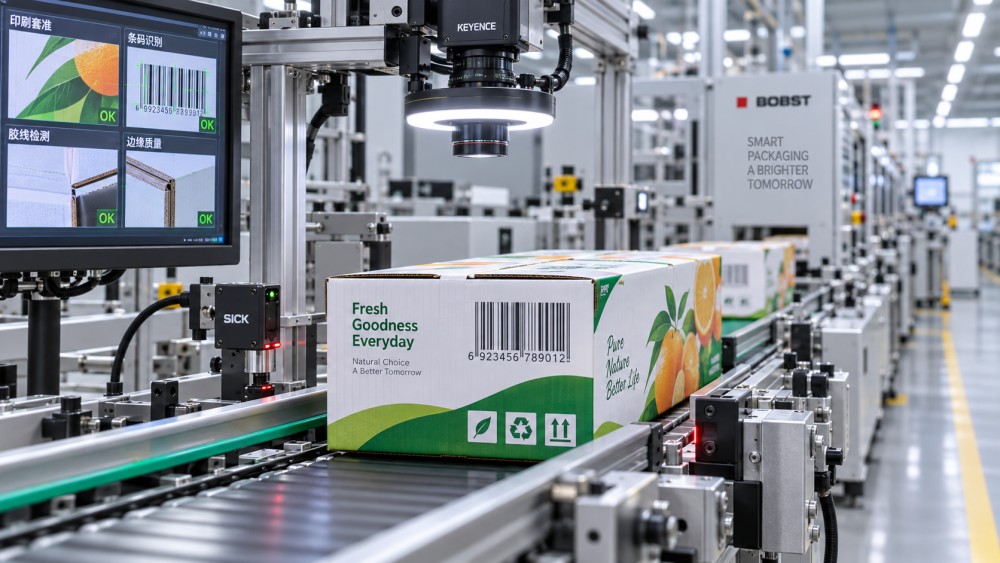
A vision inspection system is often described as a camera solution, but the camera is only one part of the system. Reliable performance depends on how several elements work together: stable product presentation, suitable lighting, image acquisition, reference data, decision rules, line synchronization, and a defined response when a defect is found.
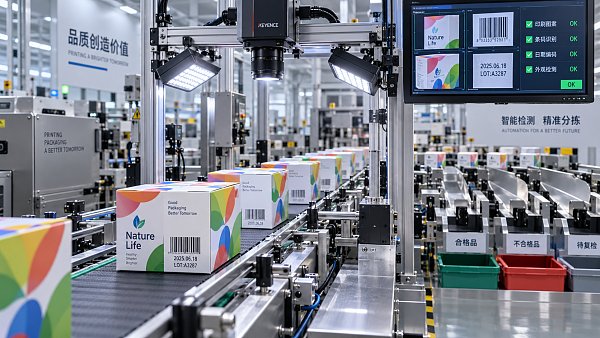
At the start of a job, the system is typically given a reference image, approved artwork file, code specification, or tolerance set. As cartons pass the inspection point, cameras capture images at line speed. Software compares each image with the approved conditions and determines whether the unit is acceptable, suspect, or rejectable. Depending on the process, the system may activate a diverter, mark the product, stop the machine, issue an alarm, or log the event for review.
This process sounds straightforward, yet the engineering details matter. Corrugated board may bow or vibrate. Gloss coatings can create reflections. Water-based inks, varnishes, metallic effects, and changing ambient light can affect image contrast. In folder-gluer lines, the relevant area may be concealed after folding unless cameras are positioned before and after key stations. A system needs appropriate optics, lighting angles, mounting rigidity, and triggering accuracy to produce repeatable results.
For this reason, a carton inspection project should not be treated as a standalone IT installation. It is a mechanical, electrical, process, and data-integration project. The best outcome comes when quality, production, maintenance, automation, and prepress teams define the requirements together.
Choosing the right inspection point in the packaging workflow
Inspection can be positioned at different points in a corrugated or carton-converting plant. The right location depends on when a defect can still be corrected and whether the product is moving in sheet, blank, or finished-carton form.
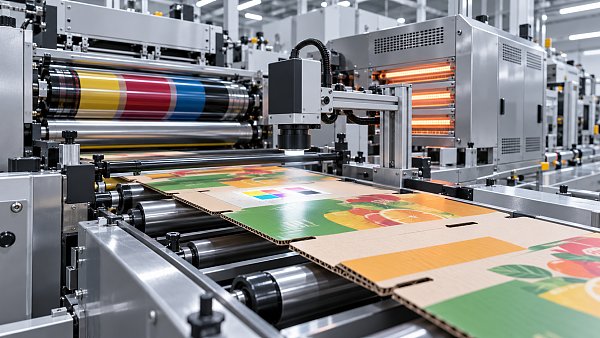
On flexographic or offset printing equipment, inline vision inspection can identify print and registration defects before a large quantity progresses to die-cutting or finishing. On a die-cutter, inspection may focus on cut-to-print alignment, stripping performance, and blank geometry. On a folder gluer, cameras and glue monitoring can check that the carton was folded correctly and that adhesive has been applied in the required pattern. At the end of line, inspection often provides a final verification point before bundling, case packing, or palletizing.
There is a practical trade-off. Earlier inspection usually reduces the amount of value added to defective product, while later inspection may verify more completed features. Some operations need both: an early-stage system for fast process correction and a final-stage system for customer-critical verification. Project managers should map where defects originate, where they become visible, and where they can be removed with the least disruption.
Speed is not the enemy; uncontrolled variation is
A common concern is that inspection will limit throughput. In practice, the goal of modern Carton Inspection Systems is to support the planned operating speed while making variation visible. The system must be sized for the real production environment, not an idealized brochure condition. That includes maximum line speed, sheet spacing, carton dimensions, print complexity, substrate range, job-change frequency, and the time available for operator setup.
False rejects are a major factor. If the tolerance window is too narrow, acceptable product may be removed unnecessarily, creating waste and frustration. If it is too broad, meaningful defects may pass. Finding the right balance requires commissioning with representative jobs and agreed acceptance standards. A minor shade variation that is acceptable for one shipping carton may be unacceptable on a premium retail pack with tightly controlled brand colors.
The system should also distinguish between an isolated defect and a developing process trend. One damaged blank may call for a reject. A sequence of registration failures may require an operator alert or controlled machine intervention. Repeated code-reading failures may indicate a coding issue, substrate change, or printhead condition that needs immediate attention. When inspection data is connected to production logic, the line becomes more responsive rather than simply more monitored.
Making inspection data useful beyond the reject bin
The most valuable inspection installations do more than count defects. They create a record of what was produced, what was rejected, why it was rejected, and when the event occurred. This supports traceability, root-cause analysis, customer reporting, and continuous improvement.
For example, defect images can help a quality team determine whether a print issue began after an anilox change, whether a die-cut variation is linked to a specific tool condition, or whether glue failures increase during certain operating conditions. Production managers can compare reject patterns across shifts, orders, substrates, or machine settings. Maintenance teams gain earlier evidence of wear or instability instead of reacting only after quality complaints rise.
Integration with manufacturing execution systems, job-management software, coding equipment, and line controls can add further value. A job ID can associate inspection results with a specific order. Variable-data verification can confirm that the right code is being printed on the right carton. A dashboard can show defect categories in real time without forcing supervisors to wait for a manual report.
However, data collection should serve a decision. A project team does not need an overwhelming number of charts; it needs information that answers operational questions. Which defect type costs the most? Which jobs need more stable setup procedures? When should a maintenance action be planned? Which rejected product can be safely segregated and reviewed? Clear reporting design is as important as camera selection.
Project questions to settle before selecting a system
When evaluating carton inspection technology, project managers should avoid beginning with a generic request for “100% inspection.” The more useful starting point is a defined quality risk assessment. Identify the critical-to-quality features, the available physical space, the line-control interfaces, and the expected production conditions.
It is worth clarifying whether the system must inspect every carton, selected zones, or only variable data. Define the smallest defect that matters commercially, rather than pursuing maximum theoretical sensitivity. Consider carton orientation, product tracking through the machine, line acceleration and deceleration, and whether rejected units can be removed reliably without creating jams.
Changeover is another decisive issue in plants handling frequent short runs. Operators need a practical way to load approved references, select recipes, confirm camera positions, and validate the inspection setup. If every new SKU requires specialist intervention, the system may be technically capable but operationally underused. Recipe management, user permissions, guided setup, and a clear approval process all help maintain consistency across shifts.
Finally, plan for ownership after commissioning. Operators need to understand alarms and first-level responses. Quality personnel need authority over tolerances and reference approval. Maintenance teams need access to cleaning, calibration, and fault-diagnosis procedures. Inspection equipment performs best when it becomes part of the plant’s daily operating discipline, not a black box installed beside the machine.
A practical route to lower defects and more stable delivery
Carton inspection is not a substitute for good printing, die-cutting, gluing, or machine maintenance. It is a way to verify that those processes remain within acceptable conditions while production is moving at speed. By detecting errors close to their source, packaging plants can reduce the amount of material committed to rework, contain suspect output sooner, and give customers greater confidence in carton consistency.
For project leaders, the strongest business case is usually built around avoided risk and improved control rather than a single headline metric. Consider the cost of waste, customer claims, missed delivery windows, manual checking, untraceable quality events, and recurring setup errors. Then assess how an inspection system fits into the wider production architecture: printing controls, converting equipment, coding, automation, and digital production management.
As corrugated and commercial print operations move toward faster changeovers and more demanding quality expectations, inspection becomes less of an optional add-on and more of a stabilizing layer. Properly specified Carton Inspection Systems allow teams to run with confidence: not because defects never occur, but because the line can recognize them, respond to them, and prevent them from travelling further than they should.
Related News
 How to Build a Reliable Compact Vision Sensor Inspection SystemBuild a reliable compact vision sensor inspection system with proven guidance on lighting, triggering, defect detection, and production-ready quality control.Machine Vision & Coding Fellow
 How High Accuracy Spectrophotometers Improve Print Color Controlhigh accuracy spectrophotometers help print and packaging teams detect color drift early, reduce waste, improve approvals, and protect brand consistency across every production run.Machine Vision & Coding Fellow
 How Spectrophotometers for Color Matching Improve Print ConsistencySpectrophotometers for color matching help printers control Delta E, reduce waste, and deliver reliable brand color across every press run.Machine Vision & Coding Fellow
 How Print Inspection Systems Prevent Defects Before ShipmentPrint Inspection Systems help detect print, barcode, color, and coding defects in real time—improving traceability, reducing waste, and preventing costly shipment failures.Machine Vision & Coding Fellow
 Smart Cameras for Inspection That Catch Print Defects in Real TimeSmart camera for inspection solutions catch print defects in real time, verify codes, reduce false rejects, and strengthen packaging quality control.Machine Vision & Coding Fellow
 How Color Sensors Support Reliable Inline Print Quality InspectionColor Sensors enable reliable inline print quality inspection, helping packaging plants detect color drift early, reduce waste, protect brand consistency, and improve traceability.Machine Vision & Coding Fellow